Introduction
Clinicians frequently grapple with the complexities of the QRS complex, which is crucial for accurate ECG analysis. This article explores practical techniques to widen the QRS complex, providing healthcare professionals with insights to improve their ECG evaluations. Given the intricate nature of heart rhythms, how can clinicians accurately assess and modify the QRS complex to enhance patient outcomes? Misinterpretation can lead to incorrect diagnoses, impacting patient care.
Understand the QRS Complex in ECG Analysis
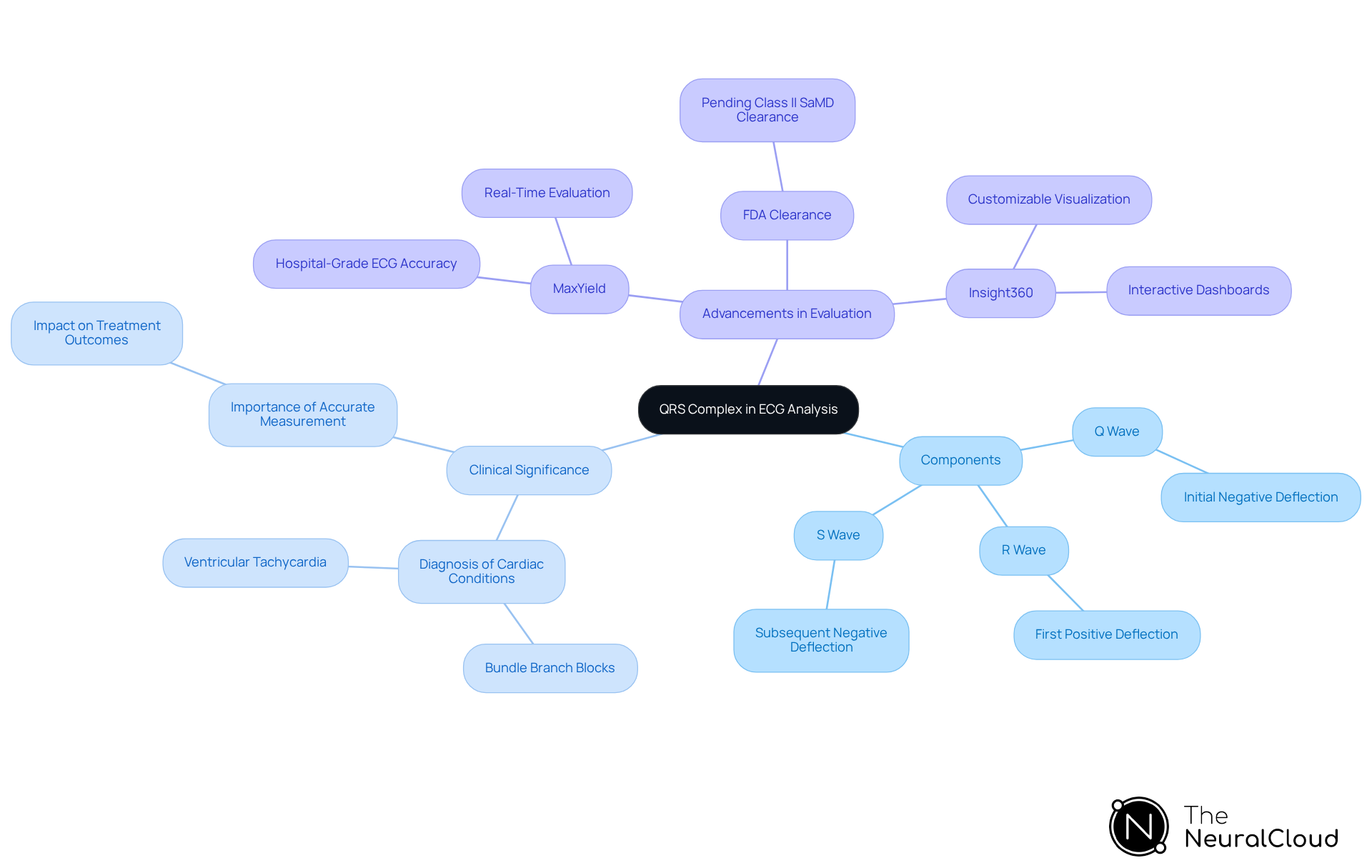
The QRS waveform is a critical component of ECG analysis, representing the heart's electrical activity during ventricular contraction. A normal QRS duration typically ranges from 70 to 100 milliseconds, and durations exceeding 120 milliseconds are classified as a widened QRS complex. This distinction is vital for diagnosing various cardiac conditions, such as bundle branch blocks and ventricular tachycardia.
Understanding the morphology of the QRS structure is essential. It consists of three main components:
- The Q wave, which is the initial negative deflection
- The R wave, the first positive deflection
- The S wave, the subsequent negative deflection
Each of these waves provides critical insights into the heart's electrical activity. Changes in their morphology can suggest underlying pathologies, making precise evaluation essential.
Traditional QRS evaluation methods often lack the precision and efficiency needed for effective patient monitoring. Recent advancements in automated algorithms, like those provided by MaxYield, have transformed QRS waveform evaluation. MaxYield provides hospital-grade ECG accuracy using consumer-grade devices, allowing for continuous monitoring at a lower cost. This platform attains a sensitivity of 98.5% and a positive predictivity of 98.9% in detecting and measuring QRS patterns in multichannel electrocardiograms (MECGs). These advancements enable real-time evaluation, essential for overseeing patients with intricate conduction disorders, as demonstrated by validation studies that reported a clinical classification accuracy of 95% for QRS duration (QRSd).
Experts agree that accurately measuring QRS duration is crucial in clinical practice. Dr. Alan Rabinowitz, Dr. Brett Heilbron, and Dr. Marc W. Deyell have endorsed MaxYield’s precision, noting its ability to rival human interpretation while significantly reducing noise. In validation studies, the clinical classification accuracy of QRS duration (QRSd) was found to be 95%, aligning closely with expert evaluations. This level of accuracy is essential for effective patient management, particularly in cardiac resynchronization therapy (CRT) patients, where understanding how to widen QRS complex can significantly impact treatment outcomes.
Furthermore, MaxYield is currently pending FDA Class II SaMD clearance, ensuring compliance with regulatory standards. The integration of Insight360, a customizable visualization and reporting tool, transforms MaxYield’s clean ECG data into interactive dashboards and clinical-ready reports, improving the overall evaluation experience.
In summary, the QRS pattern is not only a fundamental aspect of ECG evaluation but also a crucial element in diagnosing and managing various cardiac conditions. As advancements in QRS evaluation continue, platforms like MaxYield are set to redefine cardiac care and improve patient outcomes.
Apply Techniques to Widen the QRS Complex
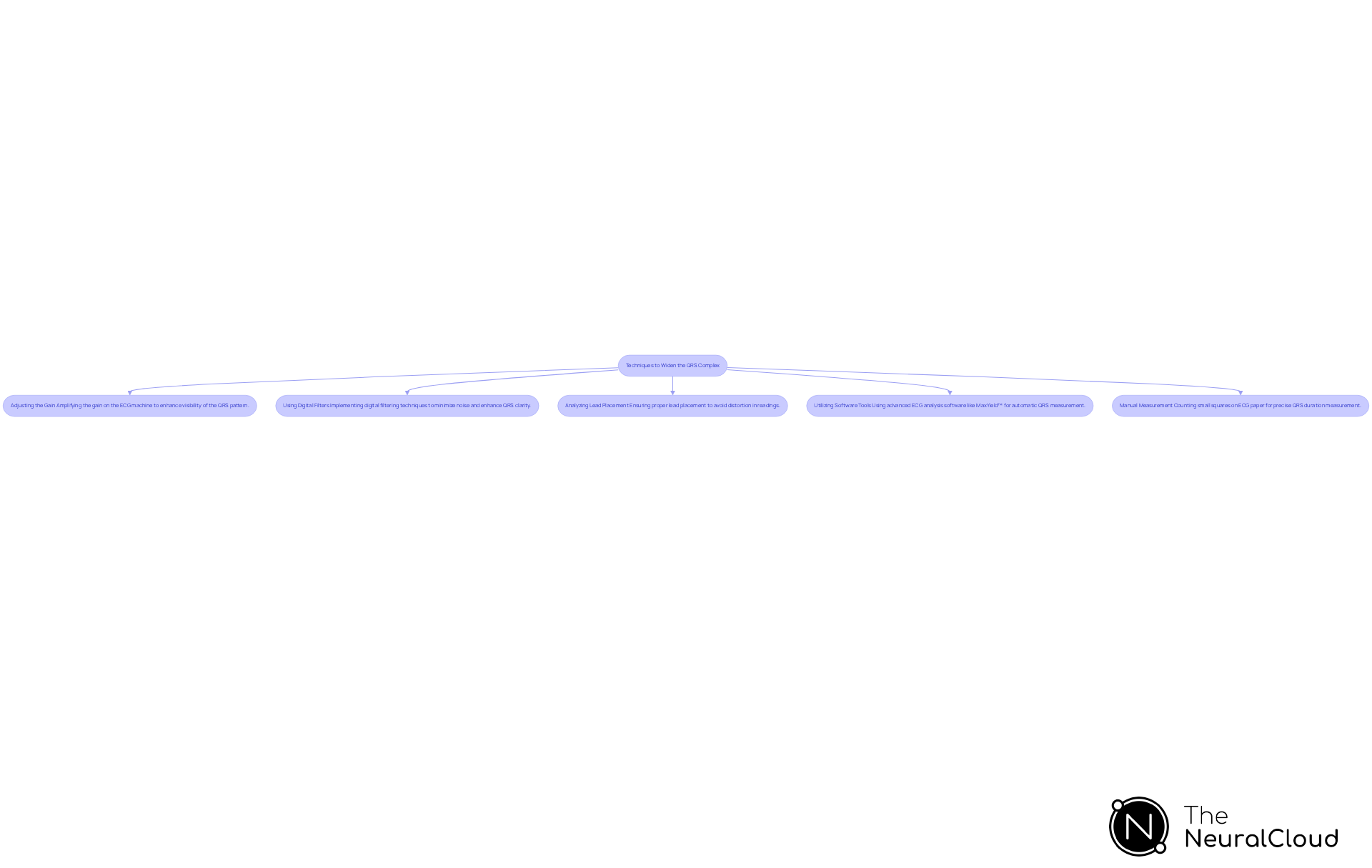
Accurately measuring the QRS complex in ECG analysis can be a complex task, but several techniques can simplify this process. To effectively widen the QRS complex in ECG analysis, consider these techniques:
- Adjusting the Gain: Amplifying the gain on your ECG machine can enhance the visibility of the QRS pattern, facilitating the identification of subtle morphological changes.
- Using Digital Filters: Implement digital filtering techniques to minimize noise and enhance the clarity of the QRS waveform. These filters can isolate the QRS from other ECG components, aiding in accurate width assessment.
- Analyzing Lead Placement: Proper lead placement is crucial; misplacement can distort readings. If the QRS pattern appears unusually narrow or wide, reassess the lead positioning to ensure accurate data capture.
- Utilizing Software Tools: Advanced ECG analysis software, such as MaxYield™, can automatically detect and measure QRS duration. This software provides insights into QRS morphology and helps identify abnormalities effectively. MaxYield™ is designed to comply with regulatory standards, including FDA Class II SaMD clearance-pending status, ensuring its reliability in clinical settings.
- Manual Measurement: For a hands-on approach, manually measure the QRS duration using the small squares on the ECG paper. Count the small squares from the start of the Q wave to the end of the S wave, with each square representing 0.04 seconds for precise measurement.
By integrating these techniques, especially with MaxYield™, healthcare professionals can streamline their ECG analysis, leading to quicker and more accurate assessments.
Validate Changes in QRS Complex Analysis
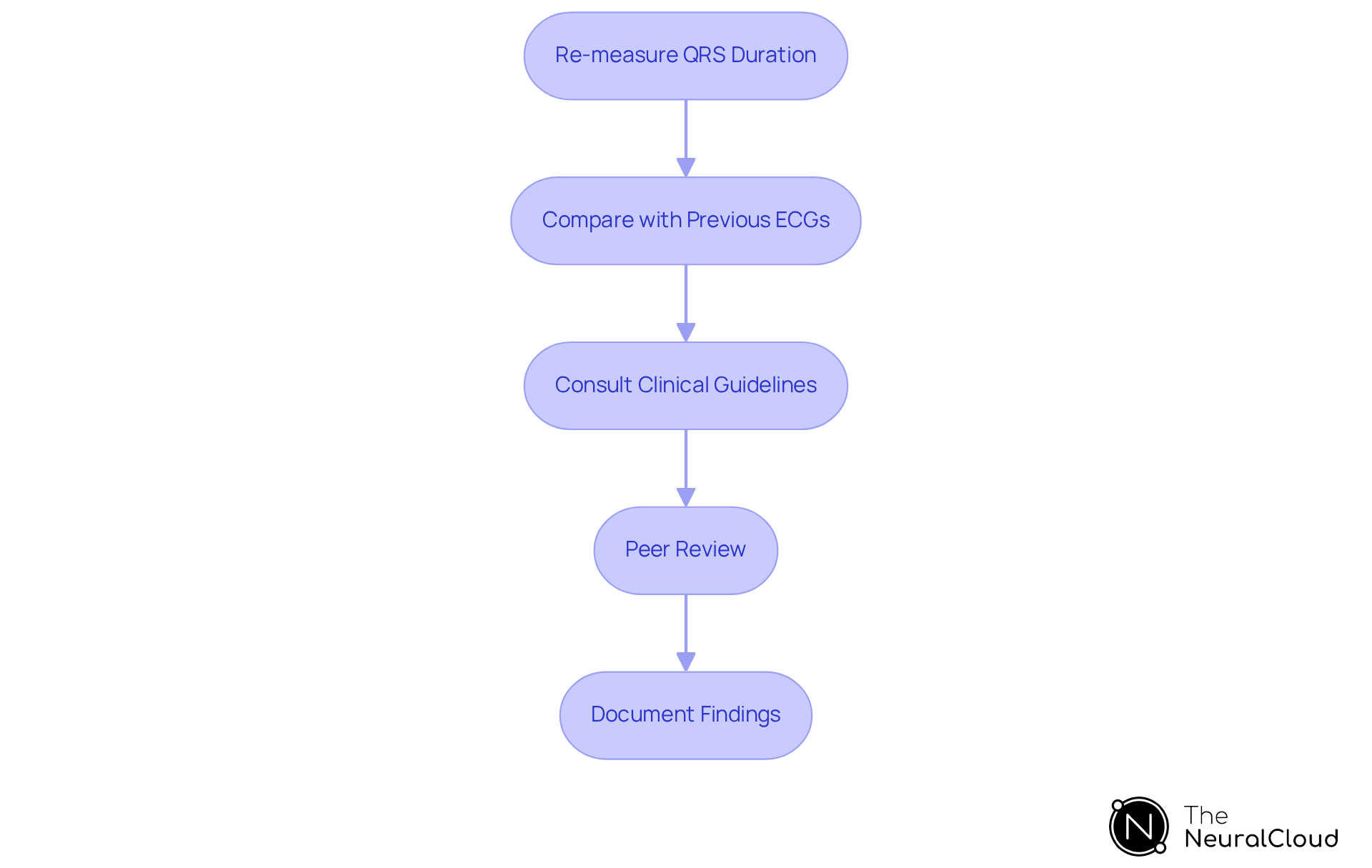
Accurate evaluation of the QRS complex is essential for effective cardiac diagnostics, yet it often presents challenges that must be addressed. Here are key validation steps to follow:
- Re-measure the QRS Duration: After applying methods to expand the QRS interval, re-measure the duration to verify it has increased suitably. The new measurement should be at least 120 milliseconds, indicating a broadened QRS interval.
- Compare with Previous ECGs: If previous ECG recordings are available, compare them with the current ECG. Look for consistent patterns in the QRS structure and evaluate whether the observed changes are significant.
- Consult Clinical Guidelines: Refer to established clinical guidelines for interpreting QRS patterns. Ensure that the changes align with recognized criteria for diagnosing conditions associated with the widen QRS complex patterns, such as ventricular tachycardia (VT).
- Peer Review: Consider reaching out to a colleague for a second opinion to enhance the reliability of your evaluation. A peer review can offer further insights and assist in validating your findings, ensuring that they are robust.
- Document Findings: Meticulously record all measurements and observations. Proper documentation is essential for ongoing patient management and serves as a valuable reference for future evaluations.
Integrating these steps not only improves the dependability of your evaluation but also conforms to best practices in cardiac diagnostics. By following these validation steps, healthcare professionals can ensure that their assessments of QRS duration are both accurate and clinically relevant.
Explore Tools and Resources for ECG Analysis
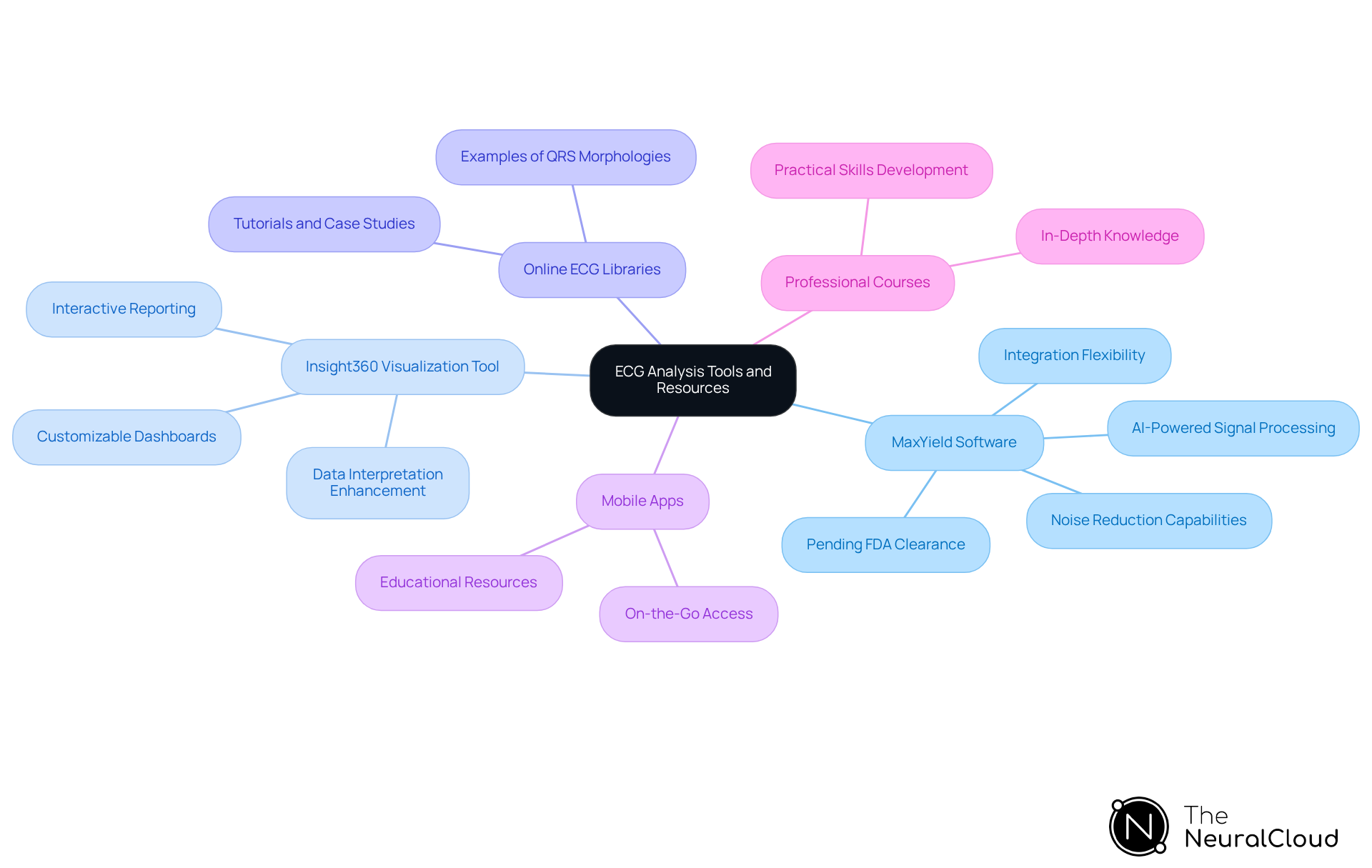
In the realm of ECG analysis, noisy signals often complicate accurate interpretation, posing challenges for healthcare professionals. To enhance your ECG analysis skills, consider utilizing the following tools and resources:
- MaxYield Software: This sophisticated AI-powered platform greatly enhances ECG data processing by isolating and refining noisy signals, which is essential for precise evaluation of the widen QRS complex. Its patented signal mapping algorithms ensure high-fidelity cardiac data, making it an essential tool for clinicians. MaxYield works with any device, easily integrating through API, SDK, or CDK, so you won’t need to change your hardware. Additionally, it is currently pending FDA Class II SaMD clearance, ensuring compliance with regulatory standards.
- Insight360 Visualization Tool: Leverage this customizable visualization and reporting tool to create interactive dashboards and clinical-ready reports based on your ECG data. Insight360 makes it easier to interpret data by turning MaxYield’s clean ECG results into visual trends that help with decision-making.
- Online ECG Libraries: Resources such as LITFL and ECG Waves offer extensive materials on ECG interpretation, including tutorials, case studies, and examples of various QRS morphologies, which can help you learn how to widen QRS complex in complex rhythms.
- Mobile Apps: Utilize mobile applications designed for ECG interpretation, providing on-the-go access to evaluation tools and educational resources, which can be particularly beneficial for busy healthcare professionals.
- Professional Courses: Enroll in online courses or workshops centered on ECG interpretation and evaluation. These programs offer in-depth knowledge and practical skills necessary for effective ECG analysis, ensuring you stay updated with the latest techniques and best practices.
Expert endorsements from Dr. Alan Rabinowitz, Dr. Brett Heilbron, and Dr. Marc W. Deyell emphasize that MaxYield rivals human interpretation in precision and significantly enhances noise reduction, making it an invaluable tool for clinicians and researchers alike. With the right tools, healthcare professionals can enhance their ECG analysis skills, leading to better patient care and outcomes.
Conclusion
Accurate interpretation of the QRS complex in ECG analysis is essential for effective cardiac diagnostics. The techniques outlined in this guide, from adjusting gain settings to utilizing advanced software like MaxYield, empower healthcare professionals to enhance their ECG evaluations. Mastering these methods enables clinicians to identify and manage heart conditions more effectively, improving patient outcomes.
Key insights discussed include:
- The importance of QRS morphology
- The role of digital filters in noise reduction
- The necessity of validating changes through meticulous measurement and peer review
Each of these elements contributes to a comprehensive approach to ECG analysis, ensuring that healthcare providers can confidently interpret QRS patterns and make informed clinical decisions.
With technology advancing rapidly in cardiac care, tools like MaxYield and Insight360 are becoming indispensable for clinicians and researchers. By leveraging these resources, healthcare professionals can refine their ECG analysis skills, stay abreast of best practices, and ultimately enhance the quality of care provided to patients. Mastering QRS complex evaluation is about more than technical skills; it’s about enhancing lives through accurate cardiac diagnostics.
Frequently Asked Questions
What does the QRS complex represent in ECG analysis?
The QRS complex represents the heart's electrical activity during ventricular contraction.
What is the normal duration of a QRS complex?
A normal QRS duration typically ranges from 70 to 100 milliseconds.
What does a widened QRS complex indicate?
A widened QRS complex, defined as a duration exceeding 120 milliseconds, is important for diagnosing various cardiac conditions, such as bundle branch blocks and ventricular tachycardia.
What are the components of the QRS waveform?
The QRS waveform consists of three main components: the Q wave (initial negative deflection), the R wave (first positive deflection), and the S wave (subsequent negative deflection).
Why is understanding the morphology of the QRS structure important?
Understanding the morphology of the QRS structure is essential because changes in their shape can indicate underlying pathologies, making precise evaluation crucial.
How have advancements in technology improved QRS evaluation?
Advancements in automated algorithms, such as those provided by MaxYield, have improved QRS evaluation by offering hospital-grade ECG accuracy using consumer-grade devices, enabling continuous monitoring at a lower cost.
What are the sensitivity and positive predictivity rates of MaxYield in detecting QRS patterns?
MaxYield achieves a sensitivity of 98.5% and a positive predictivity of 98.9% in detecting and measuring QRS patterns in multichannel electrocardiograms (MECGs).
What is the clinical classification accuracy of QRS duration using MaxYield?
The clinical classification accuracy of QRS duration (QRSd) using MaxYield is reported to be 95%, aligning closely with expert evaluations.
Who has endorsed the precision of MaxYield's QRS evaluation?
Experts such as Dr. Alan Rabinowitz, Dr. Brett Heilbron, and Dr. Marc W. Deyell have endorsed MaxYield’s precision, noting its ability to rival human interpretation while significantly reducing noise.
What is the significance of accurately measuring QRS duration in clinical practice?
Accurately measuring QRS duration is crucial for effective patient management, particularly in cardiac resynchronization therapy (CRT) patients, as it can significantly impact treatment outcomes.
What regulatory status is MaxYield currently pending?
MaxYield is currently pending FDA Class II SaMD clearance, ensuring compliance with regulatory standards.
How does Insight360 enhance the evaluation experience of ECG data?
Insight360 is a customizable visualization and reporting tool that transforms MaxYield’s clean ECG data into interactive dashboards and clinical-ready reports, improving the overall evaluation experience.
List of Sources
- Understand the QRS Complex in ECG Analysis
- Frontiers | A simple and effective deep neural network based QRS complex detection method on ECG signal (https://frontiersin.org/journals/physiology/articles/10.3389/fphys.2024.1384356/full)
- Checking your browser - reCAPTCHA (https://pmc.ncbi.nlm.nih.gov/articles/PMC6231906)
- Apply Techniques to Widen the QRS Complex
- medicalgorithmics.com (https://medicalgorithmics.com/medicalgorithmics-receives-approval-for-commercialization-in-canada-for-the-latest-generation-of-deeprhythmai-artificial-intelligence-algorithms)
- techpacs.ca (https://techpacs.ca/ecg-signal-noise-reduction-using-adaptive-filtration-for-efficient-signal-enhancement-1463)
- Differential Diagnosis of Wide QRS Complex Tachycardias (https://cancertherapyadvisor.com/home/decision-support-in-medicine/cardiology/differential-diagnosis-of-wide-qrs-complex-tachycardias)
- Comparative evaluation of filtration techniques for ECG signal denoising with emphasis on stationary wavelet transform - PMC (https://pmc.ncbi.nlm.nih.gov/articles/PMC12660802)
- theneuralcloud.com (https://theneuralcloud.com/post/understanding-the-widening-qrs-complex-causes-diagnosis-and-management)
- Validate Changes in QRS Complex Analysis
- Differential Diagnosis of Wide QRS Complex Tachycardias (https://cancertherapyadvisor.com/home/decision-support-in-medicine/cardiology/differential-diagnosis-of-wide-qrs-complex-tachycardias)
- Wide Complex Tachycardias (https://aclscertification.org/wide-qrs-complex-tachycardia)
- Explore Tools and Resources for ECG Analysis
- MaxYield-ECG (https://theneuralcloud.com/maxyield-ecg)
- theneuralcloud.com (https://theneuralcloud.com/post/maxyields-best-practices-for-qrs-heart-rhythm-analysis-in-healthcare)
- Harnessing AI to Decode the Heart | UHN Research (https://uhnresearch.ca/news/12-10-2025/harnessing-ai-to-decode-the-heart)
- AIML Subsidiary Neural Cloud Signs LOI with Circular Health to License MaxYield(TM) ECG Signal Processing (https://finance.yahoo.com/news/aiml-subsidiary-neural-cloud-signs-110000257.html)