Introduction
Interpreting the ECG ST segment is fraught with challenges that can hinder accurate cardiac health assessments. This flat section of the ECG waveform is essential for diagnosing life-threatening conditions such as ST-elevation myocardial infarction (STEMI), making accurate analysis vital for timely medical intervention. The increasing complexity of ECG data and the prevalence of noise complicate accurate ST segment evaluation. By employing advanced techniques and technologies, developers can significantly improve diagnostic accuracy and patient outcomes. This article delves into the tools necessary to enhance ST segment analysis, ultimately equipping developers to save lives.
Define the ST Segment and Its Clinical Importance
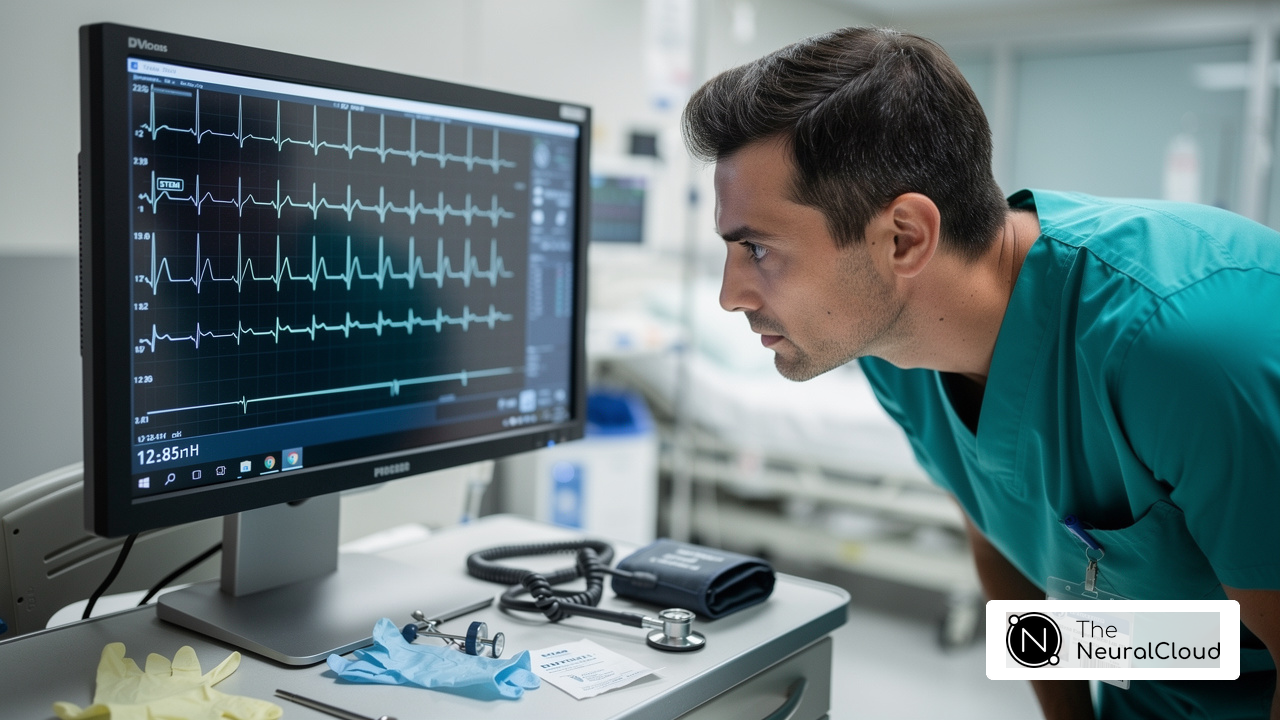
The ECG ST segment is crucial for assessing cardiac health, yet it presents significant challenges in accurate interpretation. This flat section, located between the end of the S wave and the beginning of the T wave, represents the period when the ventricles are fully depolarized. Clinically, the ECG ST segment is vital for diagnosing conditions such as ST-elevation myocardial infarction (STEMI) and other ischemic events. Irregularities in the ECG ST segment can indicate serious cardiac issues, highlighting the need for precise interpretation to enable prompt medical intervention.
Understanding both normal and abnormal ST characteristics is essential for creators of ECG evaluation software, as it directly impacts diagnostic precision. For instance, an elevation of at least 1 mm in the ECG ST segment across two contiguous leads is a hallmark of STEMI, indicating a complete blockage in a coronary artery. Statistics show that timely recognition and intervention can significantly enhance outcomes for individuals, with primary percutaneous coronary intervention (PCI) recommended within the first 120 minutes after ischemic onset.
Case studies highlight the importance of precise ST interval evaluation. The integration of AI technologies in clinical practice has improved the detection of STEMI by identifying complex ECG patterns that may be overlooked by human interpretation. This advancement helps quickly triage patients and ensures that the right interventions start without delay. Therefore, analyzing the ST portion is not just a technical necessity; it forms the foundation of effective cardiac diagnostics, crucial for improving survival rates and care for individuals.
According to the American College of Cardiology, understanding the TIMI risk score is crucial for accurate diagnosis and timely intervention in STEMI cases, as it evaluates factors like the ECG ST segment elevation. This comprehensive approach allows healthcare professionals to make informed decisions that ultimately enhance patient outcomes. With MaxYield™, developers can leverage advanced noise filtering and wave recognition to overcome traditional limitations in ECG analysis, ensuring that critical cardiac events are detected swiftly and accurately. Additionally, the Insight360 tool transforms MaxYield’s clean ECG data into interactive dashboards and clinical-ready reports, further enhancing the visualization and reporting capabilities essential for effective clinical decision-making.

Identify ST Segment Abnormalities and Their Clinical Implications
Understanding ECG ST segment abnormalities is crucial for accurate diagnosis and treatment in cardiology. These abnormalities, whether elevated or depressed, have important clinical implications. The ECG ST segment elevation is often associated with acute myocardial infarction (MI), while the ECG ST segment depression may indicate myocardial ischemia or other heart conditions. For instance, a significant rise in the ECG ST segment in leads II, III, and aVF can suggest inferior wall ischemia, which is vital for timely diagnosis and intervention. Conversely, ST interval depression confined to specific leads may indicate reciprocal changes linked to acute coronary syndromes.
It's essential for developers to understand the diagnostic criteria for these abnormalities, including the degree of deviation from the baseline and the specific leads involved. The Modified Sgarbossa Criteria, for example, are critical for accurately diagnosing acute coronary occlusion in patients with ventricular paced rhythm (VPR), where classic ST changes may be obscured. Additionally, understanding the nuances of the ECG ST segment changes can enhance algorithm development for identifying and interpreting these variations, ultimately improving outcomes for patients.
Statistics show that 18% of STEMI patients present without standard modifiable cardiovascular risk factors (SMuRFs), underscoring the need for effective diagnostic tools that can identify such cases. Moreover, the increasing percentage of SMuRF-less STEMI patients, which rose from 14% to 23% during a study period, reflects the evolving landscape of cardiovascular disease and the need to adjust diagnostic criteria accordingly. Case studies involving conditions like pericarditis and left ventricular aneurysm (LVA) highlight the importance of differentiating these from STEMI to prevent unnecessary interventions and ensure accurate treatment pathways.
By utilizing Neural Cloud Solutions' MaxYield platform, developers can enhance their algorithms for detecting and interpreting ST changes. MaxYield's advanced noise filtering and distinct wave recognition capabilities allow for the rapid isolation of ECG waves, even in recordings with high levels of noise and artifact. This enhances the precision of ST interval evaluation and addresses issues related to physiological variability and signal artifacts, leading to better patient outcomes.

Apply Systematic Techniques for ST Segment Analysis
Accurate analysis of the ECG ST segment in signals presents significant challenges due to noise and baseline shifts. To effectively analyze the ECG ST segment, developers should implement systematic techniques such as:
- Baseline correction
- Normalization
- Artifact removal
Baseline correction modifies the ECG signal to eliminate shifts that may obscure the ECG ST segment, ensuring that evaluations accurately reflect genuine cardiac activity. Normalization further enhances this process by standardizing amplitude variations, allowing for consistent interpretation across diverse patient populations and devices.
Removing artifacts is crucial for ensuring accurate evaluations of the ECG ST segment. For instance, using machine learning algorithms to identify and eliminate noise greatly improves the clarity of the ECG ST segment, resulting in more dependable diagnostic insights. MaxYield™ stands out by turning noisy recordings into clear, actionable insights, providing beat-by-beat examination of 200,000 heartbeats in under 5 minutes. Additionally, MaxYield™ is device-agnostic, integrating seamlessly via API, SDK, or CDK without requiring hardware changes.
Case studies have shown that effective baseline correction and normalization methods, when paired with MaxYield™'s features, can enhance the precision of evaluating the ECG ST segment, ultimately assisting in improved patient management and results.
Combining these techniques with MaxYield™ and Insight360 allows developers to build robust ECG evaluation tools. This approach provides reliable insights into cardiac health and advances cardiovascular diagnostics.

Leverage Advanced Technologies for Enhanced ST Segment Interpretation
Current ECG analysis methods often miss critical patterns and anomalies, making accurate diagnosis challenging. Advanced technologies, especially artificial intelligence (AI) and machine learning, are fundamentally changing the interpretation of the ECG ST segment in ECG analysis. Developers can use AI algorithms to analyze large datasets of ECG recordings. This helps uncover patterns and anomalies that traditional methods often miss. For example, deep learning models have demonstrated the ability to detect subtle changes in the ECG ST segment that correlate with various cardiac conditions, significantly enhancing diagnostic accuracy. A retrospective study highlighted that AI-based ECG interpretation achieved a sensitivity of 77% and a specificity of 99%, showcasing its potential to outperform conventional diagnostic pathways.
Moreover, the integration of real-time data processing capabilities allows for immediate feedback and alerts to healthcare providers, facilitating timely interventions. In one study, an AI model identified 94% of acute myocardial infarction cases with culprit lesions, compared to only 42% identified by human interpretation. This leads to faster diagnoses and better patient outcomes, as critical conditions are recognized and addressed promptly.
By utilizing advanced technologies such as MaxYield™, which maps ECG signals through noise and provides beat-by-beat evaluation, developers can significantly improve the functionality of their ECG assessment tools. MaxYield™ offers several key features:
- Transforms noisy recordings into detailed insights
- Provides clean signals for improved diagnostic yield
- Enhances workflow efficiency
Additionally, the customizable visualization and reporting tool, Insight360, transforms MaxYield’s clean ECG data into interactive dashboards and clinical-ready reports, further enhancing the analysis process. The ongoing evolution of AI in this field promises to further refine the accuracy and reliability of ECG interpretations, ultimately benefiting both healthcare professionals and patients alike. With MaxYield™ pending FDA clearance, healthcare professionals can trust its capabilities to enhance patient care and diagnostic accuracy.

Conclusion
Despite advancements in technology, ECG analysis remains fraught with challenges that can hinder accurate diagnosis. The ECG ST segment is a critical indicator of cardiac health, and its accurate interpretation is essential for timely medical intervention, particularly in cases like ST-elevation myocardial infarction (STEMI). By understanding the nuances of the ST segment, developers can create more effective ECG evaluation tools that enhance diagnostic precision and ultimately improve patient outcomes.
Throughout the article, we explored key techniques and technologies for analyzing the ST segment. Systematic methods such as baseline correction and artifact removal, along with the integration of advanced AI technologies, contribute to a clearer understanding of cardiac health. Recognizing ST segment abnormalities is crucial; it can lead to timely interventions that improve patient management.
As the landscape of cardiovascular diagnostics continues to evolve, leveraging tools like MaxYield™ and Insight360 will be crucial for developers aiming to enhance ECG analysis. The integration of advanced technologies not only improves diagnostic accuracy but also facilitates quicker interventions, ultimately benefiting healthcare professionals and patients alike. By fully harnessing the potential of ECG ST segment analysis, healthcare professionals can significantly elevate the standard of cardiac care.
Frequently Asked Questions
What is the ST segment in an ECG?
The ST segment is a flat section of the ECG located between the end of the S wave and the beginning of the T wave, representing the period when the ventricles are fully depolarized.
Why is the ST segment clinically important?
The ST segment is crucial for diagnosing conditions such as ST-elevation myocardial infarction (STEMI) and other ischemic events. Irregularities in this segment can indicate serious cardiac issues, necessitating precise interpretation for timely medical intervention.
What indicates a STEMI in the ST segment?
An elevation of at least 1 mm in the ST segment across two contiguous leads is a hallmark of STEMI, indicating a complete blockage in a coronary artery.
How does timely recognition of ST segment changes impact patient outcomes?
Timely recognition and intervention can significantly enhance outcomes for individuals experiencing ischemic events, with primary percutaneous coronary intervention (PCI) recommended within the first 120 minutes after ischemic onset.
How has AI technology improved the interpretation of the ST segment?
AI technologies have improved the detection of STEMI by identifying complex ECG patterns that may be overlooked by human interpretation, allowing for quicker triage and timely interventions.
What role does the TIMI risk score play in diagnosing STEMI?
The TIMI risk score evaluates factors like the ECG ST segment elevation, which is crucial for accurate diagnosis and timely intervention in STEMI cases, helping healthcare professionals make informed decisions.
How do MaxYield and Insight360 enhance ECG analysis?
MaxYield offers advanced noise filtering and wave recognition to improve ECG analysis, while Insight360 transforms clean ECG data into interactive dashboards and clinical-ready reports, enhancing visualization and reporting for effective clinical decision-making.
List of Sources
- Define the ST Segment and Its Clinical Importance
- STEMI: ST-segment Elevation Myocardial Infarction - The Cardiology Advisor (https://thecardiologyadvisor.com/ddi/stemi-st-elevation-myocardial-infarction)
- STEMI ECG Criteria: ST-Elevation Thresholds (https://powerfulmedical.com/blog/stemi-ecg-criteria)
- Acute ST-Segment Elevation Myocardial Infarction (STEMI) - StatPearls - NCBI Bookshelf (https://ncbi.nlm.nih.gov/books/NBK532281)
- What Is a STEMI? (https://my.clevelandclinic.org/health/diseases/22068-stemi-heart-attack)
- Identify ST Segment Abnormalities and Their Clinical Implications
- STEMI Mimics: ECG Impostors of Heart Attack (https://powerfulmedical.com/blog/stemi-mimics)
- ST‐Segment–Elevation Myocardial Infarction (STEMI) Patients Without Standard Modifiable Cardiovascular Risk Factors—How Common Are They, and What Are Their Outcomes? - PMC (https://pmc.ncbi.nlm.nih.gov/articles/PMC6898813)
- STEMI: ST-segment Elevation Myocardial Infarction - The Cardiology Advisor (https://thecardiologyadvisor.com/ddi/stemi-st-elevation-myocardial-infarction)
- Q4 Urgent Caring- Where Mistakes Are Made, ST Segment Depression – Urgent Care Association (https://urgentcareassociation.org/q4-urgent-caring-where-mistakes-are-made-st-segment-depression)
- ST-segment Elevation Myocardial Infarction: Challenges in Diagnosis (https://uscjournal.com/articles/st-segment-elevation-myocardial-infarction-challenges-diagnosis?language_content_entity=en)
- Apply Systematic Techniques for ST Segment Analysis
- (PDF) Systematic Review and Meta-Analysis of Diagnostic Accuracy to Identify ST-Segment Elevation Myocardial Infarction on Interpretations of Prehospital Electrocardiograms (https://researchgate.net/publication/360847799_Systematic_Review_and_Meta-Analysis_of_Diagnostic_Accuracy_to_Identify_ST-Segment_Elevation_Myocardial_Infarction_on_Interpretations_of_Prehospital_Electrocardiograms)
- Systematic review and meta-analysis of diagnostic test accuracy of ST-segment elevation for acute coronary occlusion (https://sciencedirect.com/science/article/abs/pii/S0167527324003358)
- ST-Segment Monitoring: Benefits, Barriers, and Pathways to Acceptance (https://clinicalview.gehealthcare.com/white-paper/st-segment-monitoring-benefits-barriers-and-pathways-acceptance)
- ECG data analysis to determine ST-segment elevation myocardial infarction and infarction territory type: an integrative approach of artificial intelligence and clinical guidelines - PMC (https://pmc.ncbi.nlm.nih.gov/articles/PMC11491539)
- ECG Signal De-noising and Baseline Wander Correction Based on CEEMDAN and Wavelet Threshold - PMC (https://pmc.ncbi.nlm.nih.gov/articles/PMC5751563)
- Leverage Advanced Technologies for Enhanced ST Segment Interpretation
- AI outperforms conventional diagnosis for certain types of heart attacks (https://escardio.org/news/press/press-releases/acvc-press)
- Performance of Artificial Intelligence Powered ECG Analysis in Suspected ST-Segment Elevation Myocardial Infarction (https://powerfulmedical.com/research/performance-of-artificial-intelligence-powered-ecg-analysis-in-suspected-st-segment-elevation-myocardial-infarction)
- AI-based ECG interpretation outperforms standard diagnosis of occlusive myocardial infarction (https://news-medical.net/news/20260323/AI-based-ECG-interpretation-outperforms-standard-diagnosis-of-occlusive-myocardial-infarction.aspx)
- AI Shows Promise in Detecting Type 1 MI and Need for Revascularization (https://tctmd.com/news/ai-shows-promise-detecting-type-1-mi-and-need-revascularization)