Introduction
The QRS complex serves as a crucial indicator of cardiac health, encapsulating the heart's electrical activity in a concise waveform. This waveform can reveal a wealth of information about a patient's condition. Mastering the intricacies of QRS analysis enhances diagnostic accuracy and empowers healthcare professionals to identify potentially life-threatening conditions more efficiently. As technology and artificial intelligence reshape ECG interpretation, clinicians must consider how to effectively leverage these tools to improve patient outcomes.
Define the QRS Complex: Importance and Characteristics
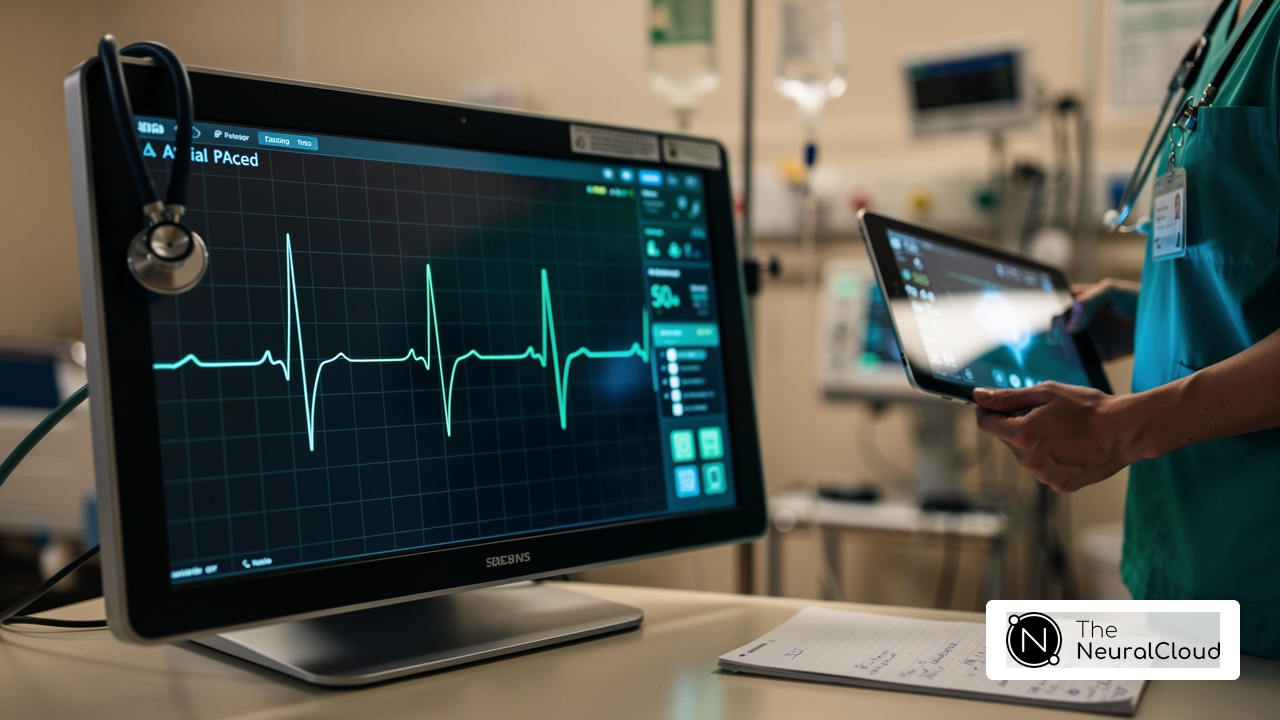
The QRS complex is a crucial part of the electrocardiogram (ECG), indicating the depolarization of the ventricles and triggering ventricular contraction. It consists of three distinct waves:
- The Q wave, which is the initial negative deflection
- The R wave, the first positive deflection
- The S wave, which follows as a subsequent negative deflection
The importance of the waveform is crucial for assessing the heart's electrical activity and for identifying various conditions, such as arrhythmias, bundle branch blocks, and ischemia. Its duration and morphology provide valuable insights into the heart's conduction system, particularly the ventricles, and overall cardiac health. With the integration of Neural Cloud Solutions' product, the examination of the QRS complex is significantly enhanced through advanced algorithms and advanced noise filtering. This allows for clearer insights, even in recordings with substantial artifacts. The system can analyze data in under 5 minutes, ensuring rapid and efficient interpretation.
Characteristics: A normal QRS interval typically ranges from 80 to 100 milliseconds. Deviations from this range can indicate potential issues, highlighting the importance of thorough evaluations in clinical practice. Recent studies have shown that an increased duration may signal conditions such as hyperkalemia or intraventricular block, highlighting its diagnostic significance. MaxYield™ aids in quickly isolating and identifying these critical features, ensuring that healthcare professionals can optimize patient outcomes through accurate ECG interpretation, even in challenging recording conditions.

Measure the QRS Interval: Techniques and Tools
To measure the QRS interval accurately, follow these steps:
- Identify the QRS complex by locating it on the ECG strip. The measurement begins at the onset of the Q wave (or R wave if no Q wave is present) and ends at the return of the S wave to the isoelectric line. With Neural Cloud Solutions' advanced system, you can enhance this process by utilizing its algorithms, which help isolate the QRS complex even in recordings with significant noise and artifacts.
- Use Calipers or Digital Tools: Utilize calipers for manual measurement or digital ECG machines that automatically calculate the QRS duration. This solution can assist in improving accuracy, ensuring precision and reducing the potential for human error.
- Count the Small Boxes: Each small box on the ECG paper represents 0.04 seconds. Count the number of small boxes from the start of the Q wave to the end of the S wave to determine the duration in milliseconds. The adaptability of this product allows it to evolve with each use, enhancing its accuracy over time.
The QRS duration is an important indicator of cardiac health. Interpret the Results: A normal QRS heart duration is between 70-100 ms. If the duration exceeds 120 ms, it may indicate a conduction delay or other cardiac abnormalities. By leveraging technology, healthcare professionals can address challenges in ECG analysis, such as physiological variability and signal artifacts, leading to more reliable interpretations.

Identify Abnormalities: Clinical Implications of QRS Variations
Abnormalities in the QRS complex can indicate various cardiac conditions, each with distinct clinical implications. Here are some notable variations:
- Prolonged QRS duration: A QRS duration exceeding 120 ms often indicates conditions such as bundle branch block or ventricular hypertrophy. This prolongation is associated with a risk of arrhythmias and heart failure, necessitating careful monitoring and potential intervention.
- Narrow QRS complex: A QRS duration of less than 70 ms typically suggests a supraventricular origin of the rhythm, which is generally less concerning. However, it is essential to evaluate the context, as it may still require further investigation depending on the patient's overall clinical picture.
- Abnormal QRS morphology: Alterations in the shape of the QRS heart formation, such as the emergence of an epsilon wave, can indicate prior myocardial infarction or other structural heart diseases. These morphological changes are critical for diagnosing underlying cardiac issues related to the QRS heart and for guiding treatment decisions.
- Continuous monitoring: Continuous monitoring is vital for understanding the progression of cardiac diseases and assessing treatment efficacy. Recent studies have shown that QRS duration is a significant predictor of adverse outcomes, highlighting the importance of routine ECG assessments in clinical practice. By integrating advanced technologies like Neural Cloud Solutions' technology, healthcare professionals can enhance the accuracy and efficiency of QRS analysis, ultimately improving patient outcomes.

Utilize Technology: Enhancing QRS Analysis with AI Solutions
AI solutions are fundamentally transforming the analysis of the QRS complex in several impactful ways. The challenges in ECG analysis often stem from the time-consuming nature of manual detection and the potential for human error. However, advanced algorithms, such as those utilized in Neural Cloud Solutions' product, can autonomously identify and delineate the QRS complex from ECG signals, drastically reducing analysis time. This system has demonstrated the ability to analyze large datasets, showcasing its effectiveness in practical applications and significantly improving diagnostic accuracy.
One of the standout features of AI in this context is its ability to enhance diagnostic capabilities. Machine learning models trained on extensive datasets improve the precision of QRS heart detection, minimizing both false positives and negatives. This improvement is crucial, especially in emergency settings where timely intervention is essential. As Bryn Mumma, a leading expert in emergency medicine, noted, "Accurate diagnosis and rapid treatment to restore blood flow are critical, and any tool that speeds up this process can help us save more lives."
Moreover, AI systems provide real-time analysis and alerts for clinicians. This capability facilitates quicker decision-making in critical situations, which is vital for conditions like STEMI, where immediate action can be life-saving. The DIFOCCULT-3 Randomized Controlled Trial further supports the effectiveness of AI in reducing treatment times for acute coronary syndromes.
Another significant advantage of AI systems, including MaxYield™, is their ability to continuously learn and evolve. These systems refine their algorithms based on new data, ensuring they remain effective as new cardiac conditions and treatments emerge. However, it is essential to remember that, as Bryn Mumma cautioned, AI should support, not replace, clinical judgment.
By harnessing these advanced technologies, healthcare professionals can significantly improve patient outcomes, ultimately leading to better clinical outcomes. The integration of AI in ECG analysis not only streamlines processes but also enhances the overall quality of care provided to patients.

Conclusion
Understanding the QRS complex is crucial for assessing cardiac health and diagnosing heart conditions. This article has highlighted the importance of the QRS waveform, the methods for measuring its duration, the clinical implications of its variations, and the role of AI tools in enhancing analysis accuracy and efficiency.
Key aspects discussed include:
- The characteristics of a normal QRS complex
- Precise measurement techniques
- The identification of abnormalities that may signal serious cardiac issues
Advanced AI solutions, such as those from Neural Cloud Solutions, significantly enhance the speed and accuracy of QRS analysis, aiding healthcare professionals in making timely and informed decisions.
As cardiac diagnostics evolve, embracing technology becomes vital for improving patient outcomes. By leveraging AI tools that refine ECG analysis, healthcare providers can achieve more accurate diagnoses and timely interventions, ultimately leading to better management of cardiac conditions. The future of QRS heart analysis lies in the collaboration between clinical expertise and innovative technology, paving the way for enhanced cardiac care.
Frequently Asked Questions
What is the QRS complex in an electrocardiogram (ECG)?
The QRS complex is a crucial part of the ECG that indicates the depolarization of the ventricles and triggers ventricular contraction. It consists of three distinct waves: the Q wave (initial negative deflection), the R wave (first positive deflection), and the S wave (subsequent negative deflection).
Why is the QRS complex important in cardiac assessments?
The QRS complex is important for assessing the heart's electrical activity and identifying various cardiac issues such as arrhythmias, bundle branch blocks, and myocardial infarctions. Its duration and morphology provide valuable insights into the heart's conduction system and overall cardiac health.
What is the normal duration of a QRS waveform?
A normal QRS waveform duration typically ranges from 80 to 100 milliseconds. Deviations from this range can indicate potential cardiac issues.
How does the integration of Neural Cloud Solutions' product enhance QRS analysis?
The integration of Neural Cloud Solutions' product enhances QRS analysis through automated labeling and advanced noise filtering, allowing for clearer insights even in recordings with substantial artifacts. It can analyze 200,000 heartbeats in under 5 minutes for rapid interpretation.
What conditions can an increased QRS duration indicate?
An increased QRS duration may signal conditions such as hyperkalemia or intraventricular block, highlighting its diagnostic significance in clinical practice.
How does MaxYield™ assist healthcare professionals with ECG interpretation?
MaxYield™ aids in quickly isolating and identifying critical features of the QRS complex, ensuring that healthcare professionals can optimize patient outcomes through accurate ECG interpretation, even in challenging recording conditions.
List of Sources
- Define the QRS Complex: Importance and Characteristics
- QRS Interval (https://litfl.com/qrs-interval-ecg-library)
- thecardiologyadvisor.com (https://thecardiologyadvisor.com/news/qrs-micro-fragmentation-effective-mortality-marker-on-ecg)
- byjus.com (https://byjus.com/neet/what-does-qrs-complex-represent-in-ecg)
- mdpi.com (https://mdpi.com/2075-4418/14/10/1042)
- Measure the QRS Interval: Techniques and Tools
- QRS Interval (https://litfl.com/qrs-interval-ecg-library)
- FDA clears new suite of ECG evaluation tools (https://cardiovascularbusiness.com/topics/cardiac-imaging/electrocardiography-ecg/fda-clears-new-suite-ecg-evaluation-tools)
- journals.lww.com (https://journals.lww.com/clinicalneurophys/fulltext/1997/09000/statistical_techniques_to_aid_qrs_complex.39.aspx)
- Checking your browser - reCAPTCHA (https://pmc.ncbi.nlm.nih.gov/articles/PMC6231906)
- businesswire.com (https://businesswire.com/news/home/20241119382378/en/New-Study-in-Heart-Rhythm-Highlights-Significant-Reductions-in-Alert-Burden-Using-AI-Algorithms-and-Leveraging-PaceMates-Advanced-Data-Capabilities)
- Identify Abnormalities: Clinical Implications of QRS Variations
- news.weill.cornell.edu (https://news.weill.cornell.edu/news/2009/08/regular-electrocardiograms-may-help-physicians-identify-patients-at-risk-of-sudden-cardiac-death)
- rarediseaseadvisor.com (https://rarediseaseadvisor.com/news/qrs-duration-marker-survival-in-wild-type-attr)
- empr.com (https://empr.com/home/news/drug-news/longer-qrs-duration-can-predict-cardiac-death-heart-attack)
- Clinical implications and risk factors for QRS prolongation over time in heart failure patients - PMC (https://pmc.ncbi.nlm.nih.gov/articles/PMC9898415)
- Utilize Technology: Enhancing QRS Analysis with AI Solutions
- PMcardio Reports Positive RCT Results and Late-Breaking Clinical Science for STEMI Detection (https://powerfulmedical.com/blog/pmcardio-reports-positive-rct-results-and-late-breaking-clinical-science-for-stemi-detection)
- New study finds AI model improves heart attack detection (https://health.ucdavis.edu/news/headlines/new-study-finds-ai-model-improves-heart-attack-detection/2025/11)
- AI-Powered ECG Analysis Offers Promising Path for Early Detection of Chronic Obstructive Pulmonary Disease, Say Mount Sinai Researchers (https://mountsinai.org/about/newsroom/2026/ai-powered-ecg-analysis-offers-promising-path-for-early-detection-of-chronic-obstructive-pulmonary-disease-say-mount-sinai-researchers)
- One moment, please... (https://hospitalnews.com/research-study-makes-heart-screening-faster-more-accessible-using-ai)
- AI-Based ECG Analysis Significantly Improves STEMI Detection, Reduces False Activations - American College of Cardiology (https://acc.org/latest-in-cardiology/articles/2025/10/24/16/56/tues-554pm-ai-tct-2025)