Introduction
Understanding the complexities of the ECG S wave is crucial for healthcare professionals dealing with cardiac diagnostics. This often-overlooked part of the QRS complex provides vital insights into the heart's electrical activity and can indicate underlying health issues. As the need for precise and efficient ECG analysis increases, how can technology enhance the interpretation of the S wave and improve patient outcomes?
The MaxYield™ platform from Neural Cloud Solutions exemplifies advanced tools that are shaping the future of ECG analysis. This platform offers features that streamline the interpretation process, ensuring that healthcare professionals can quickly and accurately assess the S wave. By leveraging cutting-edge technology, MaxYield™ enhances the clarity of ECG readings, allowing for more informed clinical decisions.
The advantages of using MaxYield™ are significant. Healthcare professionals benefit from improved diagnostic accuracy, which can lead to better patient outcomes. The platform's user-friendly interface and robust analytical capabilities make it accessible to both technical and non-technical users, ensuring that all team members can effectively utilize its features.
In summary, the MaxYield™ platform not only addresses the challenges of ECG analysis but also empowers healthcare professionals with the tools they need to enhance patient care. By integrating this technology into clinical practice, the standard for ECG interpretation is elevated, paving the way for a future where precision and clarity are paramount.
Define the ECG S Wave: Characteristics and Importance
The S wave represents the initial negative deflection following the R component in the QRS complex. This marks the final phase of ventricular depolarization, which includes the depolarization of the Purkinje fibers and the ventricles. Understanding the S wave is crucial in cardiology, as it provides vital insights into the heart's electrical activity and can signal various conditions.
The amplitude and duration of the S wave are influenced by individual physiology and underlying health issues, making it a key marker in diagnostics. For instance, a pronounced S wave pattern may suggest right ventricular hypertrophy (RVH) or conduction irregularities like bundle branch blocks, where the characteristics of the S wave can vary significantly. In cases of left ventricular hypertrophy (LVH), the deflection tends to be deeper in right-sided leads (V1-V2) and decreases in amplitude toward left precordial leads (V5-V6). Recognizing these variations in the S wave is essential for accurate diagnosis and treatment planning, as irregularities can indicate serious conditions such as myocardial infarction or heart block.
To address the challenges in S wave analysis, health tech developers are focusing on advanced solutions like Neural Cloud Solutions' MaxYield™. This platform features sophisticated noise filtering and automated labeling, which enhance the analysis of the S wave characteristics. By tackling issues such as noise and physiological variability, MaxYield™ improves diagnostic precision and streamlines workflows.
The advantages of using MaxYield™ are significant for healthcare professionals. With advanced tools, clinicians can make more informed decisions, ultimately leading to better patient outcomes. The integration of technology not only simplifies the analysis process but also empowers healthcare providers to deliver timely and effective care.
Analyze the S Wave: Interaction with Other ECG Components
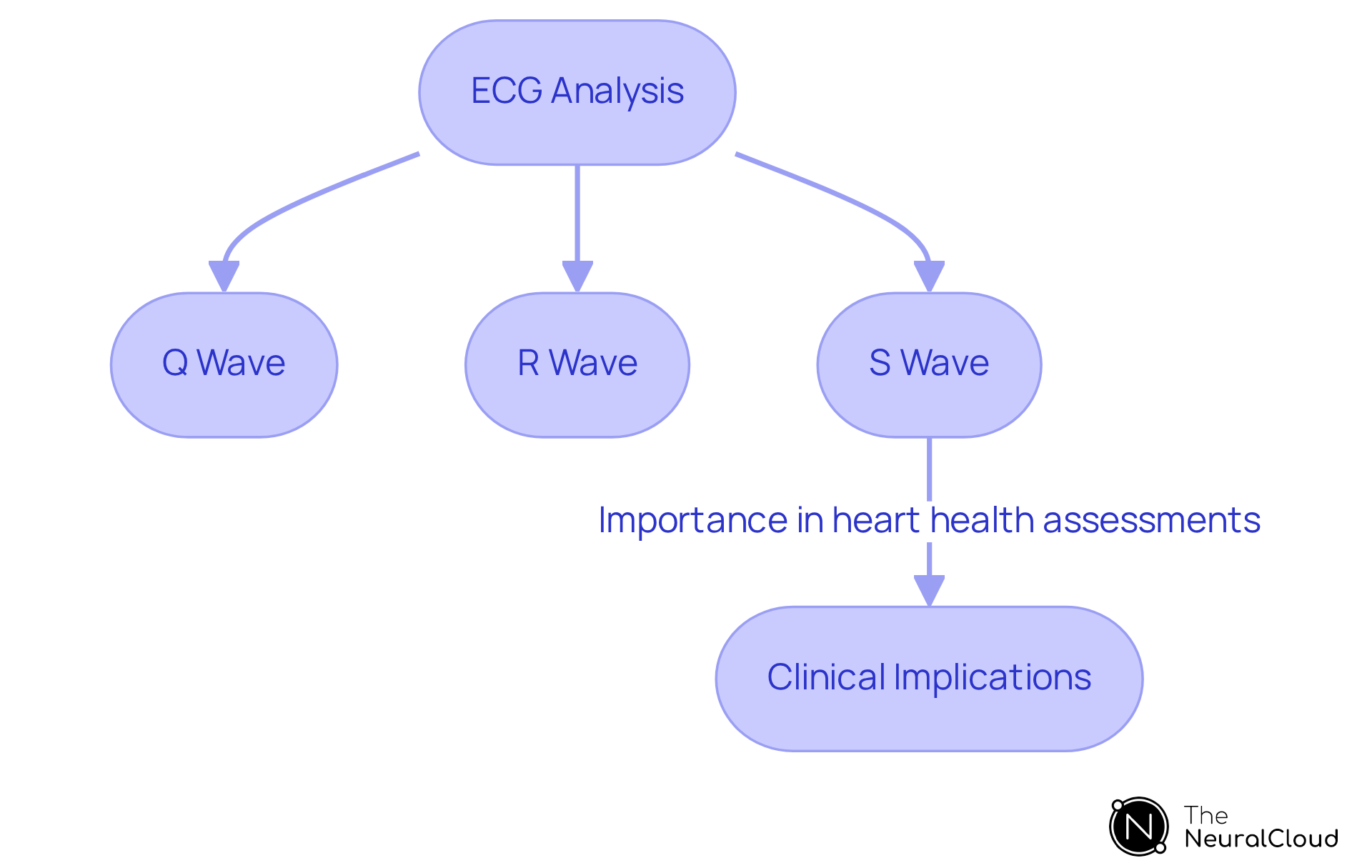
The S wave is a vital part of the ECG, which also encompasses the Q wave and R wave motion. The Q deflection marks the initial negative shift, followed by the R deflection, the first positive shift, and concluding with the S deflection, which corresponds to the T wave, another negative shift. Together, these waves represent the electrical activity linked to ventricular depolarization, offering crucial insights into heart function.
Clinicians assess the S wave along with the Q and R components to effectively evaluate heart health. Variations in the S wave amplitude or shape can signal serious heart conditions, such as ischemia or bundle branch blocks. For instance, a prominent S wave has been identified as a potential indicator of favorable outcomes in cardiac resynchronization therapy (CRT) recipients, underscoring its importance in clinical decision-making.
Recent studies reveal that the occurrence of bundle branch blocks (BBB) is significantly age-dependent, with around 71.4% of individuals with left bundle branch block (LBBB) being over 65 years old. This demographic insight highlights the need for healthcare professionals to consider age-related factors when interpreting changes in the S wave component.
To improve the accuracy of S wave analysis, Neural Cloud Solutions' MaxYield™ platform plays a crucial role by utilizing advanced algorithms and distinct wave recognition. This technology enables the swift isolation of S wave segments from recordings that may be affected by baseline wander, movement, and muscle artifacts. By recovering previously obscured segments of extensive Holter, 1-Lead, and patch monitor recordings, MaxYield™ ensures that variations in the S wave and other components are accurately captured and analyzed. Understanding these interactions is essential for precise ECG interpretation and can significantly influence patient management strategies.
Interpret the S Wave: Clinical Implications and Techniques
Interpreting the S Wave involves a thorough examination of its amplitude, duration, and morphology within the context of the QRS complex. Clinicians must remain vigilant for abnormalities, particularly the S Wave, which may show a pattern that could indicate conditions like ischemia or right ventricular hypertrophy. An effective analysis method includes comparing the S Wave signal across various leads, as these variations can reveal crucial details about the heart's electrical conduction pathways.
For example, the presence of a broad S Wave signal in LBBB suggests delayed conduction through the left bundle branch, leading to significant clinical implications such as an increased risk of heart failure and arrhythmias. Understanding the patient's clinical context—such as their medical history and presenting symptoms—further enhances the interpretation. Regular engagement with S Wave analysis is vital for refining these skills, enabling clinicians to make informed decisions based on precise data.
This practice not only improves diagnostic precision but also fosters a deeper understanding of the underlying pathophysiology related to the abnormalities. The technology from Neural Cloud Solutions addresses the challenges in ECG interpretation by converting lengthy and noisy ECG recordings into clear, distinct signals. This transformation significantly enhances the analysis process, ultimately leading to better patient outcomes.
Features of MaxYield™:
- Converts noisy ECG recordings into clear signals.
- Streamlines analysis for clinicians.
- Enhances diagnostic precision and understanding of cardiac conditions.
Advantages for healthcare providers:
- Facilitates informed decision-making based on accurate data.
- Improves patient outcomes through better analysis.
- Saves time by simplifying the ECG interpretation process.
As highlighted in user testimonials, the MaxYield™ platform has proven to be an invaluable tool for healthcare professionals, making their work more efficient and effective.
Leverage Technology: Enhancing S Wave Analysis with Advanced Tools
ECG analysis often faces challenges in accurately detecting and interpreting key elements, which can hinder effective diagnosis. Sophisticated tools, like Neural Cloud Solutions' MaxYield™, address these issues by automating the detection and understanding of ECG patterns.
MaxYield™ utilizes advanced machine learning algorithms to analyze ECG data, enabling precise identification of critical features such as the morphology and amplitude. This level of precision is vital; studies show that algorithms can achieve accuracy of up to 85.7% for various cardiac conditions.
Moreover, devices equipped with real-time monitoring capabilities provide valuable insights, allowing clinicians to track changes in the patient's condition over time. By integrating these advanced tools into clinical practice, healthcare professionals can significantly improve diagnostic accuracy, reduce false positive activations, and streamline workflows.
Ultimately, these enhancements lead to better patient outcomes, making the technology a valuable asset in modern healthcare.

Conclusion
Understanding the complexities of the ECG S wave is crucial for healthcare professionals aiming to enhance their diagnostic skills. The S wave plays a vital role in the QRS complex, and its characteristics can offer significant insights into cardiac health. By utilizing advanced technologies like Neural Cloud Solutions' MaxYield™ platform, clinicians can markedly improve the accuracy of ECG interpretations, which leads to better patient outcomes.
The MaxYield™ platform addresses common challenges in ECG analysis by providing features that streamline the interpretation process. It integrates AI-driven tools and wearable ECG devices, allowing for a more efficient analysis that empowers healthcare providers to make informed decisions based on precise data. This not only enhances the accuracy of ECG readings but also supports timely interventions, ultimately improving patient care.
Incorporating these advanced tools into clinical practice represents more than just a step towards efficiency; it signifies a commitment to enhancing patient health outcomes. As the field of ECG analysis evolves, embracing such technology becomes essential for healthcare professionals who wish to remain at the forefront of cardiac diagnostics. The ECG S wave is not merely a waveform; it serves as a window into heart health that, when interpreted accurately, can lead to effective and timely interventions.
Frequently Asked Questions
What does the ECG S wave represent?
The ECG S wave represents the initial negative deflection following the R component in the QRS complex, marking the final phase of ventricular depolarization.
Why is understanding the ECG S wave important?
Understanding the ECG S wave is crucial in ECG analysis as it provides vital insights into the heart's electrical activity and can signal various heart conditions.
What factors influence the amplitude and duration of the ECG S wave?
The amplitude and duration of the ECG S wave are influenced by individual physiology and underlying health issues.
What conditions can a pronounced ECG S wave pattern indicate?
A pronounced ECG S wave pattern may suggest right ventricular hypertrophy (RVH) or conduction irregularities like bundle branch blocks.
How does the ECG S wave differ in cases of Left Ventricular Hypertrophy (LVH)?
In LVH, the ECG S wave deflection tends to be deeper in right-sided leads (V1-V2) and decreases in amplitude toward left precordial leads (V5-V6).
What serious conditions can irregularities in the ECG S wave indicate?
Irregularities in the ECG S wave can indicate serious conditions such as myocardial infarction or heart block.
What is the MaxYield™ platform and how does it assist in ECG analysis?
The MaxYield™ platform, developed by Neural Cloud Solutions, features advanced noise filtering and automated labeling, enhancing the analysis of ECG S wave characteristics.
What are the benefits of using the MaxYield™ platform for healthcare professionals?
The MaxYield™ platform improves diagnostic precision, enhances accuracy in ECG interpretation, and helps clinicians make more informed decisions, ultimately leading to better patient outcomes.
List of Sources
- Define the ECG S Wave: Characteristics and Importance
- mesimedical.com (https://mesimedical.com/insights/how-to-interpret-the-ecg)
- ECG Case Studies | Interpretation & Answers | Geeky Medics (https://geekymedics.com/ecg-case-studies)
- droracle.ai (https://droracle.ai/articles/293632/what-are-r-waves-and-s-waves-on-an)
- Analyze the S Wave: Interaction with Other ECG Components
- mdpi.com (https://mdpi.com/1648-9144/57/8/815)
- Checking your browser - reCAPTCHA (https://pmc.ncbi.nlm.nih.gov/articles/PMC4531556)
- Interpret the S Wave: Clinical Implications and Techniques
- ECG Case Studies | Interpretation & Answers | Geeky Medics (https://geekymedics.com/ecg-case-studies)
- 10 Patient Experience Quotes for Inspiration (https://carecloud.com/continuum/patient-experience-quotes-for-inspiration)
- 10 Inspiring Patient Experience Quotes | Relias (https://relias.com/blog/patient-experience-quotes)
- ncbi.nlm.nih.gov (https://ncbi.nlm.nih.gov/books/NBK482167)
- Leverage Technology: Enhancing S Wave Analysis with Advanced Tools
- sciencedirect.com (https://sciencedirect.com/science/article/pii/S1936879825026007)
- AI-Powered ECG Analysis Offers Promising Path for Early Detection of Chronic Obstructive Pulmonary Disease, Say Mount Sinai Researchers (https://mountsinai.org/about/newsroom/2026/ai-powered-ecg-analysis-offers-promising-path-for-early-detection-of-chronic-obstructive-pulmonary-disease-say-mount-sinai-researchers)
- How is AI transforming ECG interpretation? | AI ECG (https://powerfulmedical.com/blog/how-is-ai-transforming-ecg-interpretation)
- The diagnostic accuracy of artificial intelligence enhanced electrocardiography for the detection of cardiac dysfunction (https://explorationpub.com/Journals/ec/Article/101293)
- Checking your browser - reCAPTCHA (https://pmc.ncbi.nlm.nih.gov/articles/PMC12419789)