Introduction
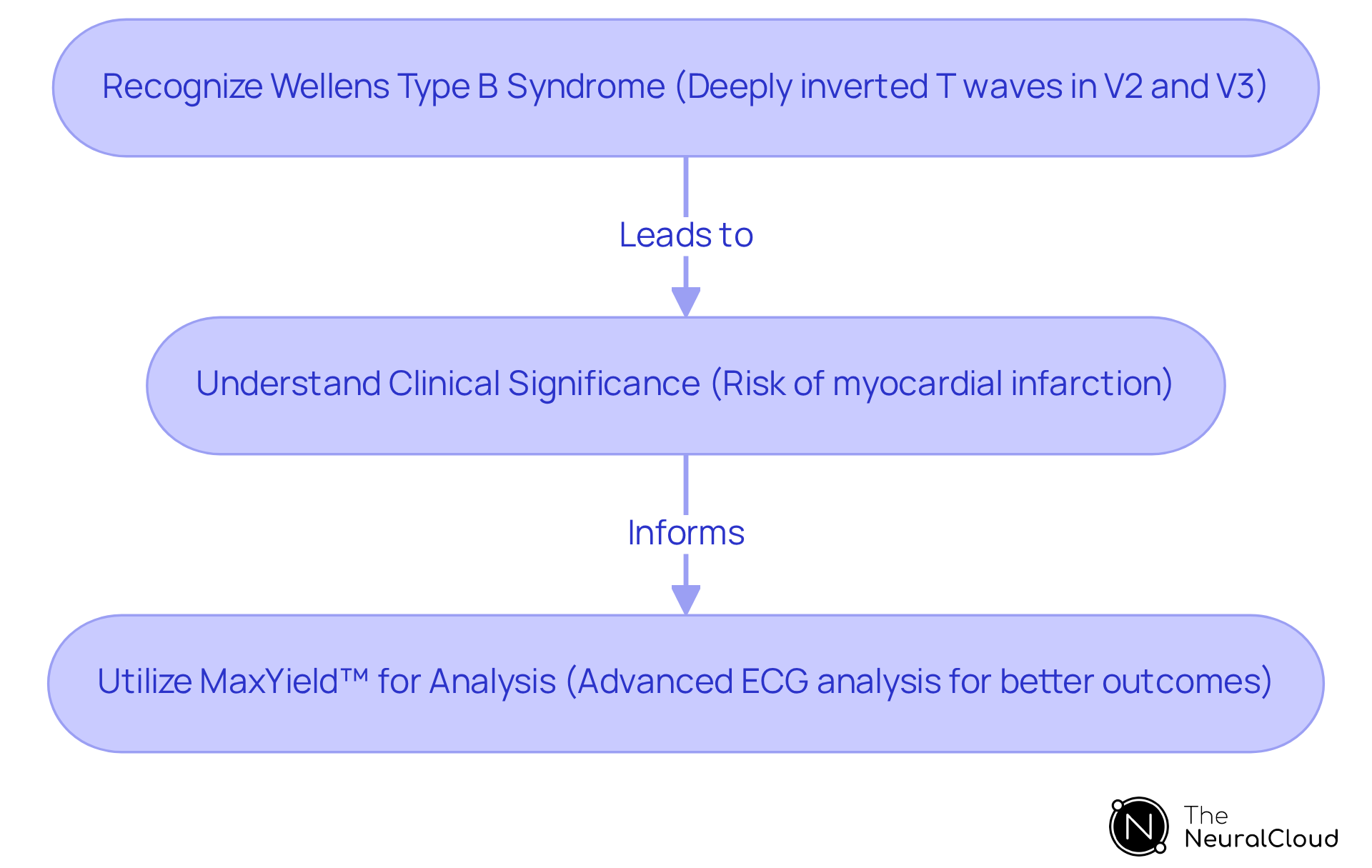
Understanding the nuances of Wellens Type B syndrome is crucial for clinicians. Its distinctive ECG patterns, marked by deeply inverted T waves, indicate a significant risk for myocardial infarction. This article explores the clinical importance of recognizing this syndrome, highlighting the need for precise identification and prompt intervention. As ECG interpretations grow increasingly complex, healthcare professionals must consider how to utilize advanced tools effectively to enhance diagnostic accuracy and improve patient outcomes.
The MaxYield™ platform addresses the challenges faced in ECG analysis by offering features that streamline the interpretation process. By providing clear visual representations of ECG data, it allows clinicians to quickly identify critical patterns, such as those associated with Wellens Type B syndrome. This not only aids in timely diagnosis but also supports better decision-making in patient care.
The advantages of using the MaxYield™ platform are significant. Clinicians can expect improved diagnostic accuracy, which directly translates to enhanced patient outcomes. With its user-friendly interface and comprehensive data analysis capabilities, the platform empowers healthcare professionals to make informed decisions swiftly. In a field where every second counts, leveraging such advanced tools is essential for effective patient management.
Define Wellens Type B Syndrome and Its Clinical Significance
Wellens Type B syndrome is marked by T-wave inversions in leads V2 and V3 of an electrocardiogram (ECG). This pattern is often seen in patients who have experienced chest discomfort that has since subsided. Clinically, the significance of the B variant is its association with myocardial ischemia, indicating a heightened risk of cardiac events if not promptly addressed. Recognizing this syndrome is crucial for clinicians, as it can inform urgent therapeutic decisions and enhance patient outcomes.
MaxYield™ offers advanced analysis tools that significantly improve the accuracy of ECG interpretation. This platform excels in noise filtering and wave recognition, ensuring accurate detection of arrhythmias, even amidst substantial noise and artifacts. Additionally, MaxYield™ provides advanced algorithms, capable of salvaging previously obscured sections of lengthy Holter, 1-Lead, and patch monitor recordings.
The features of MaxYield™ translate into several advantages for healthcare professionals. By streamlining the analysis process, it supports confident clinical decision-making, ultimately enhancing patient care. With its ability to detect subtle changes, MaxYield™ empowers clinicians to make timely interventions, improving overall patient outcomes.
Identify ECG Patterns and Diagnostic Criteria for Wellens Type B
To accurately identify the Wellens Type B syndrome, clinicians should focus on specific ECG patterns, particularly the T waves observed in leads V2 and V3. These T waves are generally symmetric and can extend to adjacent leads, making their identification crucial. The diagnostic criteria for Wellens Type B consist of:
- A history of chest pain
- Normal or slightly elevated cardiac enzymes
- The absence of significant ST-segment elevation
Distinguishing these patterns from other T-wave abnormalities, such as those seen in myopericarditis or pulmonary embolism, is vital to avoid misdiagnosis.
Tools like Neural Cloud Solutions' software offer significant improvements in ECG analysis features and distinct wave recognition capabilities, which enhance the precision of ECG analysis. For example, clinicians can leverage advanced algorithms to analyze recordings that contain high levels of noise and artifacts, ensuring reliable cardiac insights. Notably, approximately 75% of cases of this syndrome exhibit the characteristic T-wave inversion, underscoring the need for thorough assessment.
Clinical insights, including those from Paramedic Andrew Bishop, highlight the importance of accurate diagnosis in real-world scenarios. This reinforces the critical role of advanced ECG analysis in improving patient outcomes. By utilizing advanced tools, healthcare professionals can enhance their diagnostic accuracy, ultimately leading to better patient care.

Utilize Advanced ECG Analysis Tools for Accurate Interpretation
ECG analysis presents several challenges, particularly in accurately interpreting complex heart rhythms. Advanced tools like the MaxYield™ platform from Neural Cloud Solutions address these issues by utilizing algorithms to enhance the interpretation of ECG characteristics, including Wellens Type B.
Features of MaxYield™:
- Automatic Detection: Automatically detect and label critical ECG features.
- High Throughput: Processes over 200,000 heartbeats in under five minutes.
- Noise Resilience: Excels in accuracy, isolating ECG waves even in noisy recordings.
- Visual Representations: Provides clear visual outputs for better communication among healthcare professionals and patients.
These features lead to improved diagnostic capabilities. By drastically reducing analysis time, MaxYield™ enables healthcare providers to quickly recognize vital trends without hesitation. This efficiency is crucial in clinical settings, where timely decisions can impact patient outcomes. Furthermore, the platform's ability to salvage previously obscured sections of lengthy Holter and patch monitor recordings ensures that clinicians have access to clearer data sets and clean signals.
Training is essential for healthcare providers to effectively use the platform. This training ensures that clinicians can maximize diagnostic accuracy and improve patient outcomes. As noted by Nehal Revuri, the development of AI technology has emerged as a game changer, particularly in ECG analysis and continuous cardiac monitoring. The incorporation of AI not only enhances efficiency but also aids in the interpretation of data, ultimately revolutionizing patient care.

Differentiate Wellens Type B from Other ECG Patterns
Accurate differentiation of the Wellens Type B variant from other ECG patterns, particularly the Wellens Type A variant and various T-wave irregularities, is crucial for accurate diagnosis. Type A is marked by deeply symmetrical T-wave inversions in leads V2 and V3, whereas Wellens Type B is characterized by biphasic T waves in the same leads. These biphasic T waves are more common and linked to a higher risk of myocardial infarction. Misdiagnosis can happen, as illustrated by cases where patients were misidentified. For instance, a patient initially diagnosed with a specific syndrome was later found to have pulmonary embolism due to T-wave inversions in leads V1 and III. This underscores the need for accurate assessment.
The positive predictive value of this sign is around 86%, suggesting a significant correlation. Advanced analysis tools, such as Neural Cloud Solutions' platform, significantly enhance diagnostic accuracy by automating assessments and highlighting critical features that might be overlooked in manual evaluations. Our noise filtering, combined with advanced algorithms, streamlines workflows, enabling the processing of more data in less time. This technology not only assists in diagnosis but also aids in distinguishing Wellens Type B from other conditions, ultimately improving patient outcomes.
As Rhinehart et al. describe, the diagnostic criteria for Wellens syndrome include deeply inverted T waves or biphasic T waves, which may extend to V1-6. This highlights the importance of precise ECG interpretation. By leveraging the platform, healthcare professionals can navigate these complexities more effectively, ensuring accurate diagnoses and better patient care.

Conclusion
Recognizing Wellens Type B syndrome is crucial for timely clinical intervention, as it indicates severe narrowing of the left anterior descending artery and an increased risk of myocardial infarction. Accurately identifying the distinctive ECG patterns associated with this syndrome is essential for healthcare professionals, allowing them to make informed decisions that can significantly impact patient outcomes.
This article has examined the defining characteristics of Wellens Type B, emphasizing the importance of deeply inverted T waves in leads V2 and V3, along with the diagnostic criteria that differentiate it from other ECG abnormalities. The advanced features of the MaxYield™ platform have been highlighted, showcasing its role in enhancing ECG analysis through improved noise filtering and AI-driven insights. These capabilities not only streamline the diagnostic process but also empower clinicians to confidently interpret complex ECG patterns, ultimately leading to better patient care.
As cardiovascular diagnostics continue to evolve, integrating advanced analysis tools like MaxYield™ is paramount. These technologies significantly enhance the accuracy of ECG interpretations, ensuring that critical conditions such as Wellens Type B are identified and managed promptly. For healthcare professionals, staying informed about the latest trends in ECG analysis and utilizing these advanced tools will be essential for improving patient outcomes and advancing the field of cardiovascular medicine.
Frequently Asked Questions
What is Wellens Type B Syndrome?
Wellens Type B Syndrome is characterized by deeply inverted T waves in leads V2 and V3 of an electrocardiogram (ECG). It is often observed in patients who have experienced chest discomfort that has since resolved.
Why is Wellens Type B Syndrome clinically significant?
The clinical significance of Wellens Type B Syndrome lies in its association with severe narrowing of the left anterior descending (LAD) artery, which indicates an increased risk of myocardial infarction if not addressed promptly.
How can recognizing Wellens Type B Syndrome impact patient care?
Recognizing Wellens Type B Syndrome is crucial for clinicians as it can inform urgent therapeutic decisions, ultimately enhancing patient outcomes.
What is MaxYield™ and how does it relate to Wellens Type B Syndrome?
MaxYield™ from Neural Cloud Solutions is an advanced automated ECG analysis platform that improves the recognition of critical trends like Wellens Type B Syndrome by filtering noise and accurately detecting deeply inverted T waves.
What advantages does MaxYield™ offer to healthcare professionals?
MaxYield™ streamlines the ECG analysis process, supports confident clinical decision-making, and enhances patient care by enabling timely and informed decisions through its noise filtering and complex waveform recognition capabilities.
List of Sources
- Define Wellens Type B Syndrome and Its Clinical Significance
- pmc.ncbi.nlm.nih.gov (https://pmc.ncbi.nlm.nih.gov/articles/PMC5509195)
- Wellens' Syndrome – Report of two cases - PMC (https://pmc.ncbi.nlm.nih.gov/articles/PMC4882207)
- Wellens Syndrome (https://litfl.com/wellens-syndrome-ecg-library)
- Identify ECG Patterns and Diagnostic Criteria for Wellens Type B
- Wellens Syndrome (https://litfl.com/wellens-syndrome-ecg-library)
- pmc.ncbi.nlm.nih.gov (https://pmc.ncbi.nlm.nih.gov/articles/PMC5509195)
- Utilize Advanced ECG Analysis Tools for Accurate Interpretation
- AI-ECG Momentum and Rising Competition Reshape Diagnostic Cardiology in 2026 (https://signifyresearch.net/insights/diagnostic-cardiology-market-bouncing-into-2026)
- Investigating the Efficacy of AI-Powered Innovations in ECG Analysis and Continuous Heart Monitoring: A Comprehensive Narrative Review - PMC (https://pmc.ncbi.nlm.nih.gov/articles/PMC12419789)
- AI-based ECG interpretation outperforms standard diagnosis of occlusive myocardial infarction (https://news-medical.net/news/20260323/AI-based-ECG-interpretation-outperforms-standard-diagnosis-of-occlusive-myocardial-infarction.aspx)
- AI-Based ECG Analysis Significantly Improves STEMI Detection, Reduces False Activations - American College of Cardiology (https://acc.org/latest-in-cardiology/articles/2025/10/24/16/56/tues-554pm-ai-tct-2025)
- pmc.ncbi.nlm.nih.gov (https://pmc.ncbi.nlm.nih.gov/articles/PMC12594034)
- Differentiate Wellens Type B from Other ECG Patterns
- Wellens Syndrome (https://litfl.com/wellens-syndrome-ecg-library)
- pmc.ncbi.nlm.nih.gov (https://pmc.ncbi.nlm.nih.gov/articles/PMC5509195)