Introduction
Elevated potassium levels, or hyperkalemia, pose significant challenges in cardiac health, particularly in ECG interpretation. Understanding these high potassium ECG patterns is crucial for healthcare professionals, as not recognizing these patterns can result in critical patient outcomes, including life-threatening arrhythmias.
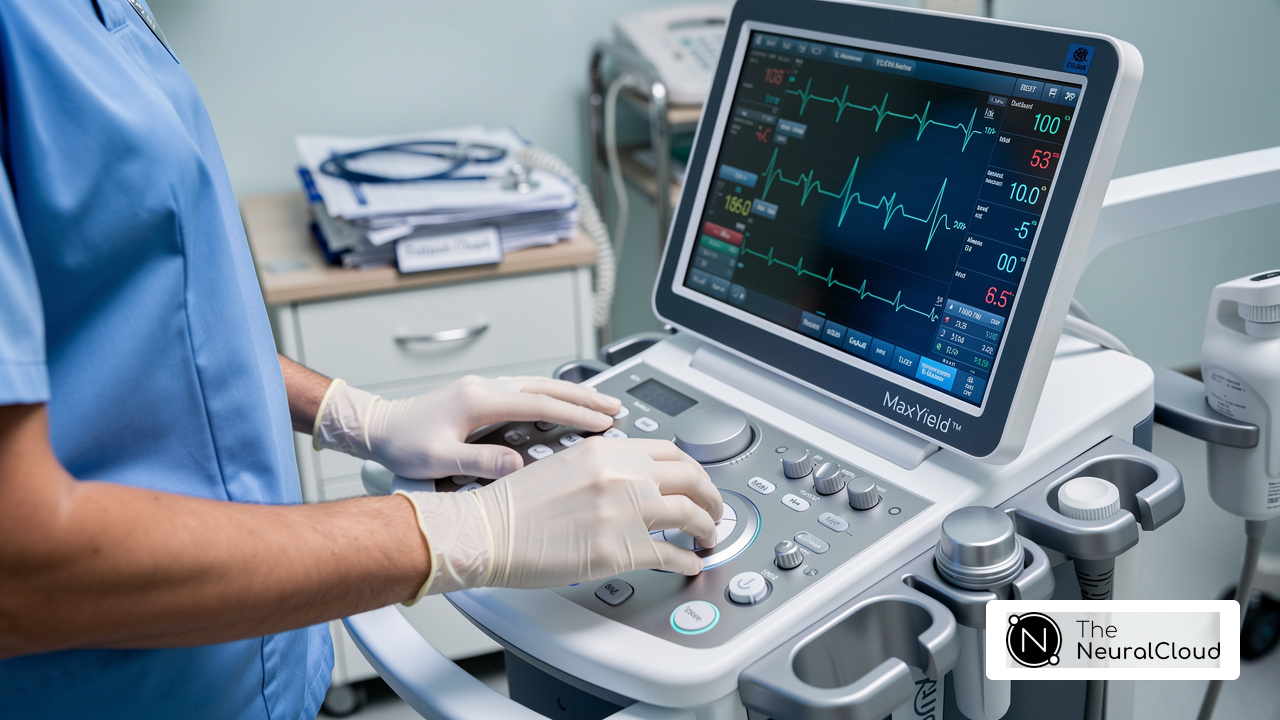
With the advent of advanced AI solutions, such as Neural Cloud Solutions' MaxYield™ platform, the ability to analyze and interpret these ECG variations accurately is now more accessible than ever. This raises the important question of how these technological advancements can improve timely diagnosis and effective patient management in the face of hyperkalemia's complexities.
Define Hyperkalemia and Its ECG Implications
Hyperkalemia, characterized by elevated serum potassium levels, poses significant challenges in the interpretation of high potassium ECGs and patient management. This condition can arise from various factors, including renal failure, excessive potassium intake, or cellular release due to tissue damage. Understanding the implications of hyperkalemia on the high potassium ECG is essential, as potassium plays a vital role in cardiac electrical activity. Elevated potassium levels can lead to alterations in the resting membrane potential, affecting depolarization and repolarization processes. Clinically, this presents as distinctive ECG variations, including high potassium ECG patterns, which can advance from mild alterations to life-threatening arrhythmias if not promptly addressed. Diagnosing hyperkalemia can be challenging due to the subtlety of ECG changes that may not be immediately apparent. Failure to recognize these ECG variations can lead to severe clinical consequences, including arrhythmias that may endanger patient lives.
The Neural Cloud Solutions platform enhances the analysis of these ECG variations by mapping ECG signals through noise, isolating and labeling essential features in each heartbeat. With its advanced noise filtering capabilities, this system can recognize and label crucial data even in recordings with high levels of noise and artifacts. This ensures that the ECG variations linked to elevated potassium levels are precisely identified as high potassium ECG. The system delivers beat-by-beat analysis, outputting detailed insights on P-wave, QRS complex, and T-wave onsets, offsets, and time-series intervals for each heartbeat. This automated analysis enhances diagnostic accuracy and aids healthcare professionals in making informed clinical decisions, crucial for timely interventions.

Identify Key ECG Changes in Hyperkalemia
As potassium levels rise, the ECG changes associated with hyperkalemia become increasingly critical for accurate diagnosis and effective management, especially when utilizing Neural Cloud Solutions' MaxYield™ platform for enhanced analysis:
- Peaked T Waves: Frequently the initial indication of elevated potassium levels, peaked T waves are tall and narrow, becoming prominent in the precordial leads as potassium levels exceed 5.5 mEq/L. This abnormality is observed in approximately 22% of patients with elevated potassium levels. The chances of seeing a peaked T wave double as potassium levels increase. Automated labeling via MaxYield™ can simplify the recognition of these variations, improving diagnostic efficiency.
- Prolonged PR Interval: As hyperkalemia progresses, the PR interval may extend beyond 200 milliseconds, indicating delayed atrioventricular conduction. This change is crucial because it can lead to serious complications in how the heart functions. Decreased amplitude of the P waves and increased PR interval occur as potassium levels exceed 7.0 mEq/L. The platform helps monitor these intervals accurately, reducing the risk of missing critical changes in clinical settings.
- Widened QRS Complex: At potassium levels above 6.0 mEq/L, the QRS complex begins to widen, reflecting impaired ventricular conduction. A QRS duration of 120 milliseconds or more is particularly predictive of hyperkalemia, especially in patients with end-stage renal disease. By employing advanced algorithms, the system can aid in swiftly recognizing these essential developments, thus enhancing patient monitoring.
- Loss of P Waves: In severe cases, particularly when potassium levels exceed 8.0 mEq/L, P waves may disappear entirely, indicating significant atrial conduction impairment. This impairment complicates the management of hyperkalemia, making timely diagnosis essential. The automated analysis features of this system ensure that such important modifications are highlighted swiftly for clinician evaluation.
- Sine Wave Pattern: In critical situations, the QRS complex may merge with the T wave, creating a sine wave appearance. This pattern is a precursor to ventricular fibrillation and indicates a life-threatening condition. Continuous ECG monitoring enabled by wearable technology combined with advanced solutions can assist in the early identification of this harmful pattern.
Recent studies have shown that over 50% of patients with high potassium levels ≥6.5 mEq/L exhibit abnormal ECG results, primarily characterized by peaked T waves and conduction abnormalities. Cardiologists stress the significance of identifying these changes promptly, as elevated potassium levels can result in life-threatening arrhythmias. Ongoing ECG monitoring, particularly via the enhanced features of Neural Cloud Solutions' MaxYield™, is crucial for patients at risk, especially those with chronic kidney disease, where high potassium ECG irregularities are seen in more than 60% of instances. Recognizing these ECG manifestations is vital, as timely intervention can significantly improve patient outcomes and reduce the risk of life-threatening complications.

Discuss Clinical Consequences of ECG Findings
The clinical implications of ECG findings related to high potassium ECG in hyperkalemia present serious challenges for healthcare professionals. One of the most pressing risks of elevated potassium levels is the onset of arrhythmias, which can vary from bradycardia to potentially fatal ventricular fibrillation. As potassium levels exceed 6.0 mmol/L, the likelihood of these arrhythmias increases, with the QRS complex potentially widening to approximately 150 ms or more, indicating a critical state.
Research indicates that 73.5% of cardiac arrest fatalities linked to hyperkalemia occur in hospitalized patients, emphasizing the need for quick recognition of these ECG changes to improve survival chances. Elevated potassium levels significantly heighten the risk of cardiac arrest, particularly when the QRS complex widens and P waves disappear.
Hyperkalemia may mimic ischemic changes on the ECG, making it challenging to diagnose and manage patients who present with chest pain. This overlap can lead to misdiagnosis and inappropriate treatment, underscoring the importance of accurate ECG interpretation.
Specific ECG changes require immediate intervention, such as administering calcium, insulin, or sodium bicarbonate to stabilize cardiac membranes and reduce serum potassium levels. Failure to act swiftly can result in irreversible harm and increased mortality risk, especially in older patients who show the highest crude mortality rates associated with elevated potassium levels.
Recognizing these clinical consequences underscores the importance of timely intervention and ECG analysis in patients with high potassium ECG levels, especially given the concerning trend of rising mortality rates from 1999 to 2020.

Integrate AI Solutions for Enhanced ECG Analysis
Healthcare professionals often struggle with the timely and accurate interpretation of ECG data, which can lead to critical delays in patient care. The integration of AI solutions into ECG analysis presents numerous advantages:
- Automated detection of variations can be achieved as AI algorithms are trained to recognize subtle variations in high potassium ECG associated with hyperkalemia, allowing for swift identification and prompt intervention.
- Enhanced Diagnostic Accuracy: Machine learning models analyze extensive datasets, significantly improving ECG interpretation accuracy and minimizing human error.
- Real-Time Monitoring: AI-driven systems provide continuous oversight of ECG data, notifying clinicians of critical changes instantly, which is essential during emergencies.
- Predictive Analytics: Advanced AI models can anticipate the probability of elevated potassium levels based on patient data and historical trends, enabling proactive management strategies.
- Integration with Existing Workflows: The solution seamlessly integrates with current ECG systems, enhancing their capabilities without necessitating extensive hardware modifications.
By utilizing AI in ECG analysis, particularly through the platform, healthcare providers can enhance patient outcomes through timely and precise diagnosis, especially in cases of high potassium ECG. MaxYield™ can analyze 200,000 heartbeats in less than 5 minutes, transforming noisy recordings into detailed insights. This capability not only streamlines the diagnostic process but also empowers healthcare providers to deliver timely interventions that can save lives.

Conclusion
Recognizing the impact of hyperkalemia on ECG readings is essential for effective patient management. High potassium levels can significantly alter cardiac electrical activity, leading to distinct ECG changes that vary from mild to severe. Recognizing these changes not only aids in timely diagnosis but also plays a vital role in preventing severe clinical consequences, including arrhythmias that can jeopardize patient lives.
Key ECG changes associated with hyperkalemia include:
- Peaked T waves
- Prolonged PR intervals
- Widened QRS complexes
- Loss of P waves
- Sine wave pattern
Each of these variations serves as a critical indicator of rising potassium levels, emphasizing the necessity for ongoing ECG monitoring, particularly in at-risk populations like those with chronic kidney disease. The integration of AI solutions, specifically through platforms like Neural Cloud Solutions' MaxYield™, can significantly enhance the accuracy of these analyses, allowing for swift identification and intervention.
Recognizing and addressing hyperkalemia is crucial because timely intervention can greatly improve patient outcomes and lower the risk of serious complications. By embracing advanced technologies, such as AI in ECG interpretation, healthcare professionals can streamline the diagnostic process and act decisively in critical situations. By leveraging AI technologies, healthcare professionals can significantly improve their ability to detect and manage hyperkalemia, ultimately enhancing patient safety.
Frequently Asked Questions
What is hyperkalemia?
Hyperkalemia is a condition characterized by elevated serum potassium levels, which can significantly impact cardiac electrical activity and patient management.
What are the common causes of hyperkalemia?
Common causes of hyperkalemia include renal failure, excessive potassium intake, and cellular release of potassium due to tissue damage.
How does hyperkalemia affect ECG readings?
Elevated potassium levels can alter the resting membrane potential, affecting the depolarization and repolarization processes, leading to distinctive ECG variations that can progress to life-threatening arrhythmias if not addressed.
What are the ECG patterns associated with high potassium levels?
High potassium ECG patterns can exhibit mild alterations that may advance to severe changes, including arrhythmias that can endanger patient lives.
Why is diagnosing hyperkalemia challenging?
Diagnosing hyperkalemia can be challenging due to the subtlety of ECG changes that may not be immediately apparent, making it difficult to recognize the condition.
How can the Neural Cloud Solutions platform assist in analyzing ECG variations related to hyperkalemia?
The Neural Cloud Solutions platform enhances ECG analysis by mapping signals through noise, isolating and labeling essential features in each heartbeat, and recognizing crucial data even in recordings with high noise levels.
What type of analysis does the Neural Cloud Solutions platform provide?
The platform delivers beat-by-beat analysis, providing detailed insights on P-wave, QRS complex, and T-wave onsets, offsets, and time-series intervals for each heartbeat, thereby enhancing diagnostic accuracy.
Why is timely intervention important in cases of hyperkalemia?
Timely intervention is crucial as failure to recognize and address hyperkalemia can lead to severe clinical consequences, including potentially fatal arrhythmias.
List of Sources
- Identify Key ECG Changes in Hyperkalemia
- Hyperkalemia ECG Changes: Peaked T Waves (https://powerfulmedical.com/blog/hyperkalemia-ecg-critical-changes)
- Hyperkalemia ECG Review (https://healio.com/cardiology/learn-the-heart/ecg-review/ecg-topic-reviews-and-criteria/hyperkalemia-review)
- tandfonline.com (https://tandfonline.com/doi/full/10.2147/OAEM.S455159)
- patientcareonline.com (https://patientcareonline.com/view/ecg-changes-hyperkalemia)
- Discuss Clinical Consequences of ECG Findings
- Hyperkalemia ECG Changes: Peaked T Waves (https://powerfulmedical.com/blog/hyperkalemia-ecg-critical-changes)
- journals.lww.com (https://journals.lww.com/annals-of-medicine-and-surgery/fulltext/2025/11000/hyperkalemia_related_mortality_trends_in_cardiac.45.aspx)
- Hyperkalemia in Chronic Kidney Disease Increases Adverse Cardiovascular Events (https://thecardiologyadvisor.com/news/hyperkalemia-in-chronic-kidney-disease-increases-adverse-cardiovascular-events)
- Integrate AI Solutions for Enhanced ECG Analysis
- AccurKardia (https://accurkardia.com/news)
- How AI is impacting electrocardiography and ECG interpretation for a more accurate diagnosis of cardiovascular diseases (https://tempus.com/resources/content/articles/ai-revolution-electrocardiography-ecg-ai-insights)
- gehealthcare.com (https://gehealthcare.com/en/insights/article/ai-and-ecg-interpretation-insights-and-trends-for-todays-cardiologists?srsltid=AfmBOopgLM1cH79IU3iKthqLUpRtvdbcEcOGS7g_-JIZu2Y75LMk0pGY)
- Checking your browser - reCAPTCHA (https://pmc.ncbi.nlm.nih.gov/articles/PMC12419789)
- MedTech Breakthrough Names AI-powered Hyperkalemia Detection Software 'Best New ECG Technology Solution' (https://dicardiology.com/content/medtech-breakthrough-names-ai-powered-hyperkalemia-detection-software-best-new-ecg)