Introduction
Accurate assessment of left ventricular (LV) function is crucial for improving cardiovascular health, especially in health technology development. Normal LV function, characterized by an ejection fraction between 55% and 70%, serves as a critical benchmark for assessing cardiac performance and guiding treatment decisions. Misdiagnoses in LV function assessment can result in serious health consequences. This presents an opportunity for health tech developers to innovate diagnostic tools that enhance patient outcomes in the Canadian healthcare landscape.
Define Normal LV Function and Its Clinical Significance
Assessing left ventricular function can be challenging for healthcare professionals, especially when it comes to accurately measuring ejection fraction. Normal lv function refers to the percentage of blood the left ventricle expels with each heartbeat, typically ranging from 50% to 70%. Values between 55% and 70% signify effective cardiac output and overall cardiovascular health. Maintaining normal lv function is crucial, as it correlates with the heart's ability to meet the body's metabolic demands. This metric acts as both a diagnostic tool and a prognostic indicator, guiding treatment decisions and helping stratify risk in patients with cardiovascular diseases.
Research shows that:
- A mildly reduced left ventricular ejection fraction falls between 41% and 49%.
- A reduced left ventricular ejection fraction is defined as 40% or less, underscoring the importance of regular monitoring.
Canadian cardiologists emphasize that understanding LVEF trajectories allows for more informed treatment decisions and personalized care, moving beyond static measurements to a dynamic framework that captures the complexities of heart failure.
For health tech creators, grasping these parameters is essential for developing precise diagnostic instruments that efficiently track and assess cardiac performance, ultimately improving outcomes in cardiovascular health. Leveraging MaxYield from Neural Cloud Solutions Inc., developers can ensure hospital-grade accuracy in ECG analysis, transforming noisy recordings into detailed insights.
With its advanced algorithms, MaxYield delivers beat-by-beat analysis, enabling precise identification of cardiac events and supporting confident clinical decisions. Additionally, the customizable visualization and reporting tool, Insight360, enhances the integration of MaxYield’s clean ECG data into interactive dashboards and clinical-ready reports.
As Dr. Alan Rabinowitz notes, "MaxYield’s precision rivals human interpretation, significantly reducing noise and enhancing diagnostic yield." This capability is crucial for developers who want to create tools that meet clinical standards and enhance patient monitoring and care. Furthermore, with FDA Class II SaMD clearance-pending status and audit-ready documentation supporting GxP inspections, MaxYield stands out as a reliable solution in the evolving landscape of digital health.

Explore Abnormal LV Function and Its Clinical Implications
Abnormal left ventricular (LV) function presents significant challenges in cardiovascular health, impacting patient outcomes. It can show up as two types:
- Systolic dysfunction, where the heart struggles to contract,
- Diastolic dysfunction, where it has trouble relaxing and filling with blood.
Systolic dysfunction is typically indicated by a left ventricular ejection fraction of under 55%, while diastolic dysfunction can occur even with a normal ejection fraction, but with irregular filling pressures. These conditions can lead to serious health issues, such as heart failure, arrhythmias, and higher rates of illness and death. Notably, individuals with a low-normal left ventricular ejection fraction, defined as between 50% and 55%, face an increased risk of heart failure compared to those with normal LV function.
Understanding these dysfunctions is vital for health tech developers. It guides the creation of diagnostic tools that can accurately detect and monitor these issues, improving patient outcomes. Recent studies indicate that failure rates associated with low-normal left ventricular ejection fraction are rising in Canada. This underscores the need for innovative solutions in cardiovascular diagnostics.

Compare Key Differences Between Normal and Abnormal LV Function
The distinction between normal and abnormal left ventricular (LV) performance is critical for effective cardiac care. An ejection fraction ranging from 55% to 70% indicates normal LV function, reflecting effective blood ejection and adequate cardiac output. Conversely, an LVEF below 55% suggests potential heart failure or other cardiovascular complications.
While normal LV function typically links to stable diastolic filling pressures, abnormal activity often presents with elevated pressures, leading to symptoms such as shortness of breath and fatigue. Without precise measurements, misdiagnosis can lead to delayed treatment and worsening patient outcomes.
Understanding these differences is vital for health tech developers. It informs the design of diagnostic tools that can distinguish between healthy and compromised cardiac function, enabling timely medical interventions. The integration of MaxYield enhances this process by ensuring consistent, clean data across connected devices, which is vital for wearable data normalization.
Furthermore, MaxYield's advanced AI-driven ECG analysis automates noise reduction and enhances workflow efficiency, ensuring hospital-grade accuracy from consumer-grade devices. Regulatory compliance, including FDA Class II SaMD clearance-pending status, adds to the credibility of these tools.
Recent studies in Canada have highlighted the clinical significance of these LVEF thresholds, reinforcing the need for precise measurement and monitoring in heart health diagnostics. As Dr. Alan Rabinowitz observes, with precision that rivals human interpretation, MaxYield proves to be an invaluable tool for remote individual monitoring. By utilizing MaxYield, healthcare professionals can ensure timely interventions, improving patient outcomes and reducing the risk of complications.

Assess Clinical Implications of Diagnosing LV Function Abnormalities
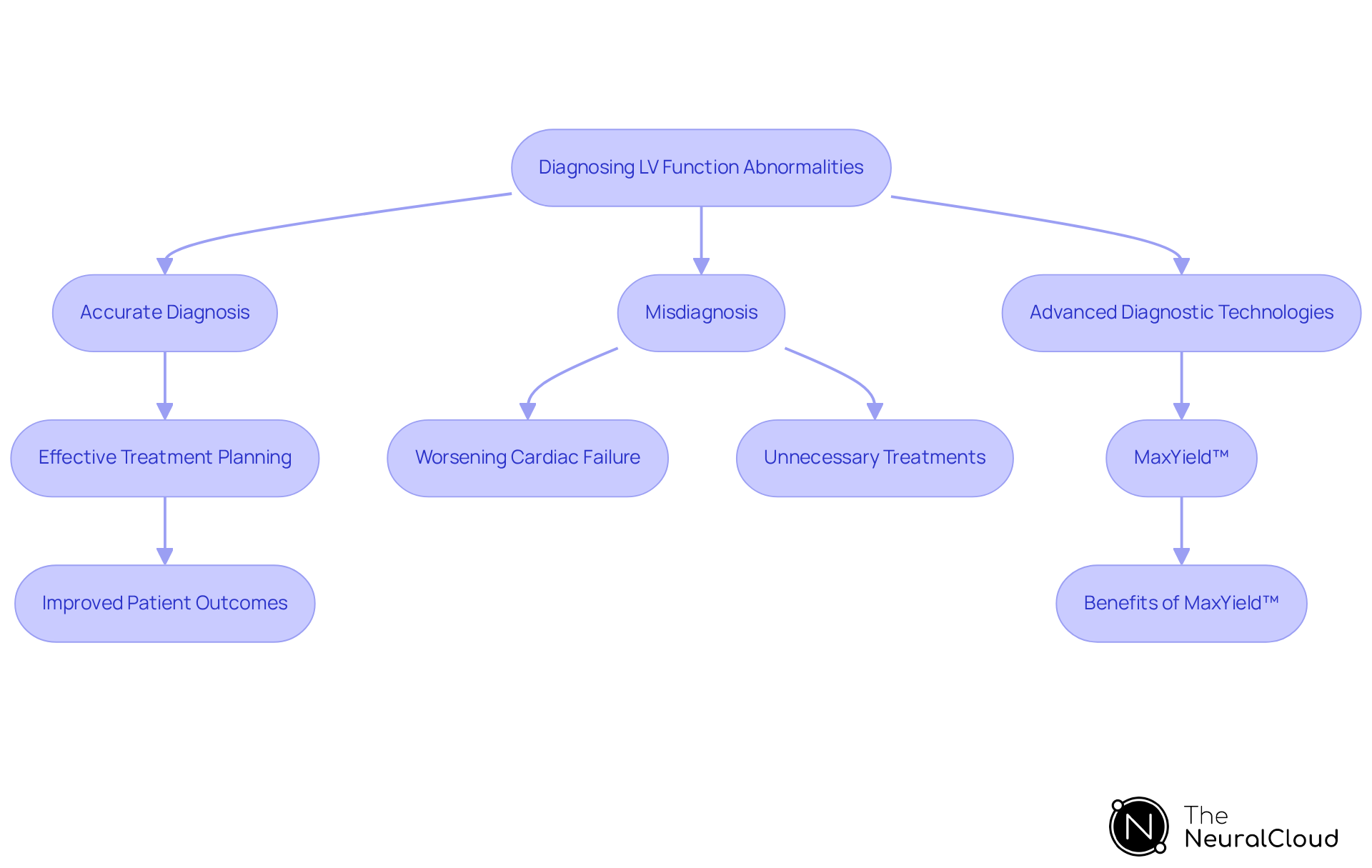
Accurate diagnosis of left ventricular (LV) function abnormalities is critical for effective treatment planning to maintain normal LV function. Misdiagnosis complicates treatment strategies, leading to adverse outcomes for individuals and increased healthcare costs. For instance, individuals with undiagnosed systolic dysfunction may miss essential interventions, resulting in worsening cardiac failure. On the other hand, overdiagnosis can lead to unnecessary treatments and increased anxiety for patients. In Canada, studies indicate that misdiagnosis rates for heart failure can range from 16.1% in hospitals to as high as 68.5% in primary care settings, highlighting the need for precise diagnostic pathways.
Advanced diagnostic technologies from Neural Cloud Solutions Inc. significantly enhance the precision of LV performance evaluations. By utilizing MaxYield™, an AI-powered tool that quickly identifies P, QRS, and T Wave onsets and offsets while offering beat-by-beat tabulation in CSV format, clinicians can analyze more data in less time. This leads to a more detailed understanding of cardiac performance, ultimately improving care and outcomes for individuals. Cardiology experts like Dr. Alan Rabinowitz, Dr. Brett Heilbron, and Dr. Marc W. Deyell emphasize that MaxYield™ matches human interpretation in precision and offers significant noise reduction benefits. Furthermore, with FDA Class II SaMD clearance-pending status, MaxYield™ is positioned to meet regulatory standards, ensuring its reliability in clinical settings.
The consequences of misdiagnosis in the assessment of normal LV function can be profound, impacting treatment efficacy and patient quality of life. Therefore, embracing advanced diagnostic tools like MaxYield™ is vital for enhancing heart failure management and optimizing patient care.
Conclusion
Accurate assessment of left ventricular (LV) function is crucial for effective patient care and treatment decisions. The ability to accurately assess and monitor LV function not only informs treatment decisions but also plays a critical role in improving patient outcomes. Without accurate tools, understanding LV function can be challenging for stakeholders. By recognizing the parameters that define normal LV function, such as ejection fraction, and the implications of deviations from these norms, healthcare professionals can better navigate the complexities of cardiovascular health.
It’s important to understand the differences between normal and abnormal LV function, as precise measurements can significantly impact clinical decisions. Normal LV function, characterized by an ejection fraction of 55% to 70%, is crucial for effective cardiac output, while abnormalities can lead to serious health complications. The insights provided underscore the importance of advanced diagnostic tools, such as MaxYield from Neural Cloud Solutions Inc., which enhance the accuracy of assessments and facilitate timely interventions.
This urgency calls for immediate action from health tech developers to innovate diagnostic solutions. By leveraging advanced technologies, the healthcare community can ensure that patients receive the most accurate diagnoses and effective treatments. Embracing these tools not only enhances individual patient care but also contributes to the overall improvement of cardiovascular health across the population. The future of cardiovascular health hinges on our ability to innovate and implement advanced diagnostic tools.
Frequently Asked Questions
What is normal left ventricular (LV) function?
Normal left ventricular function refers to the percentage of blood the left ventricle expels with each heartbeat, typically ranging from 50% to 70%. Values between 55% and 70% indicate effective cardiac output and overall cardiovascular health.
Why is maintaining normal LV function important?
Maintaining normal LV function is crucial as it correlates with the heart's ability to meet the body's metabolic demands. It serves as both a diagnostic tool and a prognostic indicator, guiding treatment decisions and helping stratify risk in patients with cardiovascular diseases.
What are the classifications of left ventricular ejection fraction (LVEF)?
A mildly reduced left ventricular ejection fraction falls between 41% and 49%, while a reduced left ventricular ejection fraction is defined as 40% or less. Regular monitoring of these values is important for assessing cardiac health.
How do Canadian cardiologists approach LVEF assessment?
Canadian cardiologists emphasize understanding LVEF trajectories to make more informed treatment decisions and provide personalized care. This approach moves beyond static measurements to a dynamic framework that captures the complexities of heart failure.
What role does MaxYield from Neural Cloud Solutions Inc. play in cardiac diagnostics?
MaxYield provides hospital-grade accuracy in ECG analysis, transforming noisy recordings into detailed insights. Its advanced algorithms deliver beat-by-beat analysis, enabling precise identification of cardiac events and supporting confident clinical decisions.
How does Insight360 enhance the use of MaxYield?
Insight360 is a customizable visualization and reporting tool that enhances the integration of MaxYield’s clean ECG data into interactive dashboards and clinical-ready reports, improving the overall assessment of cardiac performance.
What is the significance of MaxYield's precision in ECG analysis?
According to Dr. Alan Rabinowitz, MaxYield’s precision rivals human interpretation, significantly reducing noise and enhancing diagnostic yield, which is crucial for developers creating tools that meet clinical standards and enhance patient monitoring and care.
What is the regulatory status of MaxYield?
MaxYield has FDA Class II SaMD clearance-pending status and audit-ready documentation supporting GxP inspections, making it a reliable solution in the evolving landscape of digital health.
List of Sources
- Define Normal LV Function and Its Clinical Significance
- Ejection fraction: An important heart test-Ejection fraction: What does it measure? (https://mayoclinic.org/tests-procedures/ekg/expert-answers/ejection-fraction/faq-20058286)
- New Joint Scientific Statement on Ejection Fraction Released by Leading Heart Failure Organisations (https://escardio.org/news/press/press-releases/new-joint-scientific-statement-on-ejection-fraction-released-by-leading-heart-failure-organisations)
- How’s Your Ejection Fraction? (https://my.clevelandclinic.org/health/articles/16950-ejection-fraction)
- Explore Abnormal LV Function and Its Clinical Implications
- New HFSA Scientific Statement Provides Practical Guidance for Managing Heart Failure with Mildly Reduced Ejection Fraction | HFSA (https://hfsa.org/new-hfsa-scientific-statement-provides-practical-guidance-managing-heart-failure-mildly-reduced)
- New Study Offers Strong Evidence of Elevated Heart Failure Risk in Adults with Prediabetes, Hypertension and Subclinical Heart Injury or Stress (https://hopkinsmedicine.org/news/newsroom/news-releases/2026/03/new-study-offers-strong-evidence-of-elevated-heart-failure-risk-in-adults-with-prediabetes-hypertension-and-subclinical-heart-injury-or-stress)
- Norton Heart & Vascular Institute joins landmark clinical trial for HFpEF heart failure patients (https://nortonhealthcareprovider.com/news/norton-heart-vascular-institute-joins-clinical-trial-testing-pacing-therapy-for-hfpef-heart-failure-patients)
- Heart failure risk rises in people with diastolic dysfunction: Study (https://news-medical.net/news/20110824/Heart-failure-risk-rises-in-people-with-diastolic-dysfunction-Study.aspx)
- Compare Key Differences Between Normal and Abnormal LV Function
- How’s Your Ejection Fraction? (https://my.clevelandclinic.org/health/articles/16950-ejection-fraction)
- New Joint Scientific Statement on Ejection Fraction Released by Leading Heart Failure Organizations | HFSA (https://hfsa.org/new-joint-scientific-statement-ejection-fraction-released-leading-heart-failure-organizations)
- Heart failure with preserved ejection fraction (HFpEF): More than diastolic dysfunction - Mayo Clinic (https://mayoclinic.org/medical-professionals/cardiovascular-diseases/news/heart-failure-with-preserved-ejection-fraction-hfpef-more-than-diastolic-dysfunction/mac-20430055)
- New HFSA Scientific Statement Provides Practical Guidance for Managing Heart Failure with Mildly Reduced Ejection Fraction | HFSA (https://hfsa.org/new-hfsa-scientific-statement-provides-practical-guidance-managing-heart-failure-mildly-reduced)
- Left Ventricular Ejection Fraction Thresholds Defining Heart Failure Upheld (https://thecardiologyadvisor.com/news/left-ventricular-ejection-fraction-thresholds-defining-heart-failure-upheld)
- Assess Clinical Implications of Diagnosing LV Function Abnormalities
- Misdiagnosis of Heart Failure: A Systematic Review of the Literature (https://sciencedirect.com/science/article/abs/pii/S1071916421002049)
- Misdiagnosis of heart failure: a systematic review of the literature. | PSNet (https://psnet.ahrq.gov/issue/misdiagnosis-heart-failure-systematic-review-literature)
- Economic Issues in Heart Failure in the United States: A Report from the Heart Failure Society of America - PMC (https://pmc.ncbi.nlm.nih.gov/articles/PMC9031347)
- The impact of misdiagnosed heart failure and cardiac or extra-cardiac disease burden on the prognosis in patients with type 2 diabetes - BMC Cardiovascular Disorders (https://link.springer.com/article/10.1186/s12872-026-05844-3)
- Missed Opportunities in the Diagnosis of Heart Failure: Evaluation of Pathways to Determine Sources of Delay to Specialist Evaluation - PMC (https://pmc.ncbi.nlm.nih.gov/articles/PMC9169019)