Introduction
While ambulatory ECG monitors promise to transform cardiac care, significant barriers hinder their widespread adoption in clinical practice. These portable devices not only enhance the accuracy of arrhythmia detection but also empower patients to engage in their health monitoring without disrupting their daily lives. Despite their potential, many healthcare providers hesitate to adopt these technologies due to concerns about:
- Cost
- Training
- Data management
As the healthcare landscape evolves, addressing these challenges is crucial for unlocking the full potential of ambulatory ECG monitoring in enhancing patient outcomes.
Define Ambulatory ECG Monitors and Their Role in Cardiac Diagnostics
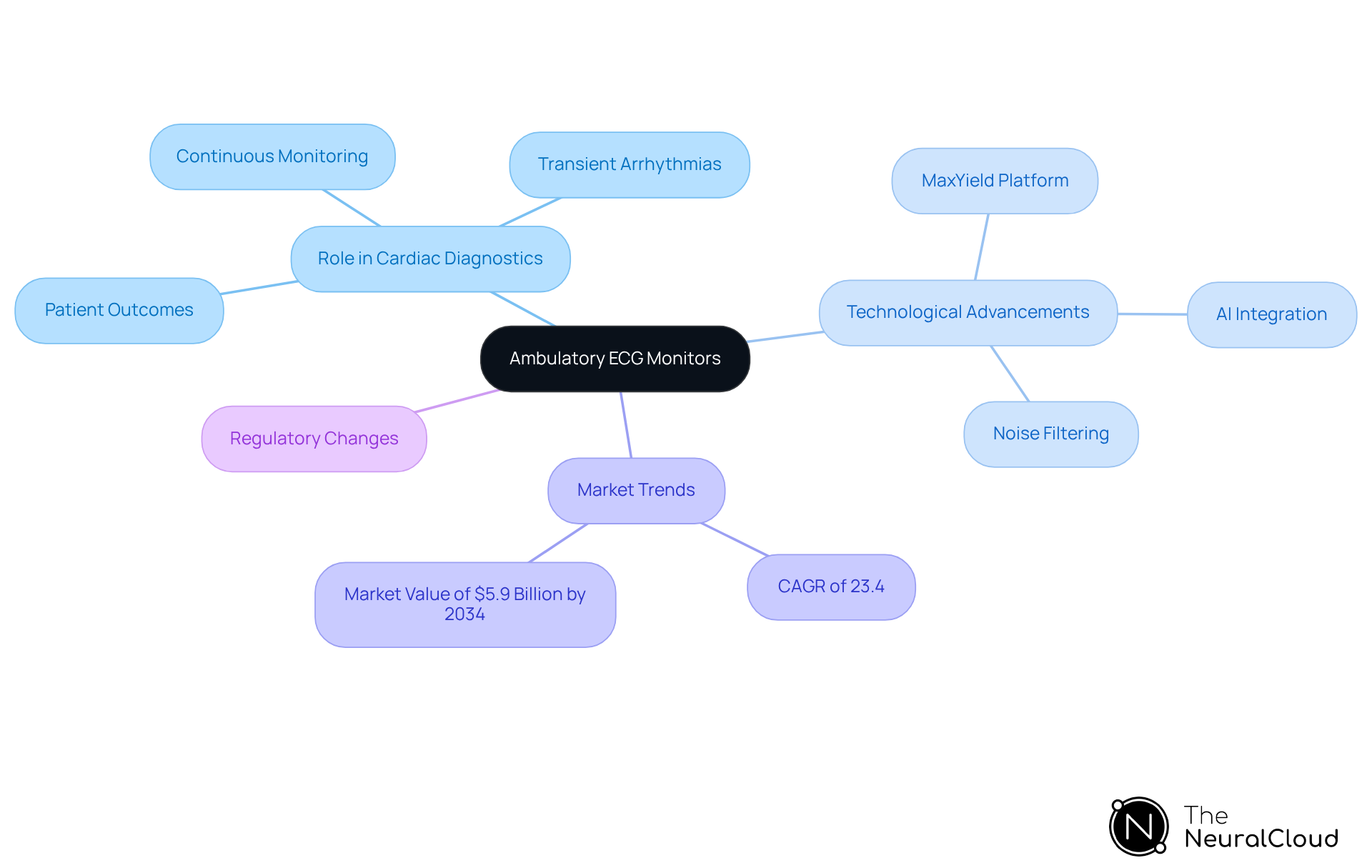
Detecting arrhythmias can be challenging, especially when standard ECGs fall short. Ambulatory ECG monitors, often referred to as Holter monitors, are portable devices that continuously record the heart's electrical activity over extended periods, usually from 24 hours to several weeks. These devices are crucial for diagnosing heart conditions, especially arrhythmias that standard ECGs often miss. Ambulatory ECG monitors provide a thorough perspective of heart function in practical situations by allowing individuals to maintain their daily activities while tracking their heart rhythms. This capability is vital for identifying transient arrhythmias and correlating symptoms with heart events, thereby enhancing diagnostic accuracy and improving patient outcomes.
Recent advancements in the ambulatory ECG monitor technology, particularly through Neural Cloud Solutions' MaxYield platform, have further solidified their significance in contemporary heart care. MaxYield's advanced noise filtering and distinct wave recognition capabilities significantly reduce motion noise, enabling accurate ECG readings even in challenging conditions. The integration of AI algorithms allows for real-time filtering of ECG streams, significantly reducing false alarms and improving workflow efficiency. Additionally, MaxYield acts as a flexible ECG intelligence layer, easily integrating with existing systems through API, SDK, or CDK, so no hardware changes are needed. The market for wearable ECG devices is expected to expand at a compound annual growth rate (CAGR) of 23.4%, indicating the rising demand for efficient heart assessment solutions.
Case studies have demonstrated the effectiveness of the ambulatory ECG monitor in diagnosing arrhythmias. For example, a study highlighted that these devices can capture intermittent arrhythmias that traditional ECGs might miss, leading to timely interventions and better management of patients with conditions like atrial fibrillation. Expert views highlight that the ongoing assessment features of the ambulatory ECG monitor, improved by MaxYield's accuracy comparable to human analysis, are crucial for precisely diagnosing and managing heart conditions, especially in high-risk groups. As mentioned by Anthony Pearson, MD, healthcare systems must prepare for the increase in atrial fibrillation detection through dependable continuous heart rhythm monitors.
In Canada, the usage of ambulatory ECG monitors is increasing, backed by recent regulatory changes that have broadened reimbursement for long-term assessment, including the pending status of FDA Class II SaMD clearance. This shift is expected to enhance accessibility and encourage more healthcare providers to incorporate these devices into their diagnostic protocols. Furthermore, the customizable visualization and reporting tool, Insight360, transforms MaxYield’s clean ECG data into interactive dashboards and clinical-ready reports, enhancing usability and data presentation. As technology advances, the role of the ambulatory ECG monitor in heart care will only grow, shaping the future of patient diagnostics. The worldwide ambulatory ECG monitor market is anticipated to reach $5.9 billion by 2034, highlighting the increasing significance of these technologies in heart care.
Examine Technological Innovations Driving Ambulatory ECG Monitoring
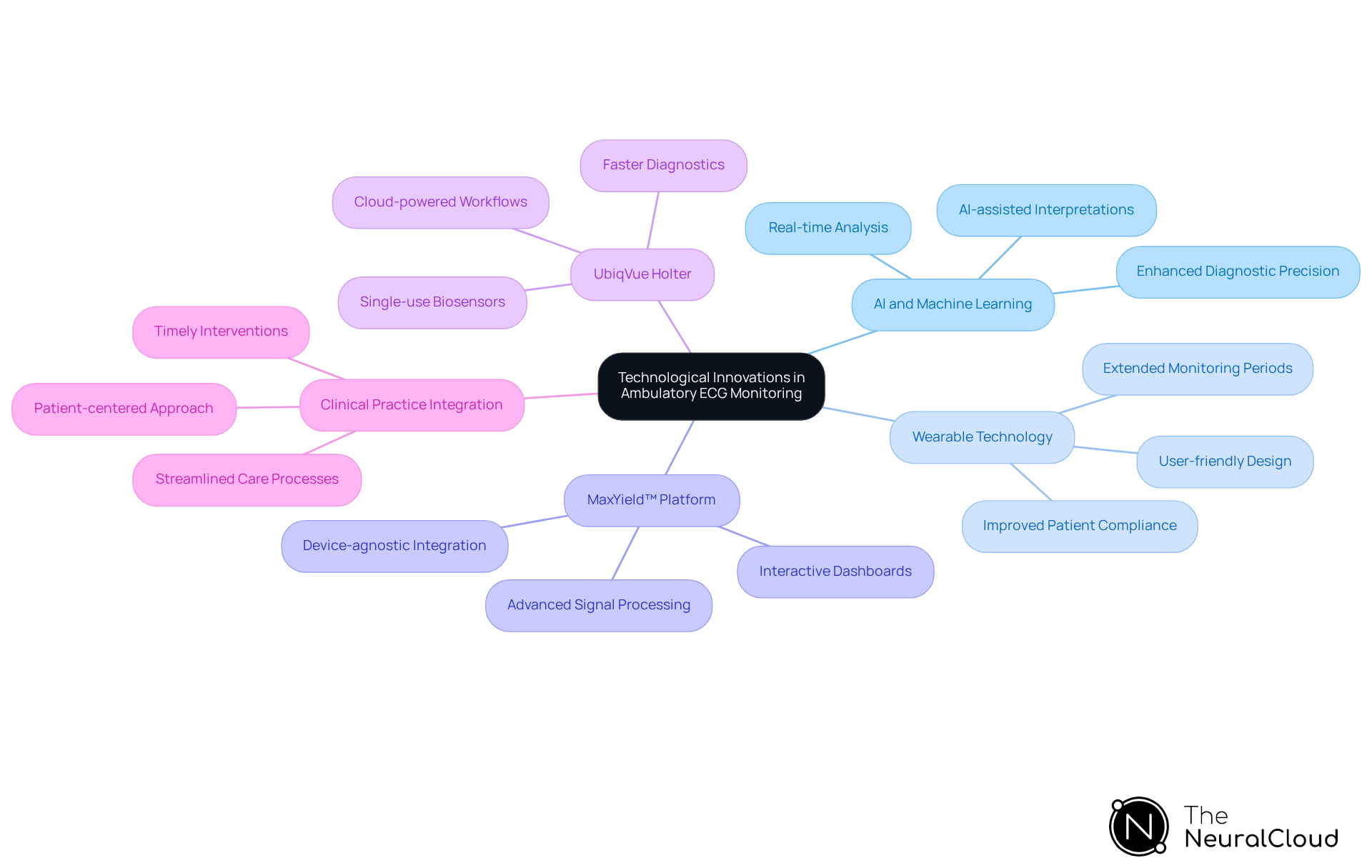
Traditional ECG monitoring often faces challenges in accuracy and patient compliance, leading to potential delays in diagnosis. Recent technological innovations have dramatically reshaped the use of ambulatory ECG monitors, particularly through the integration of artificial intelligence (AI) and machine learning algorithms. These advancements enable devices to analyze heart data more accurately and in real-time, enhancing diagnostic precision. For example, Neural Cloud Solutions' MaxYield™ platform exemplifies how advanced signal processing techniques can effectively reduce noise and filter artifacts, leading to clearer and more reliable ECG readings. Additionally, MaxYield™ is a device-agnostic ECG intelligence layer that integrates seamlessly via API, SDK, or CDK without requiring hardware changes.
Moreover, wearable technology has evolved to create smaller, user-friendly devices that individuals can wear comfortably for extended periods. This advancement not only enables longer monitoring periods but also improves individual adherence and involvement in managing their heart health. The combination of these innovations not only improves diagnostic capabilities but also supports a more patient-centered approach to cardiac care, allowing for timely interventions and better health outcomes.
With Insight360, users can visualize and report on MaxYield™ data in a customizable way, transforming clean ECG data into interactive dashboards and clinical-ready reports, further enhancing usability and data presentation. Case studies highlight the impact of these innovations: UbiqVue Holter, for instance, utilizes single-use biosensors and cloud-powered workflows to streamline diagnostics, empowering clinicians to deliver faster and more efficient patient care. Furthermore, AI-assisted interpretations of data from remote observation devices are anticipated to improve the actionability of information, further increasing clinician confidence in employing these technologies.
As the terrain of the ambulatory ECG monitor observation continues to develop, the emphasis stays on incorporating these advanced technologies into clinical practice, ensuring that healthcare providers can meet the increasing demands for effective heart assessment solutions. By prioritizing these innovations, healthcare providers can significantly enhance patient outcomes and streamline cardiac care processes.
Analyze the Impact of Ambulatory ECG Monitors on Patient Care and Clinical Efficiency
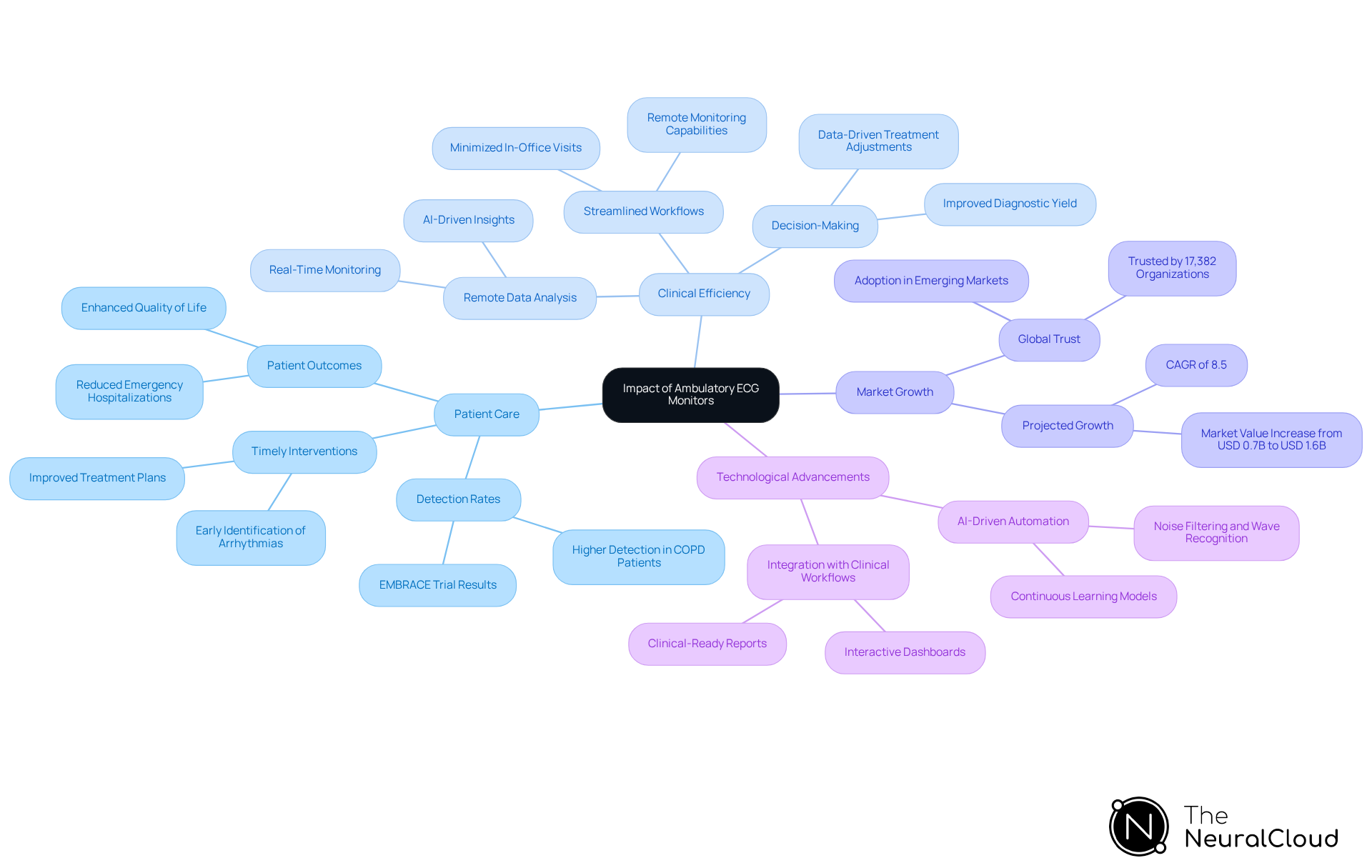
Despite advancements in cardiac care, traditional ECG testing often falls short in detecting transient arrhythmias, posing challenges for timely interventions. Ambulatory ECG monitors enhance individual care and clinical efficiency by allowing for continuous heart rhythm monitoring. This capability allows for early identification of arrhythmias and other cardiac irregularities. As a result, timely interventions can enhance patient outcomes. Research shows that individuals using an ambulatory ECG monitor have a detection rate of transient arrhythmias that is significantly greater than those undergoing standard ECG testing. In the EMBRACE trial, 30-day observation identified atrial fibrillation in 16.1% of individuals, compared to only 3.2% with 24-hour observation, highlighting the significance of extended observation.
Moreover, the integration of these monitors into clinical workflows streamlines operations by minimizing the necessity for in-office visits. Healthcare providers can analyze data from a distance, which not only saves time for both individuals and clinicians but also improves decision-making concerning treatment plans. This efficiency plays a vital role in managing cardiovascular health, especially with the growing demand for real-time monitoring. The digital health market, trusted by over 17,382 organizations globally, reflects this trend, with the ambulatory ECG monitor market projected to grow from USD 0.7 billion in 2023 to USD 1.6 billion by 2033, at a CAGR of 8.5%.
Neural Cloud Solutions' MaxYield platform takes ECG data analysis to the next level. MaxYield's advanced noise filtering and distinct wave recognition capabilities ensure that even recordings with high levels of noise and artifact are transformed into clean, crisp signals. This innovative AI-driven automation not only enhances the accuracy of ECG analysis but also streamlines workflows, allowing for rapid isolation of critical data and improved diagnostic yield. Additionally, the continuous learning model of MaxYield enhances its accuracy and efficiency over time, adapting to new data inputs. The Insight360 tool further enhances this by converting MaxYield’s clean ECG data into interactive dashboards and clinical-ready reports, offering healthcare providers valuable insights to improve their clinical efficiency and care outcomes. As a result, healthcare providers can use MaxYield to boost their clinical efficiency and improve patient care.
Discuss Challenges in Integrating Ambulatory ECG Monitors into Healthcare Systems
While the use of ambulatory ECG monitors offers clear advantages, their integration into healthcare systems is fraught with challenges. A primary obstacle is the inconsistency in reimbursement policies among various insurance providers, creating financial hurdles for healthcare providers. Additionally, data interoperability poses a critical issue; the ability of different systems to communicate effectively is essential for seamless integration with existing electronic health record (EHR) systems. This lack of compatibility complicates the implementation process and hinders the overall effectiveness of the ambulatory ECG monitor solutions.
Additionally, sticking to treatment can be quite challenging. Many individuals may experience discomfort or skin irritation from wearing monitors for extended periods, leading to inconsistent data collection and affecting the reliability of results. Furthermore, ECG recordings often contain noise and signal artifacts, such as muscle contractions and external electrical interference, which can obscure true signals and complicate analysis.
To tackle these challenges, healthcare providers, tech developers, and policymakers need to collaborate to create a supportive environment for the adoption of ambulatory ECG monitor technologies. Only through collective efforts can we overcome these barriers and improve cardiac care outcomes.

Conclusion
Ambulatory ECG monitors are revolutionizing cardiac care, yet their integration into healthcare systems faces significant challenges. These portable devices provide a comprehensive view of heart activity over extended periods. They also empower patients to engage in their daily lives while undergoing critical heart assessments. Advanced technologies, like those in Neural Cloud Solutions' MaxYield platform, are solidifying the role of these monitors in improving diagnostic accuracy and patient outcomes.
Throughout the article, key insights highlight the transformative impact of ambulatory ECG monitors on patient care and clinical efficiency. The ability to capture transient arrhythmias that traditional ECGs often miss leads to timely interventions, ultimately improving patient management. Moreover, advancements in technology, including AI-driven analysis and user-friendly designs, facilitate better adherence and enhance the overall patient experience. As the market for these devices continues to grow, driven by increasing demand and regulatory support, their integration into healthcare systems is poised to reshape cardiac diagnostics.
However, integrating these monitors into existing healthcare systems presents challenges that must be addressed. By addressing issues such as reimbursement inconsistencies and data interoperability, the full potential of these innovative devices can be realized. Successfully addressing these challenges will unlock the full potential of ambulatory ECG monitors, leading to better patient care. Embracing the advancements in ambulatory ECG monitoring not only promises to enhance clinical efficiency but also significantly improves patient outcomes, marking a pivotal shift in the landscape of cardiac care. The future of cardiac diagnostics hinges on our ability to fully embrace and integrate these innovative monitoring solutions.
Frequently Asked Questions
What are ambulatory ECG monitors and their primary function?
Ambulatory ECG monitors, commonly known as Holter monitors, are portable devices that continuously record the heart's electrical activity over extended periods, typically ranging from 24 hours to several weeks. They are essential for diagnosing heart conditions, particularly arrhythmias that standard ECGs may miss.
How do ambulatory ECG monitors enhance diagnostic accuracy?
These monitors allow individuals to maintain their daily activities while tracking their heart rhythms, which is crucial for identifying transient arrhythmias and correlating symptoms with heart events. This capability enhances diagnostic accuracy and improves patient outcomes.
What advancements have been made in ambulatory ECG monitor technology?
Recent advancements, particularly through Neural Cloud Solutions' MaxYield platform, include advanced noise filtering and distinct wave recognition capabilities that reduce motion noise, enabling accurate ECG readings in challenging conditions. The integration of AI algorithms allows for real-time filtering of ECG streams, reducing false alarms and improving workflow efficiency.
How does MaxYield integrate with existing systems?
MaxYield acts as a flexible ECG intelligence layer that can easily integrate with existing systems through API, SDK, or CDK, eliminating the need for hardware changes.
What is the expected market growth for wearable ECG devices?
The market for wearable ECG devices is projected to expand at a compound annual growth rate (CAGR) of 23.4%, indicating a rising demand for efficient heart assessment solutions.
Can you provide an example of the effectiveness of ambulatory ECG monitors?
Case studies have shown that ambulatory ECG monitors can capture intermittent arrhythmias that traditional ECGs might miss, leading to timely interventions and better management of conditions like atrial fibrillation.
What are expert opinions on the importance of ambulatory ECG monitors?
Experts emphasize that the ongoing assessment features of ambulatory ECG monitors, enhanced by MaxYield's accuracy comparable to human analysis, are crucial for diagnosing and managing heart conditions, especially in high-risk groups.
How is the usage of ambulatory ECG monitors evolving in Canada?
The usage of ambulatory ECG monitors in Canada is increasing due to recent regulatory changes that have broadened reimbursement for long-term assessment, including the pending status of FDA Class II SaMD clearance, which is expected to enhance accessibility.
What tools enhance the usability of data from ambulatory ECG monitors?
The customizable visualization and reporting tool, Insight360, transforms MaxYield’s clean ECG data into interactive dashboards and clinical-ready reports, improving usability and data presentation.
What is the projected market value for ambulatory ECG monitors by 2034?
The worldwide ambulatory ECG monitor market is anticipated to reach $5.9 billion by 2034, highlighting the increasing significance of these technologies in heart care.
List of Sources
- Define Ambulatory ECG Monitors and Their Role in Cardiac Diagnostics
- Why Ambulatory ECG Monitors Are the Future of Heart Health (https://doctronic.ai/procedures-screenings-tests/why-ambulatory-ecg-monitors-are-the-future-of-heart-health-LpsGA5)
- Ambulatory Cardiac Monitoring Market Size, Share & 2030 Growth Trends Report (https://mordorintelligence.com/industry-reports/ambulatory-cardiac-monitoring-market)
- Wearable ECG Monitors Industry to More Than Double During 2026-2030, Exceeding $13.6 Billion Total Revenue - Rising Demand for AI-Driven Diagnostics and Home-Based Cardiac Monitoring (https://finance.yahoo.com/sectors/healthcare/articles/wearable-ecg-monitors-industry-more-142200578.html)
- Ambulatory ECG Monitoring: An Evolving Landscape for Cardiologists (https://gehealthcare.com/en-us/insights/article/ambulatory-ecg-monitoring-an-evolving-landscape-for-cardiologists?srsltid=AfmBOop-JkpwDilsisRUXAgbpDIVTZmWrclKkEnRsp0ufuJ8lN8rKlXe)
- Ambulatory ECG Monitoring Market Research Report 2034 (https://dataintelo.com/report/ambulatory-ecg-monitoring-market)
- Examine Technological Innovations Driving Ambulatory ECG Monitoring
- Technological Advancements in Cardiology: Improved Monitoring (https://bstquarterly.com/article/technological-advancements-in-cardiology-improved-monitoring)
- Study Shows AI-Powered ECG Could Help Patients Requiring Lifelong Heart Monitoring (https://dicardiology.com/content/study-shows-ai-powered-ecg-could-help-patients-requiring-lifelong-heart-monitoring)
- Ambulatory ECG Monitoring: An Evolving Landscape for Cardiologists (https://gehealthcare.com/en-us/insights/article/ambulatory-ecg-monitoring-an-evolving-landscape-for-cardiologists?srsltid=AfmBOoqaIVDoyk4IuXlEIVcK-8wQKGHaN31XRsMZTRGvs40dUV3m8Ygz)
- Advances in Cardiac ECG Monitoring Technologies (https://dicardiology.com/channel/advances-cardiac-ecg-monitoring-technologies)
- The Future of Holter Monitoring: How Digital Innovation is Revolutionizing Cardiac Care | LifeSignals® (https://lifesignals.com/the-future-of-holter-monitoring)
- Analyze the Impact of Ambulatory ECG Monitors on Patient Care and Clinical Efficiency
- Why Ambulatory ECG Monitors Are the Future of Heart Health (https://doctronic.ai/procedures-screenings-tests/why-ambulatory-ecg-monitors-are-the-future-of-heart-health-LpsGA5)
- Ambulatory Electrocardiography Market Set to Expand at 8.5% CAGR to US$1.6 Billion (https://media.market.us/ambulatory-electrocardiography-ecg-market-news)
- Ambulatory ECG Monitoring - StatPearls - NCBI Bookshelf (https://ncbi.nlm.nih.gov/books/NBK597374)
- Vivalink Launches Turnkey Ambulatory Cardiac Monitoring Solution for MCT and Holter (https://dicardiology.com/content/vivalink-launches-turnkey-ambulatory-cardiac-monitoring-solution-mct-and-holter)
- Assessment of Variation in Ambulatory Cardiac Monitoring Among Commercially Insured Patients | AJMC (https://ajmc.com/view/assessment-of-variation-in-ambulatory-cardiac-monitoring-among-commercially-insured-patients)
- Discuss Challenges in Integrating Ambulatory ECG Monitors into Healthcare Systems
- Cardiac device billing presents unique challenges for providers (https://mobihealthnews.com/video/cardiac-device-billing-presents-unique-challenges-providers)
- Balancing cost and care: How cardiac physicians and health care providers can adapt to changing reimbursement structures | Medical Economics (https://medicaleconomics.com/view/balancing-cost-and-care-how-cardiac-physicians-and-health-care-providers-can-adapt-to-changing-reimbursement-structures)
- USA ECG Equipment Market: Expansion, Drivers, and Challenges (2026-2035) (https://linkedin.com/pulse/usa-ecg-equipment-market-expansion-drivers-challenges-xtmhf)
- Canadian doctors go digital but hit a wall with system integration (https://benefitsandpensionsmonitor.com/benefits/group-health/canadian-doctors-go-digital-but-hit-a-wall-with-system-integration/388498)