Introduction
Understanding the nuances of cardiac rhythms is crucial for effective diagnosis and treatment in cardiology. Among these rhythms, accelerated junctional rhythm and junctional tachycardia pose unique challenges, even though they originate from the same anatomical region. This article explores the critical distinctions between these two conditions, providing insights into their symptoms, management strategies, and clinical implications.
Healthcare professionals must recognize the key differences between accelerated junctional rhythm and junctional tachycardia to ensure optimal patient care. These distinctions can significantly impact treatment decisions and patient outcomes. Furthermore, advanced technologies play a vital role in enhancing the accuracy of ECG analysis in these scenarios, allowing for more precise diagnoses and tailored management plans.
Define Accelerated Junctional Rhythm and Junctional Tachycardia
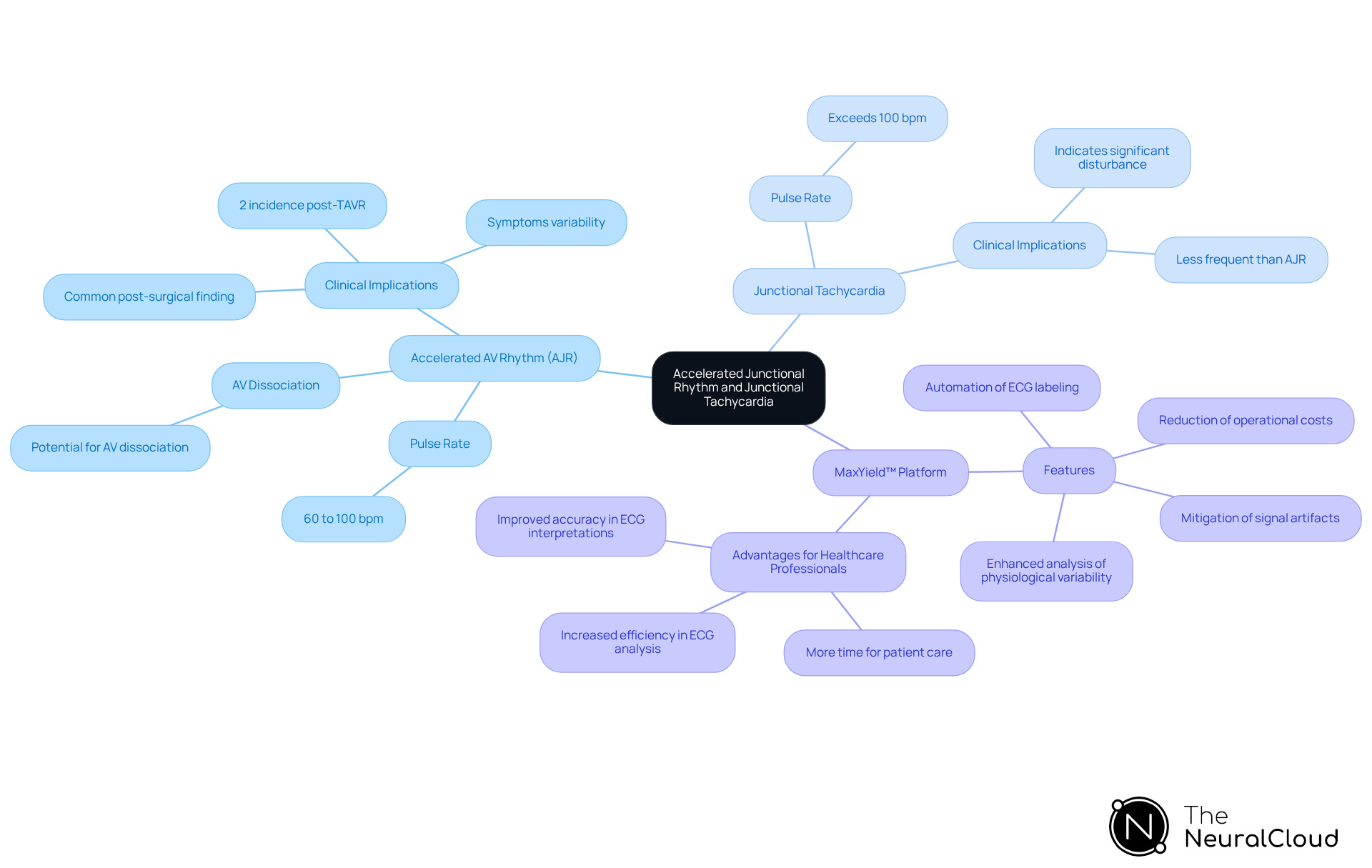
AJR is characterized by a pulse rate ranging from 60 to 100 beats per minute (bpm), originating from the atrioventricular (AV) junction. This condition arises when the pacemaker activity of the AV junction exceeds that of the sinus node, leading to a rhythm that is faster than normal. A key feature of AJR is the potential for AV dissociation, which sets it apart from rapid heart rates originating from junctions. In contrast, junctional tachycardia features a pulse rate exceeding 100 bpm, also stemming from the AV junction, but typically indicates a more significant disturbance in the heart's electrical conduction system.
Both conditions may display similar electrocardiogram (ECG) features, such as narrow QRS complexes, yet they differ primarily in heart rate thresholds and their clinical implications. Recent studies reveal that AJR can be a common post-surgical finding; for instance, a study indicated that 2% of patients developed a junctional rhythm after the procedure. Conversely, junctional tachycardia is less frequent and often associated with more severe underlying issues. It's important to note that not all individuals with junctional rhythms exhibit symptoms, highlighting the variability in clinical presentation. Understanding these distinctions is vital for diagnosis.
Integrating wearable technology with Neural Cloud Solutions' platform can significantly enhance patient monitoring. This platform automates labeling and reduces operational costs, addressing challenges such as physiological variability and data management. By streamlining these processes, clinicians can dedicate more time to critical decision-making, ultimately improving the accuracy and reliability of ECG interpretations.
Features of MaxYield™:
- Automation of ECG labeling
- Reduction of operational costs
- Enhanced analysis of physiological variability
- Mitigation of data inconsistencies
Advantages for Healthcare Professionals:
- Increased efficiency in workflow
- More time for patient care and decision-making
- Improved accuracy in ECG interpretations
In summary, the MaxYield™ platform not only addresses existing challenges in ECG analysis but also provides significant benefits for healthcare professionals, enhancing both the quality of care and operational efficiency.
Compare Symptoms of Accelerated Junctional Rhythm and Junctional Tachycardia
Individuals with Accelerated Junctional Rhythm often report mild symptoms such as palpitations, dizziness, and fatigue. These symptoms arise primarily from the heart's rate, typically ranging from 60 to 100 beats per minute. In contrast, Junctional Tachycardia occurs at a faster rate, leading to more pronounced symptoms. These can include shortness of breath, lightheadedness, chest pain, and, in severe cases, syncope.
The intensity and frequency of symptoms can vary widely. While Accelerated Junctional Rhythm is generally less severe, the specific arrhythmia often presents with more severe manifestations due to its higher heart rate. For instance, individuals experiencing Junctional Tachycardia may describe episodes that begin suddenly and can last from seconds to several days, with some requiring medical assistance to manage their symptoms effectively.
Monitoring is essential for both conditions. This practice helps identify underlying rhythm disturbances and allows for the tailoring of appropriate treatment strategies.

Contrast Treatment Approaches for Accelerated Junctional Rhythm and Junctional Tachycardia
Management of accelerated junctional rhythm typically emphasizes careful monitoring, with interventions if symptoms arise. AJR may resolve spontaneously, and treatment is generally unnecessary if the patient remains asymptomatic. In contrast, junctional tachycardia, particularly when symptomatic or persistent, may necessitate more aggressive interventions. These interventions can include medications, particularly in cases where the pulse rate exceeds 100 beats per minute and symptoms such as dizziness or chest pain are present.
The treatment approach is tailored to the severity of symptoms, the underlying causes, and the patient's overall health status. For instance, junctional tachycardia occurs in approximately 6-8% of children following congenital surgery and often resolves within a week. This highlights the importance of monitoring. Follow-up assessments are crucial to confirm resolution and effectively manage any potential complications.

Summarize Key Differences and Similarities
The comparison of tachycardia reveals that both originate from the atrioventricular (AV) junction, yet they differ in rates and clinical implications. AJR occurs at a rate of 60 to 100 beats per minute (BPM), while Junctional Tachycardia is characterized by a heart rate exceeding 100 BPM. Although symptoms may overlap, this is often associated with more severe manifestations, including dizziness.
The management strategies for these rhythms vary significantly. AJR is typically managed conservatively, focusing on monitoring and addressing underlying causes. In contrast, Junctional Tachycardia often requires more aggressive measures, such as medications like amiodarone or catheter ablation, especially in symptomatic patients. Statistics indicate that up to 9% of untreated heart rhythm cases can be fatal, highlighting the need for effective treatment.
Possible reasons for rapid heart rate at the junction include:
- Digoxin toxicity
- Myocarditis
- Other factors that clinicians must consider in diagnosis and treatment
Clinicians should be skilled at recognizing the similarities in ECG features between AJR and Junctional Tachycardia, as both conditions may present with inverted P waves that can appear before, after, or be buried within the QRS complex.
Leveraging technology like AI can significantly enhance the efficiency of diagnosis. This platform filters out noise and accurately recognizes waveforms, aiding clinicians in distinguishing between these rhythms and improving patient outcomes. The benefits of using MaxYield™ include improved diagnostic accuracy, reduced analysis time, and enhanced patient safety.

Conclusion
Understanding the distinctions between accelerated junctional rhythm and junctional tachycardia is vital for accurate diagnosis and effective management of heart rhythm disorders. Both conditions arise from the atrioventricular junction, yet they differ significantly in heart rate thresholds, clinical implications, and treatment strategies. Recognizing these differences enables clinicians to tailor their interventions, ultimately leading to improved patient outcomes.
Accelerated junctional rhythm typically presents with a heart rate ranging from 60 to 100 bpm and may not necessitate treatment if the patient is asymptomatic. Conversely, junctional tachycardia is characterized by rates exceeding 100 bpm, often resulting in more severe symptoms that require a more aggressive management approach. The MaxYield™ platform plays a crucial role in enhancing ECG analysis, aiding in the differentiation of these arrhythmias and optimizing clinical decision-making.
Given the potential severity of junctional tachycardia and the varying presentations of accelerated junctional rhythm, continuous monitoring and timely intervention are essential. Clinicians must remain vigilant in identifying the symptoms and ECG features associated with each condition to deliver the most effective care. By embracing innovative tools and methodologies, healthcare professionals can improve diagnostic accuracy, enhance patient safety, and increase treatment efficacy in managing these complex arrhythmias.
Frequently Asked Questions
What is Accelerated Junctional Rhythm (AJR)?
Accelerated Junctional Rhythm (AJR) is characterized by a pulse rate of 60 to 100 beats per minute, originating from the atrioventricular (AV) junction. It occurs when the pacemaker activity of the AV junction exceeds that of the sinus node, resulting in a faster rhythm than normal.
How does Junctional Tachycardia differ from AJR?
Junctional Tachycardia features a pulse rate exceeding 100 beats per minute and also originates from the AV junction. It typically indicates a more significant disturbance in the heart's electrical conduction system compared to AJR.
What are the electrocardiogram (ECG) features of AJR and Junctional Tachycardia?
Both AJR and Junctional Tachycardia may display similar ECG features, such as narrow QRS complexes. However, they differ primarily in their heart rate thresholds and clinical implications.
Is AJR common after surgical procedures?
Yes, AJR can be a common post-surgical finding. For instance, a study indicated that 2% of patients (6 out of 301) undergoing Transcatheter Aortic Valve Replacement (TAVR) developed a junctional rhythm after the procedure.
Do all individuals with Heart Rhythm Disorders show symptoms?
No, not all individuals with Heart Rhythm Disorders exhibit symptoms, which highlights the variability in clinical presentation.
How can wearable technology improve ECG analysis?
Integrating wearable technology with Neural Cloud Solutions' MaxYield™ platform enhances ECG analysis efficiency by automating labeling, reducing operational costs, and addressing challenges such as physiological variability and signal artifacts.
What are the features of the MaxYield™ platform?
Features of the MaxYield™ platform include automation of ECG labeling, reduction of operational costs, enhanced analysis of physiological variability, and mitigation of signal artifacts.
What advantages does the MaxYield™ platform provide for healthcare professionals?
The MaxYield™ platform increases efficiency in ECG analysis, allows more time for patient care and decision-making, and improves the accuracy of ECG interpretations.
List of Sources
- Define Accelerated Junctional Rhythm and Junctional Tachycardia
- heartrhythmjournal.com (https://heartrhythmjournal.com/article/S1547-5271(20)30753-0/abstract)
- healthline.com (https://healthline.com/health/accelerated-junctional-rhythm)
- Accelerated Junctional Rhythm (AJR) (https://litfl.com/accelerated-junctional-rhythm-ajr)
- Junctional Tachycardia: Causes, Symptoms and Treatment (https://my.clevelandclinic.org/health/diseases/23216-junctional-tachycardia)
- Compare Symptoms of Accelerated Junctional Rhythm and Junctional Tachycardia
- Junctional Tachycardia: Causes, Symptoms and Treatment (https://my.clevelandclinic.org/health/diseases/23216-junctional-tachycardia)
- healthline.com (https://healthline.com/health/accelerated-junctional-rhythm)
- Checking your browser - reCAPTCHA (https://pmc.ncbi.nlm.nih.gov/articles/PMC1122581)
- Junctional Tachycardia (https://webmd.com/heart-disease/junctional-tachycardia)
- Contrast Treatment Approaches for Accelerated Junctional Rhythm and Junctional Tachycardia
- Junctional Ectopic Tachycardia Treatment & Management: Approach Considerations, Pharmacologic Therapy, Surgical Care (https://emedicine.medscape.com/article/898989-treatment)
- Junctional Tachycardia: Causes, Symptoms and Treatment (https://my.clevelandclinic.org/health/diseases/23216-junctional-tachycardia)
- healthline.com (https://healthline.com/health/accelerated-junctional-rhythm)
- Junctional Tachycardia (https://webmd.com/heart-disease/junctional-tachycardia)
- Summarize Key Differences and Similarities
- healthline.com (https://healthline.com/health/accelerated-junctional-rhythm)
- Junctional Tachycardia: Causes, Symptoms and Treatment (https://my.clevelandclinic.org/health/diseases/23216-junctional-tachycardia)
- Junctional Rhythms (https://aclscertification.org/ecg-course-advanced-junctional-rhythms)