Introduction
Grasping the nuances of a normal axis EKG is essential for health tech developers focused on creating innovative diagnostic tools. This foundational knowledge not only improves the interpretation of electrocardiograms but also plays a crucial role in spotting potential cardiac issues. Given the complexities of cardiac orientations and the implications of deviations, how can developers ensure their tools deliver accurate and timely insights? This guide explores key steps and strategies for mastering normal axis EKG interpretation, ultimately leading to better patient outcomes in healthcare technology.
Define Normal Cardiac Axis EKG
The typical normal axis is represented by the axis, which refers to the general direction of the heart's electrical activity as shown on an electrocardiogram (ECG). It is typically measured in degrees, with a normal range between -30° and +90°. This range indicates that the heart's electrical impulses are propagating in a healthy manner, primarily towards the left and downward, reflecting a normal cardiac function. In practical terms, this signifies that on a standard ECG, the deflections should be mainly positive in positions I and aVF.
Understanding this framework is essential for health tech developers, as it serves as the foundation for recognizing variations in a normal axis that may suggest underlying cardiac issues. Right deviation (RAD) is frequently caused by right ventricular hypertrophy, resulting in a negative deflection in lead I and more positive deflections in leads aVF and III. Conversely, left deviation (LAD) leads to a negative deflection in lead III and is significant only if lead II also becomes negative, typically caused by conduction abnormalities.
As noted by a Consultant Interventional Cardiologist, "The normal cardiac axis, as determined by a standard ECG, represents the overall direction of electrical activity as it spreads through the cardiac conduction system." With the integration of Neural Cloud Solutions' technology, developers can enhance ECG analysis by leveraging advanced algorithms and machine learning.
Features of MaxYield™
- Signal Processing: Reduces signal artifacts, ensuring clearer ECG readings.
- Automated Labeling: Streamlines the analysis process, saving time for healthcare professionals.
Advantages for Healthcare Professionals
These features empower developers to create more effective diagnostic tools, ultimately improving patient outcomes by addressing challenges such as signal artifacts and physiological variability. By utilizing the latest technology, healthcare professionals can enhance their ECG analysis, leading to more accurate diagnoses and better patient care.
Identify Key Characteristics of Normal Axis EKGs
Identifying a normal axis EKG can be challenging; however, with the right tools, developers can streamline this EKG process. Leveraging Neural Cloud Solutions' technology, several key characteristics stand out:
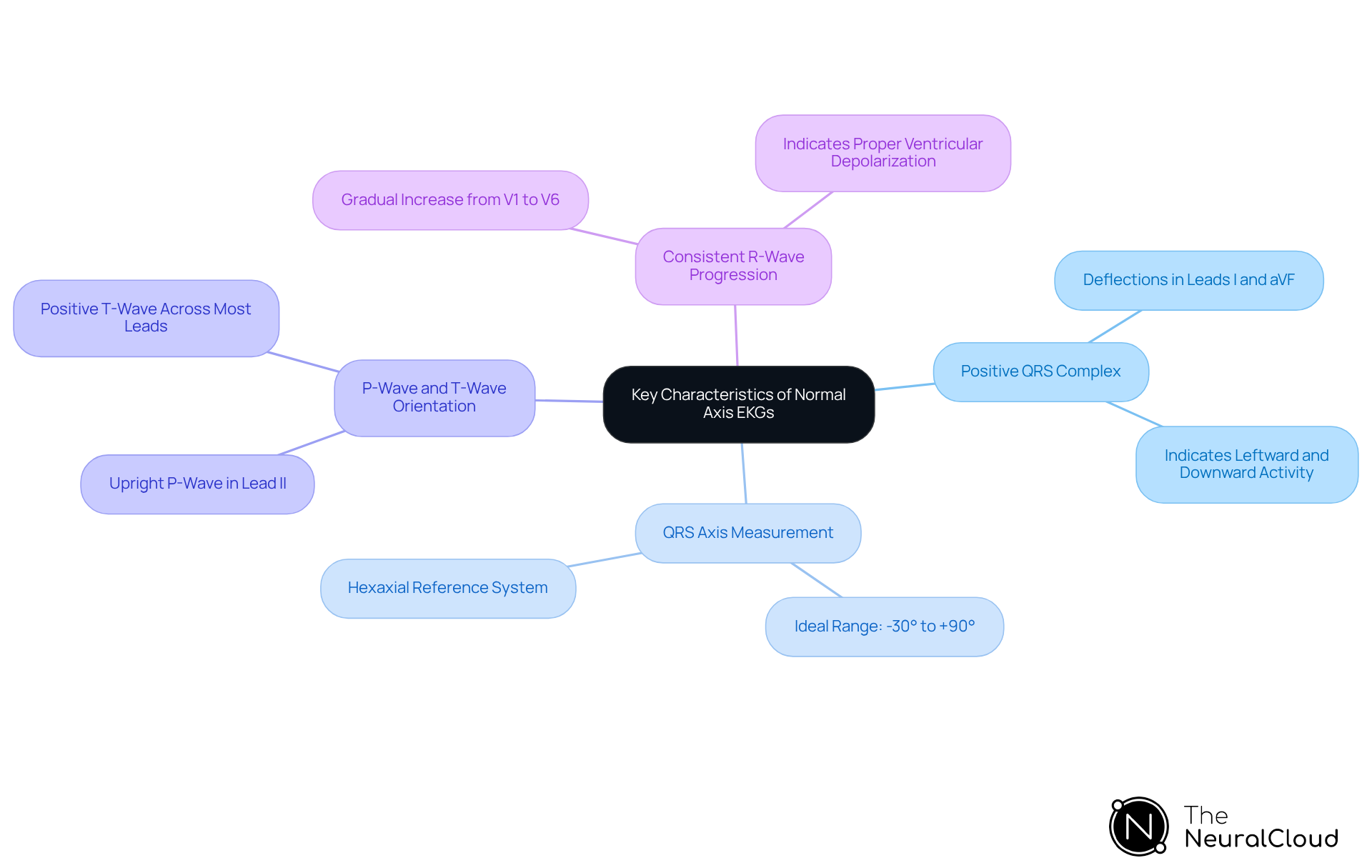
- QRS complex: A normal QRS complex should show predominantly positive deflections in both leads, indicating that the heart's electrical activity is directed leftward and downward.
- Axis range: The axis should ideally fall within -30° to +90°. This can be visually assessed using the hexaxial reference system, where the axis is plotted based on electrode positions. Accurate alignment is essential for interpreting ECGs in healthy individuals.
- Waveforms: The P-wave should be upright in lead II, while the T-wave is typically positive across most leads. These waveforms are crucial for evaluating normal cardiac function.
- R-wave amplitude: In precordial leads, a gradual increase in R-wave amplitude from V1 to V6 indicates proper ventricular depolarization.
By understanding these characteristics, developers can significantly improve their EKG analysis. For instance, in a typical cardiac orientation, all leads exhibit positive deflections, particularly lead II, while lead aVR shows the most negative deflection due to its position opposite the heart's electrical activity. This foundational knowledge is vital for creating accurate diagnostic tools.
Moreover, with MaxYield™, developers can automate and employ adaptive algorithms to recover previously obscured sections of lengthy recordings. This reinforces the importance of these characteristics, ultimately achieving better diagnostic outcomes.
Recognize Deviations: Left and Right Axis
Understanding directional deviations is essential for health tech developers. Key deviations to recognize include:
- Left Axis Deviation: This occurs when the QRS orientation ranges from -30° to -90°. Typically, it is indicated by a positive QRS complex in channel I and a negative QRS complex in channel aVF. Common causes include left anterior fascicular block and left ventricular hypertrophy, both of which can significantly affect cardiac function.
- Right Axis Deviation (RAD): Identified when the QRS orientation is between +90° and +180°, RAD is characterized by a negative QRS complex in position I and a positive QRS complex in position aVF. Conditions such as right ventricular hypertrophy and pulmonary embolism are often linked with RAD. Recent studies show that RAD occurs in about 20% of patients with certain cardiac conditions, underscoring its clinical importance.
- Extreme Axis Deviation: This deviation occurs when the orientation is between -90° and +180°, indicating severe underlying pathology. Recognizing these deviations is vital for developers aiming to create algorithms that alert healthcare providers to potential cardiac issues. Recent research emphasizes the importance of precise orientation identification, as it can lead to better diagnosis and improved patient outcomes.
By incorporating these insights into software design, developers can enhance the accuracy of EKG interpretation, ultimately supporting clinicians in making informed decisions.

Apply Quick Tips for On-the-Spot Interpretation
For health tech developers looking to improve immediate interpretation, several key recommendations stand out:
- Utilize the EKG machine: Conduct testing using a 12-lead EKG to gain a comprehensive view of the heart's electrical activity.
- Evaluate leads I and aVF: Quickly assess the QRS complexes in leads I and aVF to determine the axis. A positive result in both channels indicates a normal orientation.
- Identify Common Patterns: Familiarize yourself with common deviations. For instance, a positive lead I paired with a negative lead aVF indicates left axis deviation.
- Leverage Software Tools: Integrate software solutions, like those from leading companies, which can automatically detect and highlight deviations in real-time. This allows clinicians to focus on patient care rather than manual interpretation, enhancing clarity and speed in ambulatory ECG waveform analysis.
- Promote Continuous Learning: Encourage the use of adaptive algorithms such as machine learning models, which adapt and improve over time. This model addresses the challenges of traditional methods by evolving with each use, ensuring accuracy and efficiency.
By incorporating these strategies, developers can significantly boost the efficiency and accuracy of EKG interpretation.

Conclusion
Mastering the normal axis EKG is essential for health tech developers who want to create effective diagnostic tools. Understanding the typical orientation of cardiac electrical activity and recognizing deviations can significantly enhance ECG interpretation, ultimately leading to better patient outcomes. Advanced technologies, like Neural Cloud Solutions' MaxYield™, help developers streamline analysis and address common challenges in ECG readings.
Key insights from this guide include:
- Defining a normal axis EKG
- Identifying characteristics that indicate healthy cardiac function
- Recognizing left and right axis deviations
By utilizing a 12-lead system, evaluating key leads, and leveraging AI-driven algorithms, developers can improve ECG interpretation. These strategies not only boost diagnostic accuracy but also assist healthcare professionals in providing timely and effective patient care.
The importance of mastering normal axis EKG goes beyond just technical knowledge; it’s about using this understanding to innovate and enhance healthcare solutions. Developers are encouraged to engage in continuous learning and adapt their tools to meet the evolving challenges in ECG analysis, ensuring they make meaningful contributions to the future of cardiac health management.
Frequently Asked Questions
What is a normal cardiac axis EKG?
A normal cardiac axis EKG represents the general direction of the heart's electrical activity on an electrocardiogram (ECG), typically measured in degrees within a range of -30° to +90°. This indicates healthy propagation of electrical impulses primarily towards the left and downward.
What does a normal axis EKG indicate about the QRS complex?
On a normal axis EKG, the QRS complex should be mainly positive in leads I and aVF, indicating that the heart's electrical activity is functioning normally.
Why is understanding normal cardiac axis EKG important for health tech developers?
Understanding normal cardiac axis EKG is essential for health tech developers as it serves as a foundation for identifying variations that may indicate underlying cardiac problems.
What is right axis deviation (RAD) and what causes it?
Right axis deviation (RAD) is often caused by right ventricular hypertrophy, leading to a negative deflection in lead I and more positive deflections in leads aVF and III.
What is left axis deviation (LAD) and when is it significant?
Left axis deviation (LAD) results in a negative deflection in lead III and is significant only if lead II also becomes negative, typically caused by conduction abnormalities.
What features does the MaxYield™ platform offer for ECG interpretation?
The MaxYield™ platform offers advanced noise filtering to reduce signal artifacts and automated labeling to streamline the analysis process, enhancing ECG interpretation.
How do the features of MaxYield™ benefit healthcare professionals?
The features of MaxYield™ empower healthcare professionals to create more effective diagnostic tools, improving patient outcomes by addressing challenges such as signal artifacts and physiological variability, leading to more accurate diagnoses and better patient care.
List of Sources
- Define Normal Cardiac Axis EKG
- What is Cardiac Axis? | ECG Interpretation | Geeky Medics (https://geekymedics.com/what-is-cardiac-axis)
- Identify Key Characteristics of Normal Axis EKGs
- What is Cardiac Axis? | ECG Interpretation | Geeky Medics (https://geekymedics.com/what-is-cardiac-axis)
- Recognize Deviations: Left and Right Axis
- emra.org (https://emra.org/students/newsletter-articles/guide-for-reading-ekgs)
- Apply Quick Tips for On-the-Spot Interpretation
- world.einnews.com (https://world.einnews.com/pr_news/899930160/artificial-intelligence-ai-electrocardiogram-ecg-analysis-market-2026-advancing-cardiac-diagnostics)
- AI-ECG Momentum and Rising Competition Reshape Diagnostic Cardiology in 2026 (https://signifyresearch.net/insights/diagnostic-cardiology-market-bouncing-into-2026)