Introduction
Understanding the complexities of the QRS complex is essential for anyone involved in cardiac diagnostics, as it serves as a crucial indicator of heart health. This article explores the significance of the QRS complex in ECG analysis, emphasizing its role in identifying critical cardiac conditions and guiding treatment decisions. However, the challenges posed by physiological variations and potential artifacts in ECG recordings raise an important question: how can health tech developers improve the accuracy and efficiency of QRS interpretation to enhance patient outcomes?
By addressing these challenges, developers can create solutions that not only streamline ECG analysis but also empower healthcare professionals with the tools they need to make informed decisions. The MaxYield™ platform exemplifies this approach, offering features designed to enhance the interpretation of the QRS complex. Through advanced algorithms and user-friendly interfaces, it simplifies the analysis process, allowing for quicker and more accurate assessments.
The advantages of utilizing such a platform are significant. Healthcare professionals can expect improved diagnostic accuracy, reduced time spent on analysis, and ultimately, better patient care. By focusing on the features, advantages, and benefits of the MaxYield™ platform, this article aims to provide a comprehensive understanding of how technology can transform ECG analysis and support healthcare providers in their critical work.
Define the QRS Complex: Importance in ECG Analysis
The QRS complex is a fundamental element of the electrocardiogram (ECG), which signifies the electrical depolarization of the ventricles. It comprises three distinct waves: the Q wave, the initial negative deflection; the R wave, the first positive deflection; and the S wave, which follows as a negative deflection after the R wave. This system is crucial for diagnosing a range of cardiac conditions, as it conveys essential insights into the heart's electrical activity and overall health.
In clinical practice, the duration, amplitude, and shape of the QRS complex serve as critical indicators of ventricular function. A normal QRS complex, with deviations potentially indicating serious conditions such as bundle branch blocks or ventricular hypertrophy. For example, a widened QRS interval greater than 120 milliseconds may suggest a right bundle branch block, while increased amplitude can indicate left ventricular hypertrophy.
Challenges in interpretation
can be hindered by noise and artifacts, making it difficult to accurately interpret the QRS pattern. This is where Neural Cloud Solutions' technology comes into play.
MaxYield™ Features
- Clarity Enhancement: Enhances the clarity of ECG recordings.
- Distinct Wave Recognition: Allows for rapid isolation of ECG waves, even in noisy environments.
These features are essential for accurate diagnosis, as they address challenges in interpretation by overcoming inefficiencies and physiological variability, ensuring that critical data is accurately identified and labeled.
Advantages for Healthcare Professionals
Recent studies emphasize the importance of the QRS complex. Understanding the QRS complex is essential for healthcare providers, as it guides the creation of tools that improve accuracy and efficiency in clinical environments.
Case studies have shown that accurate interpretation of the QRS complex can prompt further investigation into potential cardiac issues, ensuring that healthcare providers can make informed decisions based on reliable data. As the field of cardiac diagnostics evolves, the role of the QRS pattern remains central to advancing patient care and optimizing treatment strategies, particularly with the integration of Neural Cloud Solutions' continuous learning model that enhances accuracy and efficiency through AI-driven automation.

Explore QRS Morphology: Components and Variations
The variability in the morphology of the QRS complex is influenced by various physiological conditions, complicating ECG interpretation. Each component of the QRS complex has distinct characteristics:
- Q Wave: Typically small and may be absent in certain leads. Its presence can indicate previous myocardial infarction, signaling significant cardiac events.
- R Wave: The highest point in the complex, representing the majority of ventricular depolarization. Its height can suggest hypertrophy, often linked to increased cardiac workload.
- S Wave: A negative deflection following the R Wave, which varies in depth and duration, reflecting the electrical activity of the ventricles.
The factors such as age, sex, and underlying cardiac conditions can lead to variations in QRS morphology. For example, studies indicate that fragmented QRS (fQRS) can predict myocardial scar in patients with coronary artery disease, underscoring its clinical relevance. Additionally, the presence of QRS fragmentation may indicate significant damage to the heart muscle, complicating further diagnosis.
Understanding these variations is essential for clinicians and for developing algorithms where the technology can adapt to diverse patient populations. Traditional methods often struggle to filter out noise and artifacts, which can obscure true ECG signals. However, Neural Cloud Solutions' MaxYield™ platform offers advanced and innovative AI solutions to effectively manage and reduce signal artifacts. For instance, in a case study involving a 70-year-old woman with lung cancer, the ECG revealed electrical alternans, illustrating how physiological conditions can impact QRS morphology. Such insights are vital for health tech developers aiming to create innovative solutions that enhance healthcare delivery and improve patient outcomes.

Analyze Clinical Significance: Abnormalities and Their Implications
Understanding the QRS Complex is crucial, as abnormalities can signal various cardiac issues, making their identification essential for effective clinical decision-making. Key abnormalities include:
- Wide QRS: A duration exceeding 120 ms may indicate conditions such as bundle branch block or ventricular pacing. These conditions can disrupt normal heart function and increase the risk of arrhythmias.
- Prolonged QRS: This abnormality often suggests underlying myocardial scarring or ischemia, linking it to a higher risk of heart failure. Recent studies, including findings published in the European Heart Journal, have shown that prolonged QRS duration can serve as a significant predictor of adverse cardiac events. Dr. Peter Okin, a leading cardiologist, emphasizes that an increase in QRS duration suggests an increased risk of mortality, indicating that further evaluation and treatment may be necessary.
- Pathological Q Waves: The presence of pathological Q patterns usually signifies a history of myocardial infarction, which can guide treatment strategies and risk evaluations.
Understanding the clinical significance of QRS abnormalities is crucial for clinicians because it guides further diagnostic testing and treatment decisions. For health tech developers, integrating algorithms capable of detecting these abnormalities into ECG analysis tools, such as those powered by Neural Cloud Solutions' technology, enhances diagnostic accuracy and supports clinicians in making informed decisions based on reliable cardiac insights.
Features of ECG analysis tools:
- Noise Reduction: This feature allows for the rapid isolation of ECG waves from recordings with high levels of noise and artifact.
- Distinct Wave Recognition: Ensures that critical data is not overlooked, improving the overall quality of ECG analysis.
Advantages for Healthcare Professionals:
By utilizing advanced ECG analysis tools, healthcare professionals can enhance their diagnostic capabilities, leading to better patient outcomes. The platform not only streamlines the ECG analysis process but also provides reliable insights that inform treatment decisions. This integration of technology into clinical practice ultimately supports improved patient care.

Interpret QRS Complexes: Practical Guide for Clinicians
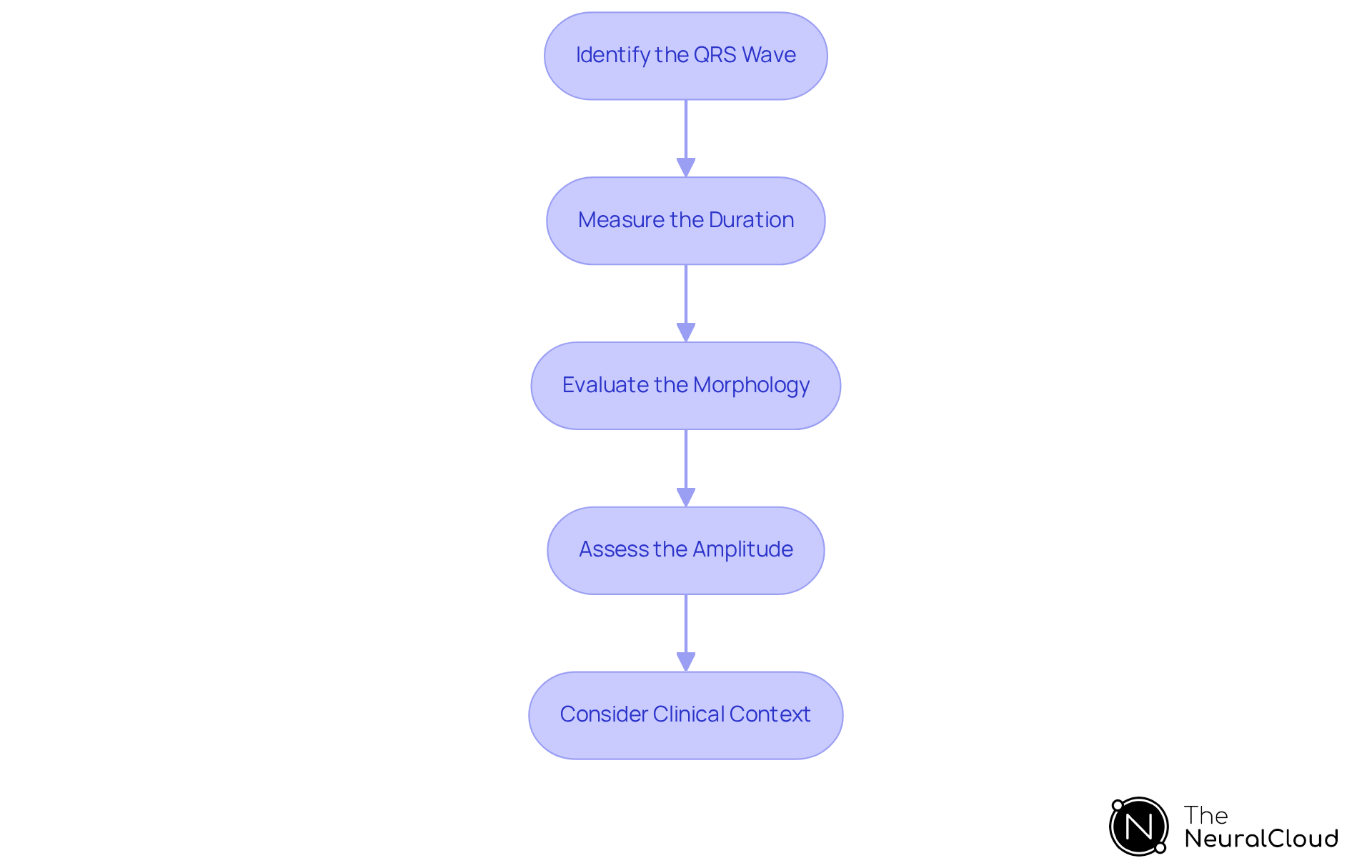
Interpreting QRS complexes involves several essential steps that enhance diagnostic accuracy and patient outcomes:
- Identify the QRS complex: Locate the largest deflection on the ECG, which typically represents the ventricular depolarization. This is crucial as it indicates the electrical activity of the ventricles.
- Measure the Duration: Assess the width of the QRS complex. A normal duration ranges from 70 to 100 milliseconds. Deviations from this range can indicate underlying cardiac conditions, such as bundle branch blocks or ventricular hypertrophy. For instance, in a patient with an ECG rate of 108 beats per minute, a prolonged QRS duration may suggest conduction delays.
- Evaluate the Morphology: Analyze the shape of the QRS complex for abnormalities, such as notched or slurred patterns. These morphological changes can provide insights into specific cardiac issues, including ischemia or conduction disturbances.
- Assess the Amplitude: Measure the height of the R wave. Elevated amplitude may indicate left ventricular hypertrophy, especially if the Sokolow-Lyon criteria are satisfied, where the depth of the S component in V1 or V2 combined with the height of the R component in V5 or V6 surpasses 35 mV. For example, in a case study of a 45-year-old man with hypertension, the S deflection in V2 measured 32 mV and the R deflection in V5 measured 18 mV, totaling 50 mV, indicating left ventricular hypertrophy.
- Consider Clinical Context: Integrate findings with patient history and other ECG components, such as P waves and T waves, to form a comprehensive assessment. For example, in situations of complete heart block, the QRS patterns may demonstrate total dissociation from atrial activity, requiring urgent clinical attention. As noted, "The ECG demonstrates complete dissociation between atrial and ventricular activity," highlighting the critical nature of accurate interpretation.
By adhering to these steps, clinicians can effectively interpret the QRS complex, which leads to improved patient outcomes and more accurate diagnoses.
Challenges in Interpretation
Interpreting QRS complexes can be complex, often hindered by noise and artifacts that obscure critical data. This is where the technology comes into play.
Features of MaxYield™
- Advanced Algorithms: MaxYield™ employs advanced algorithms to analyze ECG recordings, identifying and labeling critical data even in challenging conditions.
- Noise Reduction: The platform effectively filters out noise and artifacts, ensuring clearer readings.
- Comprehensive Reporting: It provides detailed reports that summarize findings, making it easier for healthcare professionals to interpret results.
Advantages for Healthcare Professionals
The benefits of using MaxYield™ are significant:
- Improved Clarity: By improving the clarity of ECG readings, clinicians can make more informed decisions.
- Time Efficiency: MaxYield™ saves time, allowing healthcare providers to focus on patient care.
- Improved Patient Outcomes: With more accurate interpretations, patients receive timely and appropriate interventions.
In clinical settings, MaxYield™ has been utilized to salvage previously obscured sections of lengthy Holter recordings, demonstrating its practical application in enhancing diagnostic yield.
Conclusion
The QRS complex is a crucial marker in electrocardiogram (ECG) analysis, indicating the electrical depolarization of the ventricles. This understanding is vital for diagnosing various cardiac conditions. For health tech developers, grasping the components of the QRS complex - the Q wave, R wave, and S wave - and their implications is essential for enhancing diagnostic tools that accurately reflect heart health.
Challenges in ECG analysis often stem from noise and artifacts, which can obscure critical data. The MaxYield™ platform from Neural Cloud Solutions addresses these challenges by providing advanced algorithms that enhance the clarity of ECG readings. This platform not only improves diagnostic accuracy but also facilitates timely interventions, ensuring that healthcare professionals can respond effectively to patient needs.
Key features of the MaxYield™ platform include:
- Its ability to filter out noise
- Analyze QRS complex duration, amplitude, and morphology
- Provide real-time feedback
These features translate into significant advantages for healthcare providers, allowing for more precise interpretations of ECG data. By leveraging these insights, health tech developers can create innovative solutions that enhance the reliability of cardiac diagnostics.
As the field of cardiac diagnostics continues to evolve, the importance of the QRS complex remains paramount. By prioritizing accurate interpretation, healthcare professionals can significantly improve patient outcomes, ensuring that critical cardiac conditions are diagnosed and treated effectively. The MaxYield™ platform stands as a testament to the advancements in this area, offering tools that empower healthcare providers to deliver the best possible care.
Frequently Asked Questions
What is the QRS complex in an ECG?
The QRS complex is a fundamental element of the electrocardiogram (ECG) that signifies the electrical depolarization of the ventricles. It consists of three waves: the Q wave (initial negative deflection), the R wave (first positive deflection), and the S wave (negative deflection following the R wave).
Why is the QRS complex important in ECG analysis?
The QRS complex is crucial for diagnosing various cardiac conditions as it provides essential insights into the heart's electrical activity and overall health. Its duration, amplitude, and shape serve as critical indicators of ventricular function.
What is the normal duration of a QRS complex?
A normal QRS duration typically ranges from 80 to 120 milliseconds. Deviations from this range may indicate serious conditions such as bundle branch blocks or ventricular hypertrophy.
What does a widened QRS interval indicate?
A widened QRS interval greater than 120 milliseconds may suggest a right bundle branch block, while an increased amplitude can indicate left ventricular hypertrophy.
What challenges can occur in ECG analysis?
ECG analysis can be hindered by noise and artifacts, making it difficult to accurately interpret the QRS pattern.
How does the MaxYield™ platform assist in ECG analysis?
The MaxYield™ platform features advanced noise filtering to enhance the clarity of ECG recordings and distinct wave recognition to allow for rapid isolation of ECG waves, even in noisy environments.
What advantages do healthcare professionals gain from understanding the QRS waveform?
Understanding the QRS waveform is crucial for timely interventions in conditions like myocardial infarction, thus enhancing patient outcomes. Accurate interpretation of the QRS pattern can significantly influence patient management.
How does the integration of AI-driven automation impact ECG analysis?
The integration of Neural Cloud Solutions' continuous learning model enhances accuracy and efficiency in ECG analysis, guiding the creation of tools that improve diagnostic accuracy in clinical environments.
List of Sources
- Define the QRS Complex: Importance in ECG Analysis
- byjus.com (https://byjus.com/neet/what-does-qrs-complex-represent-in-ecg)
- Clinical Implications of QRS Duration in Patients Hospitalized With Worsening Heart Failure and Reduced Left Ventricular Ejection Fraction (https://jamanetwork.com/journals/jama/fullarticle/182060)
- thecardiologyadvisor.com (https://thecardiologyadvisor.com/news/qrs-micro-fragmentation-effective-mortality-marker-on-ecg)
- Electrocardiogram - StatPearls - NCBI Bookshelf (https://ncbi.nlm.nih.gov/books/NBK549803)
- QRS Interval (https://litfl.com/qrs-interval-ecg-library)
- Explore QRS Morphology: Components and Variations
- QRS complex nomenclature and morphology (https://squigglylines.substack.com/p/qrs-complex-nomenclature-and-morphology)
- ECG Case Studies | Interpretation & Answers | Geeky Medics (https://geekymedics.com/ecg-case-studies)
- Analyze Clinical Significance: Abnormalities and Their Implications
- rarediseaseadvisor.com (https://rarediseaseadvisor.com/news/qrs-duration-marker-survival-in-wild-type-attr)
- thecardiologyadvisor.com (https://thecardiologyadvisor.com/news/qrs-micro-fragmentation-effective-mortality-marker-on-ecg)
- news.weill.cornell.edu (https://news.weill.cornell.edu/news/2009/08/regular-electrocardiograms-may-help-physicians-identify-patients-at-risk-of-sudden-cardiac-death)
- Interpret QRS Complexes: Practical Guide for Clinicians
- ECG Case Studies | Interpretation & Answers | Geeky Medics (https://geekymedics.com/ecg-case-studies)