Introduction
Understanding the complexities of ECG reports can be challenging, yet it remains an essential skill for healthcare professionals dedicated to delivering accurate diagnoses and effective patient care. This guide presents a clear, step-by-step approach to ECG interpretation, highlighting the key components and their clinical significance. With the risk of misinterpretations and the intricacies of cardiac conditions, it’s crucial to navigate these reports carefully to avoid common pitfalls.
The MaxYield™ platform addresses these challenges by offering advanced features designed to enhance ECG analysis. It simplifies the interpretation process, allowing healthcare professionals to focus on critical insights rather than getting lost in technical details. By leveraging this platform, users can improve their diagnostic accuracy and streamline patient care.
The advantages of using MaxYield™ are significant. Not only does it provide a user-friendly interface, but it also integrates educational resources that clarify complex concepts. This ensures that both technical and non-technical readers can engage with the material effectively, enhancing their understanding and application of ECG analysis.
Understand the Basics of ECG Interpretation
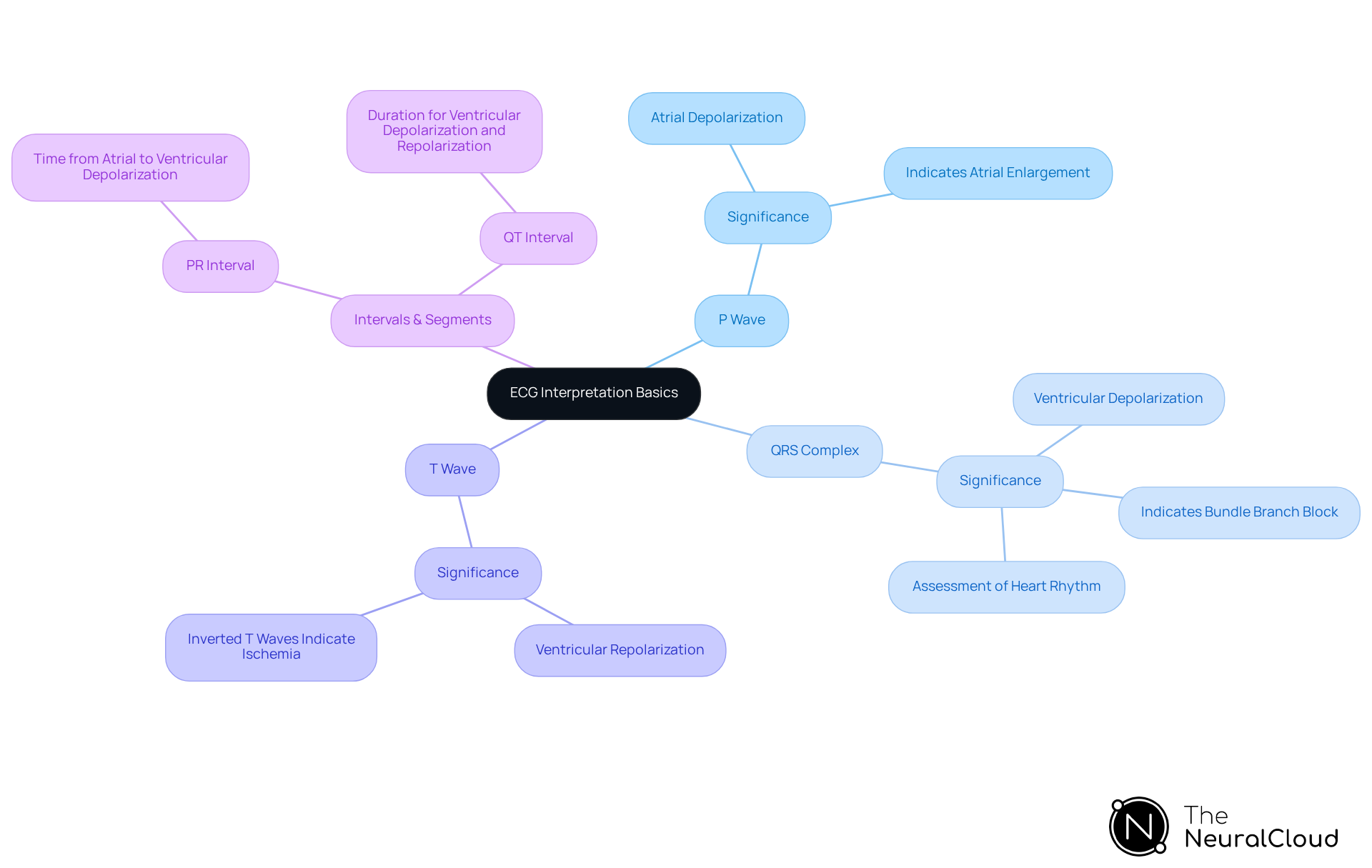
To effectively learn how to read ECG reports, it's crucial to understand the fundamental components of an ECG waveform. An ECG typically comprises several key elements:
- P Wave: This represents atrial depolarization and is the first upward deflection in the ECG tracing. Irregularities in the P component can suggest conditions like atrial enlargement.
- QRS Complex: This complex signifies ventricular depolarization and is characterized by a sharp spike followed by a downward deflection. It is essential for assessing heart rhythm and rate, with wide QRS complexes often indicating significant cardiac conditions like bundle branch block.
- T Wave: Reflecting ventricular repolarization, the T deflection follows the QRS complex and is typically a modest upward movement. Inverted T waves can signal myocardial ischemia or infarction, highlighting their diagnostic importance.
- Intervals and Segments: Key spans include the PR interval, which measures the time from atrial depolarization to ventricular depolarization, and the QT interval, which indicates the duration for ventricular depolarization and repolarization. Understanding these intervals is essential for diagnosis, as deviations can indicate underlying problems.
Research indicates that approximately 70% of healthcare professionals are familiar with these ECG basics, underscoring the importance of foundational knowledge in clinical practice. Cardiologists emphasize that a systematic approach to ECG interpretation is crucial, making it easier to identify abnormalities. Familiarizing yourself with these components will provide a solid foundation for learning how to read ECG reports accurately.
Moreover, integrating advanced tools like MaxYield™ can significantly enhance this process. MaxYield™ offers real-time analysis, providing beat-by-beat insights and effectively reducing noise. This allows healthcare professionals to focus on critical diagnostic tasks. By addressing challenges such as noise reduction and efficiency improvements, MaxYield™ streamlines the ECG interpretation process.
Key Features:
- Provides beat-by-beat insights
Advantages for Healthcare Professionals:
- Saves time in analysis
- Improves focus on critical tasks
Real-world instances, such as the examination of P waves in patients with atrial enlargement or the evaluation of QRS complexes in cases of bundle branch block, further demonstrate the practical application of these concepts in clinical settings.
Follow a Step-by-Step Method for ECG Analysis
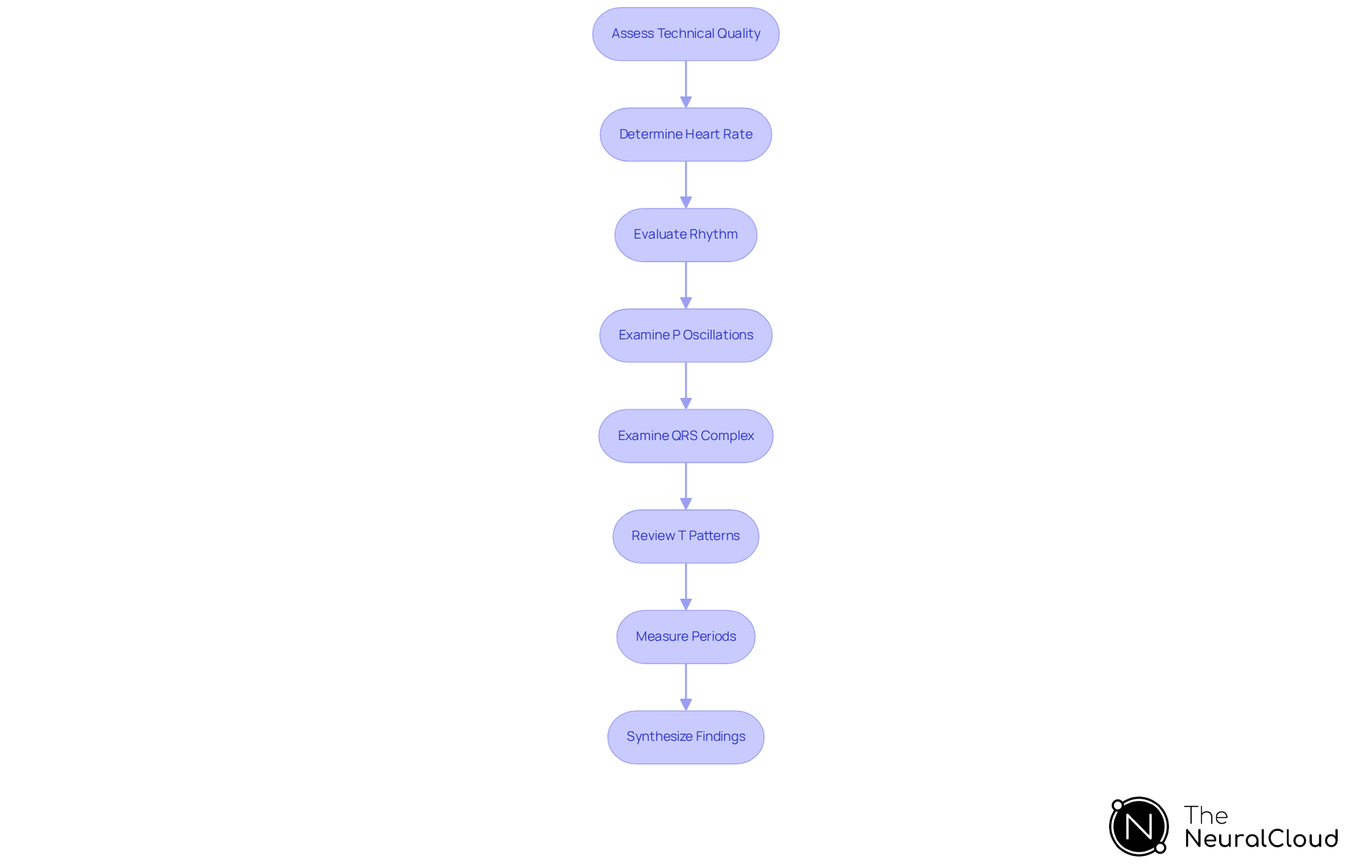
To effectively analyze an ECG report, follow these structured steps:
- Start by ensuring the ECG is clear and free from artifacts. With Neural Cloud Solutions' technology, enhance signal clarity. This feature facilitates proper lead placement and verifies signal quality, addressing common challenges in ECG analysis.
- Determine the Heart Rate: Count the number of R waves in a 10-second segment and multiply by six to estimate the beats per minute. This step is essential for evaluating cardiac function and understanding the patient's condition.
- Assess the Rhythm: Assess whether the rhythm is regular or irregular by measuring the intervals between R peaks. This evaluation can indicate potential arrhythmias, which are critical for diagnosis.
- Examine the P Waves: Verify the existence of P waves occurring before each QRS complex. This confirmation of atrial activity is essential for diagnosing atrial conditions, ensuring comprehensive analysis.
- Evaluate the QRS Complex: Evaluate the width and morphology of the QRS complex for abnormalities. Variations can signify various cardiac issues, including conduction blocks, which require attention.
- Review the T Waves: Investigate T wave characteristics for abnormalities such as inversion or flattening. These changes may suggest ischemia or other cardiac concerns, highlighting the importance of thorough examination.
- Measure Intervals: Calculate the PR and QT durations to evaluate conduction times and repolarization. Extended intervals can indicate significant pathologies, making this step crucial for accurate assessment.
- Integrate Findings: Integrate all observations to form a comprehensive interpretation. Correlate findings with the clinical context to prioritize life-threatening conditions, ensuring effective patient management.
By following this methodical approach and utilizing the capabilities of technology, including automated annotations, healthcare professionals can improve their skills on how to read ECG reports. This improvement leads to better diagnostic accuracy and effectively addresses challenges such as physiological variability and interpretation errors.
Identify and Troubleshoot Common ECG Interpretation Errors
Common errors in ECG interpretation can lead to misdiagnosis and inappropriate treatment. Here are some frequent pitfalls and how to troubleshoot them:
- Artifacts: Artifacts can mimic arrhythmias, leading to false diagnoses. Always check for lead misplacement or patient movement that may distort the ECG. With Neural Cloud Solutions' technology, which employs advanced algorithms, you can rapidly isolate ECG waves from recordings affected by baseline wander and muscle artifact. This significantly reduces the risk of misinterpretation, ensuring more accurate diagnoses.
- Ignoring Clinical Context: It’s crucial to consider patient history and symptoms. An isolated abnormality may not be clinically significant. Research shows that emergency physicians correctly classified ECGs according to their emergency level in 82% of cases, highlighting the importance of context in interpretation.
- Overreliance on Computer Analysis: Overreliance on computer-generated results can lead to misinterpretation, with studies revealing that up to 39% of ECGs were misinterpreted. Always verify computer-generated results with manual analysis to avoid potential pitfalls. MaxYield™ enhances this process by evolving its algorithms with each use, improving accuracy and efficiency over time.
- Neglecting Interval Measurements: Failing to measure PR and QT durations can overlook critical conduction abnormalities. Accurate interval measurement is essential, as neglecting this can lead to significant diagnostic errors.
- Inadequate Familiarity with Normal Variants: Some normal variants can be mistaken for pathology. Familiarize yourself with common normal variations to avoid unnecessary alarm. Continuous education on ECG interpretation is crucial, as studies indicate that clinician experience significantly impacts diagnostic accuracy.
By being aware of these common errors and employing a systematic approach to troubleshooting, along with the advanced capabilities of MaxYield™, you can significantly enhance your skills in how to read ECG reports and improve patient outcomes.

Conclusion
Understanding how to read ECG reports is essential for healthcare professionals aiming to enhance their diagnostic capabilities. The challenges in ECG analysis often stem from the complexity of waveforms and the potential for misinterpretation. By grasping the fundamental components of ECG waveforms and employing a structured approach, one can significantly improve interpretation accuracy. This guide emphasizes the importance of a systematic method and the integration of advanced tools like MaxYield™ to streamline the analysis process.
MaxYield™ offers several key features that enhance ECG analysis:
- Comprehensive Waveform Analysis: It provides detailed insights into the P wave, QRS complex, and T wave, ensuring accurate identification of critical elements.
- Automated Interval Measurements: The platform automates the measurement of intervals and segments, reducing the risk of human error.
- Artifact Detection: Advanced algorithms help identify and mitigate misinterpretation of artifacts, improving overall accuracy.
The advantages of using MaxYield™ are significant for healthcare professionals. By being aware of common pitfalls in ECG analysis and utilizing technology effectively, practitioners can enhance their proficiency in ECG interpretation. This not only leads to more accurate diagnoses but also improves patient outcomes through timely intervention. Continuous education and practice, combined with the use of innovative tools, are vital in overcoming the complexities of ECG interpretation.
Ultimately, mastering ECG analysis is about more than just recognizing patterns; it’s about delivering better care. Embracing these strategies will empower healthcare providers to tackle the intricacies of cardiac assessments with confidence, ensuring they are well-equipped to improve patient outcomes.
Frequently Asked Questions
What are the key components of an ECG waveform?
The key components of an ECG waveform include the P Wave, QRS Complex, T Wave, and various intervals and segments such as the PR span and QT span.
What does the P Wave represent in an ECG?
The P Wave represents atrial depolarization and is the first upward deflection in the ECG tracing. Irregularities in the P component can suggest conditions like atrial enlargement.
What is the significance of the QRS Complex in an ECG?
The QRS Complex signifies ventricular depolarization and is characterized by a sharp spike followed by a downward deflection. It is essential for assessing heart rhythm and rate, with wide QRS complexes often indicating significant cardiac conditions like bundle branch block.
What does the T Wave indicate in an ECG?
The T Wave reflects ventricular repolarization and follows the QRS complex as a modest upward movement. Inverted T waves can signal myocardial ischemia or infarction.
Why are intervals and segments important in ECG interpretation?
Intervals and segments, such as the PR span and QT span, are crucial for identifying various cardiac conditions, as deviations in these time periods can indicate underlying problems.
How familiar are healthcare professionals with ECG basics?
Research indicates that approximately 70% of healthcare professionals are familiar with the basic components of ECG interpretation.
What is the importance of a systematic approach to ECG interpretation?
A systematic approach enhances diagnostic accuracy and makes it easier to recognize patterns of normality and abnormality in ECG readings.
How can advanced tools like MaxYield™ assist in ECG interpretation?
MaxYield™ automates ECG analysis, providing beat-by-beat insights and reducing noise, which allows healthcare professionals to focus on critical diagnostic tasks.
What are the features of MaxYield™?
The features of MaxYield™ include automating ECG analysis, providing beat-by-beat insights, and reducing noise for clearer readings.
What advantages does MaxYield™ offer to healthcare professionals?
MaxYield™ enhances diagnostic accuracy, saves time in analysis, and improves focus on critical tasks in ECG interpretation.
List of Sources
- Understand the Basics of ECG Interpretation
- bookey.app (https://bookey.app/book/the-ecg-made-easy/quote)
- mpo-mag.com (https://mpo-mag.com/breaking-news/studies-show-ai-powered-electrocardiogram-improves-heart-attack-detection)
- AI-Based ECG Analysis Significantly Improves STEMI Detection, Reduces False Activations - American College of Cardiology (https://acc.org/latest-in-cardiology/articles/2025/10/24/16/56/tues-554pm-ai-tct-2025)
- biomedical-engineering-online.biomedcentral.com (https://biomedical-engineering-online.biomedcentral.com/articles/10.1186/s12938-023-01075-1)
- quiverquant.com (https://quiverquant.com/news/iRhythm+Technologies+Presents+New+Data+Supporting+Consistency+of+Zio+ECG+Monitoring+Performance+in+Asian+and+Non-Asian+Patients+at+APHRS+2025)
- Follow a Step-by-Step Method for ECG Analysis
- AI-Based ECG Analysis Significantly Improves STEMI Detection, Reduces False Activations - American College of Cardiology (https://acc.org/latest-in-cardiology/articles/2025/10/24/16/56/tues-554pm-ai-tct-2025)
- Stepwise Approach to STAT ECGs Hub – ECG Weekly (https://ecgweekly.com/ecgstat/stepwise-ecg-interpretation)
- ecg-od.com (https://ecg-od.com/case_studies/royal-brompton-hospitals-use-of-ecg-on-demands-ai-assisted-mail-order-holter-monitoring-service)
- escardio.org (https://escardio.org/Councils/Council-for-Cardiology-Practice-(CCP)/Cardiopractice/artificial-intelligence-in-ecg-diagnostics-where-are-we-now)
- mdpi.com (https://mdpi.com/2673-3846/2/4/39)
- Identify and Troubleshoot Common ECG Interpretation Errors
- researchgate.net (https://researchgate.net/publication/392409540_The_most_common_errors_in_automatic_ECG_interpretation)
- bmcmededuc.biomedcentral.com (https://bmcmededuc.biomedcentral.com/articles/10.1186/s12909-023-04670-x)
- Checking your browser - reCAPTCHA (https://pmc.ncbi.nlm.nih.gov/articles/PMC12137353)
- Accuracy of Physicians’ Electrocardiogram Interpretation (https://jamanetwork.com/journals/jamainternalmedicine/fullarticle/2771093)