Introduction
Understanding junctional rhythm on an ECG is crucial for healthcare professionals, as it can reveal significant underlying cardiac conditions. However, ECG analysis presents challenges, including the complexity of patterns and the potential for misinterpretation. This comprehensive tutorial offers developers the opportunity to enhance their ECG interpretation skills by delving into the key characteristics, clinical significance, and identification techniques associated with junctional rhythms. By utilizing the MaxYield™ platform, healthcare professionals can improve their ECG analysis, ensuring accurate interpretations that lead to better patient outcomes.
The MaxYield™ platform features advanced algorithms that streamline ECG interpretation, making it easier to identify junctional rhythms. This not only enhances the accuracy of analyses but also saves valuable time for healthcare providers. With clear visual representations and user-friendly interfaces, the platform supports both technical and non-technical users in mastering ECG interpretation. Ultimately, the benefits of using MaxYield™ extend beyond individual skill enhancement; they contribute to improved patient care and outcomes.
Define Junctional Rhythm: Key Characteristics and Clinical Significance
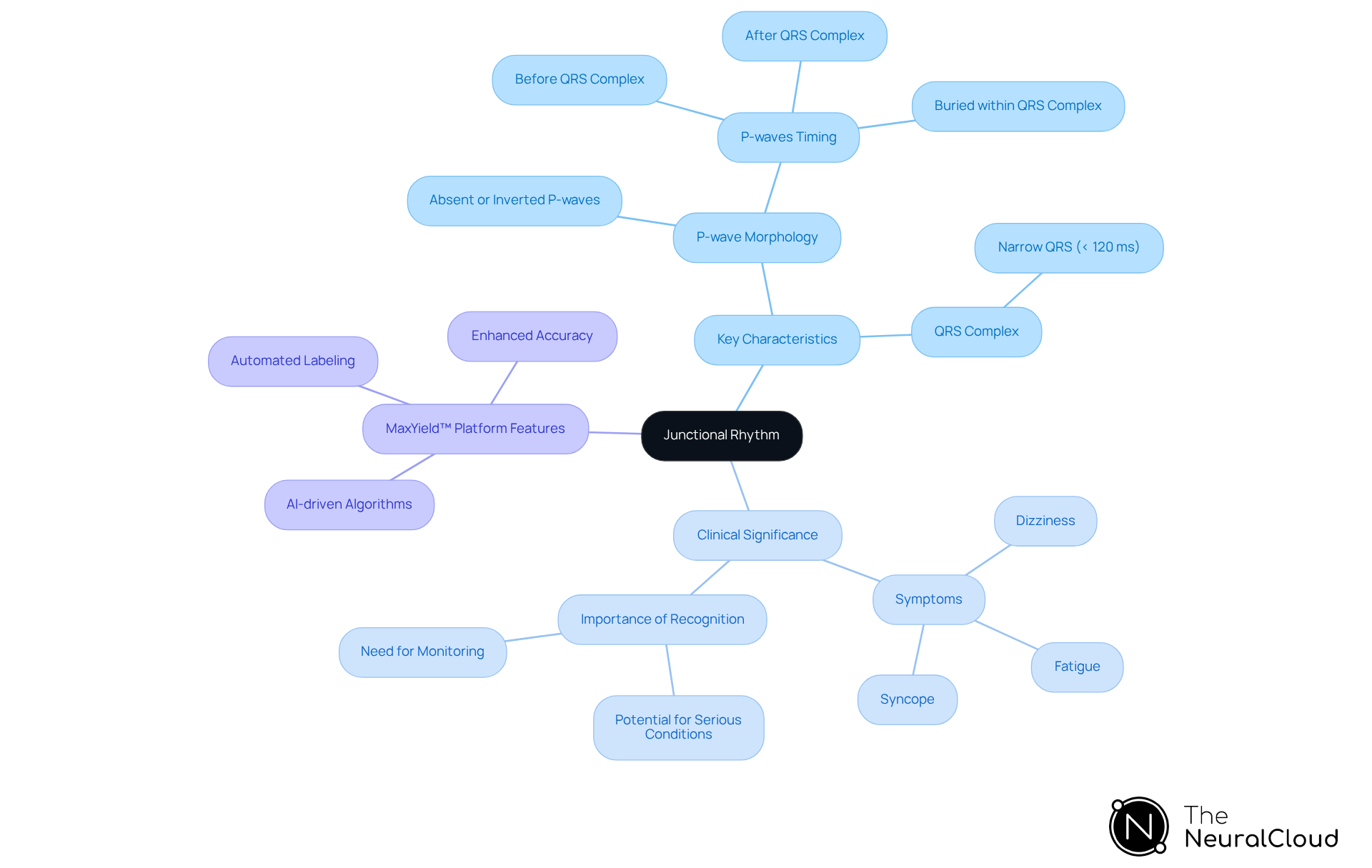
Junctional rhythm, often referred to as nodal activity, arises when electrical impulses originate from the atrioventricular (AV) node or His bundle rather than the sinoatrial (SA) node. This results in a heart rate typically ranging from 40 to 60 beats per minute for escape patterns and 60 to 100 bpm for accelerated escape patterns. Key characteristics of junctional rhythm include:
- P-waves may be absent, inverted, or occur after the QRS complex, indicating that atrial depolarization is not initiated by the SA node. In cases of premature junctional contractions (PJCs), the P wave is often inverted and can appear before, after, or be hidden within the QRS complex.
- The QRS complex is generally narrow, measuring less than 120 milliseconds, reflecting normal ventricular conduction.
The clinical significance of junctional rhythm can indicate underlying conditions such as sick sinus syndrome or AV nodal dysfunction. Their identification is crucial, as they may lead to symptoms like dizziness, fatigue, or syncope if not promptly recognized. For instance, a patient with bradycardia may exhibit a heart rate as low as 47 BPM while awake, necessitating careful monitoring and potential intervention.
Understanding the junctional rhythm on ECG is vital for accurate diagnosis and treatment planning in clinical practice. Recent studies highlight the importance of recognizing these patterns, as they can signal significant cardiac issues and require tailored management strategies. Clinicians must assess the relationship between P waves and QRS complexes to accurately identify the junctional rhythm, ensuring effective patient care. Furthermore, addressing underlying causes is essential, which may involve adjusting medications or considering the insertion of a permanent pacemaker in symptomatic cases.
The platform from Neural Cloud Solutions enhances the efficiency of ECG analysis by automating labeling and tackling challenges such as physiological variability and signal artifacts. This ultimately leads to improved patient outcomes. Key features of the platform include:
- Advanced algorithms: These ensure seamless signal processing during the analysis and annotation of abnormal electrocardiograms.
- Time-saving tools: This feature streamlines the ECG analysis process, saving time for healthcare professionals.
- Enhanced Accuracy: By addressing signal artifacts, the platform improves the reliability of ECG interpretations.
In summary, the platform not only simplifies ECG analysis but also enhances the accuracy and efficiency of clinical handling of junctional rhythm patterns, ultimately benefiting healthcare professionals and their patients.
Analyze ECG Features: Identifying Junctional Rhythm Patterns
To effectively identify junctional rhythms on an ECG, developers should focus on several key features:
- Heart rate: Ensure the heart rate falls within the range of 40-60 bpm. This is essential for accurate diagnosis, as the junctional rhythm typically exhibits this rate.
- P-waves: Assess the presence or absence of P-waves. In junctional rhythms, P-waves may appear before or appear after the QRS complex, which reflects the unique conduction characteristics associated with these rhythms.
- QRS complex: Verify that the QRS complex is narrow, usually measuring under 120 ms. A narrow QRS complex indicates conduction through the ventricles, which is a hallmark of junctional rhythms.
- Pattern consistency: Evaluate the consistency of the pattern. A regular pattern features consistent R-R intervals, while irregular patterns may vary by more than two small boxes, offering critical diagnostic insights.
- Common patterns: Familiarize yourself with common and accelerated junctional patterns. Understanding these patterns enhances recognition skills and aids in differentiating junctional rhythms from other arrhythmias.
By concentrating on these features, developers can enhance their ECG interpretation skills, leading to more accurate diagnoses and improved patient outcomes.

Implement ECG Interpretation: Step-by-Step Guide for Clinical Application
To effectively implement ECG interpretation, it’s crucial to follow a structured approach that enhances accuracy and efficiency. Here’s how the process addresses the challenges in ECG analysis:
- Data Acquisition: The platform collects high-quality ECG data from various sources, such as hospitals and wearable ECG devices. This ensures that the data reflects a wide range of patient conditions, providing a comprehensive view of cardiac health.
- Preprocessing: Techniques are employed to enhance signal clarity. Methods like low-pass filters eliminate high-frequency noise, while adaptive thresholding identifies and removes artifacts that can obscure true ECG signals, leading to more reliable interpretations.
- Feature Extraction: The platform implements algorithms to extract critical features, including heart rate, rhythm classification, and QRS duration. This step is vital for precise beat classification, utilizing techniques like wavelet transforms.
- Beat Classification: Strong classification algorithms are created to differentiate junctional rhythms from other arrhythmias. By employing machine learning models, particularly convolutional neural networks (CNNs), the platform analyzes extracted features, significantly improving classification accuracy.
- Validation: The algorithms undergo rigorous testing against a dataset of known junctional rhythms. This ensures their accuracy and reliability in clinical applications, with performance metrics such as accuracy, sensitivity, and specificity being evaluated.
- Integration: Finally, the interpretation algorithms are seamlessly integrated into the clinical workflow. This enhances usability for healthcare professionals, facilitating decision-making, ultimately leading to improved patient outcomes.

Overcome Challenges: Enhancing ECG Clarity with Advanced Technology
To enhance ECG clarity and address common challenges, developers should consider several effective strategies:
- Noise Reduction: The technology employs algorithms that intelligently filter out noise and artifacts from ECG signals. This significantly improves data quality, ensuring clearer readings for patients.
- Machine Learning: MaxYield™ utilizes machine learning models that adapt to various ECG data types. This adaptability allows for better handling of physiological variability, ultimately enhancing diagnostic yield and accuracy.
- Data Integration: By combining data from various ECG devices, MaxYield™ creates a comprehensive analysis. This approach leverages the strengths of each device type, facilitating rapid labeling and processing of data.
- Continuous Improvement: The platform establishes a feedback loop where it learns from new data. This continuous learning process enhances its accuracy and efficiency in ECG interpretation, evolving with each use.
- User Training: To maximize the capabilities of the platform, targeted training resources are essential. Providing workshops and online tutorials for users ensures they can effectively utilize the platform in clinical practice.

Conclusion
Understanding junctional rhythm on an ECG is essential for healthcare professionals, as it plays a critical role in diagnosing and managing various cardiac conditions. This rhythm, which arises from the AV node or His bundle, presents unique characteristics that differentiate it from other arrhythmias. Recognizing these traits is vital for effective patient care and intervention.
The MaxYield™ platform addresses the challenges in ECG analysis by streamlining interpretation and enhancing diagnostic capabilities. Key features include:
- AI-driven algorithms
- Automated labeling
These advancements not only improve accuracy but also save time for healthcare providers, allowing them to focus on patient care.
By integrating the MaxYield™ platform into their practice, clinicians can navigate the complexities of junctional rhythm more effectively. The advantages are clear: improved diagnostic precision leads to better patient outcomes. As the landscape of ECG analysis evolves, embracing such innovations is crucial for staying at the forefront of cardiac care.
In conclusion, adopting best practices in ECG interpretation and leveraging advanced technology like the MaxYield™ platform ensures that practitioners are well-equipped to meet the challenges of contemporary medical practice. By enhancing accuracy and efficiency, healthcare professionals can provide timely, effective care, ultimately benefiting their patients.
Frequently Asked Questions
What is junctional rhythm?
Junctional rhythm, also known as nodal activity, occurs when electrical impulses originate from the atrioventricular (AV) node or His bundle instead of the sinoatrial (SA) node, typically resulting in a heart rate of 40 to 60 beats per minute for escape patterns and 60 to 100 bpm for accelerated escape patterns.
What are the key characteristics of junctional rhythm?
Key characteristics include: - P-wave Morphology: P-waves may be absent, inverted, or occur after the QRS complex, indicating that atrial depolarization is not initiated by the SA node. In premature junctional complexes (PJCs), the P wave is often inverted and may appear before, after, or be hidden within the QRS complex. - QRS Complex: The QRS complex is generally narrow, measuring less than 120 milliseconds, reflecting normal ventricular conduction.
What is the clinical significance of junctional rhythm?
Junctional rhythm can indicate underlying conditions such as sick sinus syndrome or AV nodal dysfunction. If not recognized promptly, it may lead to symptoms like dizziness, fatigue, or syncope. For example, a patient with bradycardia may have a heart rate as low as 47 BPM while awake, requiring careful monitoring and potential intervention.
How can junctional rhythm be identified on an ECG?
Identification involves assessing the relationship between P waves and QRS complexes. Recognizing these patterns is vital for accurate diagnosis and treatment planning in clinical practice.
What role does the MaxYield™ platform play in ECG analysis?
The MaxYield™ platform enhances the efficiency of ECG analysis by automating labeling and addressing challenges such as physiological variability and signal artifacts, ultimately improving patient outcomes.
What are the key features of the MaxYield™ platform?
Key features include: - AI-driven Algorithms: These ensure seamless signal processing during the analysis and annotation of abnormal electrocardiograms. - Automated Labeling: This feature streamlines the ECG analysis process, saving time for healthcare professionals. - Enhanced Accuracy: The platform improves the reliability of ECG interpretations by addressing signal artifacts.
Why is it important to address underlying causes of junctional rhythm?
Addressing underlying causes is essential for effective treatment, which may involve adjusting medications or considering the insertion of a permanent pacemaker in symptomatic cases.
List of Sources
- Define Junctional Rhythm: Key Characteristics and Clinical Significance
- Junctional Rhythm: Causes, Symptoms and Treatment (https://my.clevelandclinic.org/health/diseases/23206-junctional-rhythm)
- Junctional Rhythms (https://aclscertification.org/ecg-course-advanced-junctional-rhythms)
- pmc.ncbi.nlm.nih.gov (https://pmc.ncbi.nlm.nih.gov/articles/PMC9453362)
- Junctional Rhythm - StatPearls - NCBI Bookshelf (https://ncbi.nlm.nih.gov/books/NBK507715)
- Analyze ECG Features: Identifying Junctional Rhythm Patterns
- Junctional Rhythm - StatPearls - NCBI Bookshelf (https://ncbi.nlm.nih.gov/books/NBK507715)
- litfl.com (https://litfl.com/junctional-escape-rhythm-ecg-library)
- practicalclinicalskills.com (https://practicalclinicalskills.com/junctional-rhythms)
- thevisualnurse.com (https://thevisualnurse.com/blog/junctional-rhythm-recognition-on-ecg-for-new-nurses-and-students)
- Implement ECG Interpretation: Step-by-Step Guide for Clinical Application
- Junctional Rhythms (https://aclscertification.org/ecg-course-advanced-junctional-rhythms)
- AI-Powered ECG Analysis Offers Promising Path for Early Detection of Chronic Obstructive Pulmonary Disease, Say Mount Sinai Researchers (https://mountsinai.org/about/newsroom/2026/ai-powered-ecg-analysis-offers-promising-path-for-early-detection-of-chronic-obstructive-pulmonary-disease-say-mount-sinai-researchers)
- practicalclinicalskills.com (https://practicalclinicalskills.com/junctional-rhythms)
- 1st synthesized 12-lead ECG to launch in 2026 (https://beckershospitalreview.com/supply-chain/1st-synthesized-12-lead-ecg-to-launch-in-2026)
- pmc.ncbi.nlm.nih.gov (https://pmc.ncbi.nlm.nih.gov/articles/PMC10490810)