Introduction
Understanding left ventricular (LV) function is crucial for effective cardiovascular care, as it significantly impacts the heart's ability to pump oxygenated blood throughout the body. This article explores the latest techniques and technologies available to health tech developers, emphasizing the importance of accurate LV function assessment in diagnosing and managing cardiac conditions. With advancements in echocardiography, artificial intelligence, and wearable technology, healthcare professionals face the challenge of leveraging these innovations. How can they optimize patient outcomes and streamline clinical workflows?
By addressing these questions, we can better appreciate the role of LV function assessment in modern healthcare. The integration of cutting-edge technologies not only enhances diagnostic accuracy but also supports more effective treatment strategies. As we delve deeper into this topic, we will highlight the features, advantages, and benefits of these advancements, ensuring that both technical and non-technical readers can grasp the significance of these developments.
Define Left Ventricular Function and Its Clinical Significance
The left ventricular function is vital for the heart's ability to contract and effectively circulate oxygenated blood throughout the body. This performance is primarily assessed through ejection fraction, which indicates the percentage of blood expelled from the ventricle with each heartbeat. Ejection fraction is crucial for diagnosing various heart conditions, including heart failure, ischemic heart disease, and cardiomyopathies. Clinicians depend on precise assessments of left ventricular function to inform treatment strategies, monitor disease progression, and evaluate the effectiveness of therapeutic interventions.
The medical significance of the left ventricular function is underscored by its role in cardiovascular health. For instance, reduced ejection fraction is associated with a significantly increased risk of adverse cardiovascular events. Research indicates that cardiac failure affects approximately 6.5 million adults in the United States, highlighting the importance of the left ventricular function in clinical practice. A normal EF typically ranges from 55% to 70%, with values below 40% often suggesting heart failure or cardiomyopathy.
Moreover, advanced metrics like global longitudinal strain (GLS) have become essential for identifying early heart dysfunction. An LVGLS of less than 14.7% is linked to more than a 2.5-fold increase in the risk of mortality. Understanding the left ventricular function not only aids in medical decision-making but also enhances patient outcomes through timely and appropriate interventions.
Assess Left Ventricular Function Using Echocardiographic Techniques
Echocardiography is considered the gold standard for evaluating LV function, employing several key techniques that enhance diagnostic accuracy and reliability.
- Two-Dimensional Echocardiography: This technique provides a detailed visual representation of the heart's structure and function. It enables precise measurements of chamber sizes and identifies wall motion abnormalities. Particularly effective in assessing left ventricular ejection fraction, normal ranges are established at 72-52% for men and 74-54% for women. Values below 52% in men and 54% in women indicate reduced function, with further classifications of mild (51-41% for men and 53-41% for women) and moderate (40-30% for both genders).
- Doppler Echocardiography: By utilizing sound waves, this method evaluates blood flow across heart valves. This method offers essential insights into diastolic performance and pressure gradients, making it crucial for diagnosing diastolic dysfunction, which is common in various cardiovascular diseases.
- Tissue Doppler Imaging: TDI measures myocardial motion velocities, providing a sensitive evaluation of LV performance, especially in the early stages of dysfunction. This technique can reveal subtle changes in myocardial performance that may not be apparent through traditional methods.
- Speckle Tracking Echocardiography: An advanced modality, speckle tracking evaluates myocardial strain, offering valuable information on the deformation of heart muscle during contraction and relaxation. This technique enhances the understanding of regional myocardial activity and is particularly beneficial in stress echocardiography to identify significant coronary artery stenosis.
Together, these echocardiographic methods allow clinicians to gain a comprehensive perspective of LV function, which aids in prompt and accurate diagnoses. Recent advancements in echocardiography, including the integration of new echocardiographic variables introduced since the 2016 ASE/EACVI guidelines, further enhance assessment accuracy, ensuring healthcare professionals can make informed decisions based on reliable data.

Interpret Key Metrics of Left Ventricular Function for Clinical Decision-Making
Key metrics for assessing left ventricular function include:
- Ejection Fraction: This is a critical measure of systolic function. EF is calculated by dividing the volume of blood pumped out of the left ventricle by the total volume of blood in the ventricle at the end of diastole. A low EF indicates heart dysfunction.
- Strain: This metric provides insights into myocardial deformation and is sensitive to early changes in cardiac function, often detecting issues before EF declines.
- Filling Pressures: These assess how well the heart fills with blood, which is crucial for overall cardiac performance.
Understanding these metrics allows healthcare professionals to apply the findings to make informed clinical decisions. This includes determining the initiation of therapies and the need for further interventions.

Explore Advanced Technologies and Their Impact on LV Function Analysis
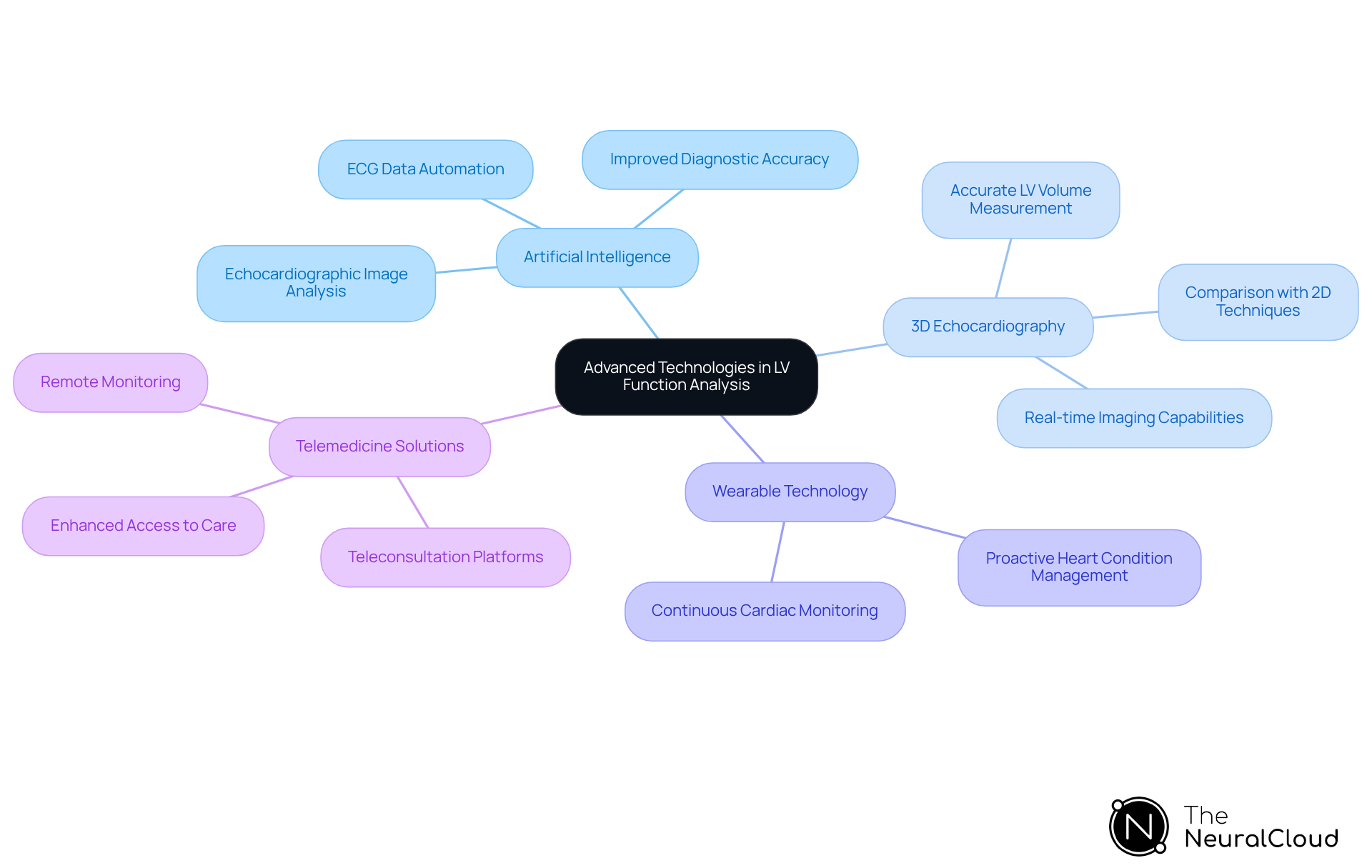
Recent advancements in technology are transforming the assessment of left ventricular function, with several key innovations leading the way:
- AI algorithms are increasingly utilized to analyze echocardiographic images and ECG data. This automation significantly reduces analysis time and enhances accuracy, facilitating more reliable assessments of the LV function.
- Three-dimensional echocardiography offers a more accurate depiction of LV volumes and performance by eliminating geometric assumptions present in conventional methods. A systematic review revealed that three-dimensional echocardiography is more accurate than two-dimensional echocardiography for measuring LV function. For instance, three-dimensional echocardiography underestimates LV end-diastolic volume by approximately 19.1 ml, compared to 48.2 ml for two-dimensional echocardiography, showcasing its superior accuracy.
- Wearable devices consist of sensors that continuously track heart activity, offering invaluable data on the LV function. This continuous data stream allows for proactive management of heart conditions, enabling timely interventions when necessary.
- Telehealth solutions, such as remote monitoring and teleconsultation platforms, facilitate the assessment of LV function without the need for in-person visits. This innovation enhances access to care and enables healthcare providers to make decisions based on real-time data.
These technological advancements not only enhance the assessment process but also streamline patient management, ultimately leading to improved patient outcomes. The integration of telehealth solutions and AI in routine practice is expected to further refine the assessment of LV function, making it a cornerstone of modern cardiology.
Conclusion
Mastering left ventricular (LV) function is essential for healthcare professionals committed to enhancing cardiac health. Accurately assessing LV function through various echocardiographic techniques and advanced technologies is crucial, as these methods significantly inform clinical decision-making and improve patient outcomes.
Key insights include the importance of metrics such as ejection fraction (EF) and global longitudinal strain (GLS) in evaluating LV performance. Echocardiography stands out as the gold standard for assessment, utilizing techniques like:
- 2D echocardiography
- Doppler imaging
- The innovative applications of artificial intelligence
- 3D imaging technologies
These advancements not only enhance diagnostic accuracy but also enable timely interventions, which are vital for effective management of cardiovascular conditions.
As technology evolves, integrating innovative solutions in LV function analysis will be pivotal in shaping the future of cardiology. Embracing these advancements empowers healthcare professionals to provide more precise, efficient, and patient-centered care. By prioritizing mastery of LV function assessment techniques, clinicians can significantly influence heart disease management, ultimately leading to improved health outcomes for patients.
Frequently Asked Questions
What is left ventricular (LV) function and why is it important?
Left ventricular function refers to the heart's ability to contract and effectively circulate oxygenated blood throughout the body. It is vital for overall cardiovascular health.
How is left ventricular function assessed?
Left ventricular function is primarily assessed through ejection fraction (EF), which indicates the percentage of blood expelled from the ventricle with each heartbeat.
Why is the accurate evaluation of LV function crucial?
Accurate evaluation of LV function is crucial for diagnosing various cardiac conditions, including heart failure, ischemic heart disease, and cardiomyopathies. It helps inform treatment strategies, monitor disease progression, and evaluate the effectiveness of therapeutic interventions.
What is the clinical significance of impaired LV function?
Impaired LV function is associated with a significantly increased risk of adverse cardiovascular events. It is important for risk stratification in patients with cardiovascular issues.
What is the typical range for a normal ejection fraction (EF)?
A normal ejection fraction typically ranges from 55% to 70%. Values below 40% often suggest heart failure or cardiomyopathy.
What advanced metrics are used to assess LV function?
Advanced metrics like global longitudinal strain (GLS) are used to identify early myocardial dysfunction. An LVGLS of less than 14.7% is linked to more than a 2.5-fold increase in the risk of mortality.
How does understanding LV function benefit patient outcomes?
Understanding LV function aids in medical decision-making and enhances patient outcomes through timely and appropriate interventions.
List of Sources
- Define Left Ventricular Function and Its Clinical Significance
- droracle.ai (https://droracle.ai/articles/392774/what-is-left-ventricular-lv-function)
- jacc.org (https://jacc.org/doi/10.1016/j.jcmg.2018.11.005)
- sciencedirect.com (https://sciencedirect.com/science/article/abs/pii/S0964339718302751)
- Ejection Fraction Heart Failure Measurement (https://heart.org/en/health-topics/heart-failure/diagnosing-heart-failure/ejection-fraction-heart-failure-measurement)
- Assess Left Ventricular Function Using Echocardiographic Techniques
- Left ventricular function | 123sonography (https://123sonography.com/blog/common-topics/left-ventricular-function)
- pubmed.ncbi.nlm.nih.gov (https://pubmed.ncbi.nlm.nih.gov/18165124)
- LV function assessment - Alberta Sono (https://albertasono.ca/echo-2/lv-function-assessment)
- Left Ventricular Diastolic Function – ASE (https://asecho.org/guideline/left-ventricular-diastolic-function-by-echo)
- Interpret Key Metrics of Left Ventricular Function for Clinical Decision-Making
- Left ventricular function | 123sonography (https://123sonography.com/blog/common-topics/left-ventricular-function)
- Ejection Fraction Heart Failure Measurement (https://heart.org/en/health-topics/heart-failure/diagnosing-heart-failure/ejection-fraction-heart-failure-measurement)
- newsroom.heart.org (https://newsroom.heart.org/news/combination-pill-for-heart-failure-improved-heart-function-symptoms-and-quality-of-life)
- Explore Advanced Technologies and Their Impact on LV Function Analysis
- pmc.ncbi.nlm.nih.gov (https://pmc.ncbi.nlm.nih.gov/articles/PMC3773600)
- ecrjournal.com (https://ecrjournal.com/articles/advances-live-3d-echocardiography?language_content_entity=en)
- Year in Review: Evidence Around AI in Cardiology Grows (https://tctmd.com/news/year-review-evidence-around-ai-cardiology-grows)
- cfrjournal.com (https://cfrjournal.com/articles/role-automated-3d-echocardiography-left-ventricular-ejection-fraction-assessment?language_content_entity=en)
- pmc.ncbi.nlm.nih.gov (https://pmc.ncbi.nlm.nih.gov/articles/PMC7527391)