Introduction
Understanding the complexities of electrocardiography (ECG) is crucial for health tech developers who want to improve diagnostic accuracy and enhance patient outcomes. As the need for effective cardiac monitoring grows, recognizing the importance of normal ECG values and their interpretation becomes vital. However, given the intricate nature of ECG readings and the risk of misdiagnosis, how can developers utilize the latest technologies to interpret these essential signals accurately? This article explores the core components of ECGs, outlines the key characteristics of normal readings, and highlights advanced tools that can revolutionize ECG analysis, ultimately leading to more effective healthcare solutions.
Explain the Fundamentals of Electrocardiography
Electrocardiography (ECG) serves as a vital diagnostic tool that captures the heart's electrical activity through electrodes placed on the skin. This process provides a graphical representation, which is essential for diagnosing various cardiac conditions. However, ECG interpretation can present challenges, particularly in accurately interpreting the components that reflect heart health.
The fundamental components of an ECG include:
- P Wave: Represents atrial depolarization, typically lasting around 80 milliseconds, indicating the heart's electrical activity from the atria.
- QRS Complex: Signifies ventricular depolarization, with a duration that is crucial for assessing the heart's pumping ability, typically ranging from 80 to 100 milliseconds.
- T Wave: Reflects ventricular repolarization, usually upright in most leads except for lead aVR, which is crucial for understanding the heart's recovery phase.
- Intervals: Key intervals include the PR interval (120 to 200 milliseconds) and the QT interval (corrected QT ideally ≤ 0.40 seconds), which are critical for evaluating the timing related to electrical conduction through the heart.
By 2026, approximately 70% of healthcare professionals are expected to utilize ECGs for cardiac diagnosis, highlighting the method's prevalence in clinical practice. Cardiologists emphasize the importance of accurately interpreting these components, as it can significantly impact patient outcomes. For instance, understanding the nuances of the P wave, QRS complex, and T wave can lead to improved diagnosis.
Advanced platforms like Neural Cloud Solutions' innovative technology automate the examination of these components, mapping ECG signals through noise and isolating key features in every heartbeat. This system delivers rapid analysis, providing insights from 200,000 heartbeats in less than 5 minutes. Such technology enhances diagnostic accuracy and streamlines workflow, ultimately improving patient care. Furthermore, real-world applications of this product demonstrate its effectiveness in clinical settings, allowing clinicians to focus on high-level decision-making rather than manual tasks.
The recent advancements exemplify the advancements in ECG technology that are shaping cardiac care. These innovations not only improve the efficiency of diagnosis but also ensure that healthcare professionals can provide better care for their patients.

Identify Key Characteristics of Normal ECGs
exhibit distinct features crucial for accurate analysis, and leveraging advanced tools can significantly enhance this process. Here’s a closer look at the key features:
- Heart Rate: Typically, 60-100 bpm, with variations influenced by age and fitness levels. For example, well-trained athletes might have resting heart rates as low as 40 bpm, while a heart rate consistently above 90 bpm could signal potential health concerns. The normal range for a 30-year-old is 95-162 bpm; for a 40-year-old, 90-153 bpm; and for a 50-year-old, 85-145 bpm.
- Rhythm: A regular rhythm that originates from the sinoatrial node, known as sinus rhythm, is vital for normal cardiac function. This rhythm shows consistent intervals between beats, reflecting stability.
- P Waves: These waves appear before each QRS complex and should be uniform in shape and rounded, indicating proper atrial depolarization. The system aids in interpretation, ensuring reliable interpretation.
- QRS Complex: This complex should be narrow (80-100 milliseconds) and consistent, reflecting effective ventricular depolarization. Abnormalities in QRS duration can indicate conduction issues, making it essential to distinguish between normal and pathological Q-waves.
- T Waves: Typically upright in leads I, II, and V3-V6, T waves may be inverted in lead aVR, which is a normal variant. Understanding T wave morphology is crucial, as inversions in contiguous leads can suggest underlying cardiac conditions. This system provides detailed insights into T wave characteristics.
- Intervals: According to guidelines, the PR interval should be 120-200 milliseconds, while the QT interval should be ≤ 0.40 seconds. Prolonged QT intervals can heighten the risk of arrhythmias, making accurate measurement vital. This system facilitates precise interval measurements, enhancing diagnostic accuracy.
These characteristics establish a foundational baseline for developers to create algorithms that accurately identify deviations indicating potential cardiac issues. By utilizing MaxYield™, which maps ECG signals through noise and offers beat-by-beat analysis, developers can significantly improve the efficacy of ECG analysis tools. Current research underscores the importance of these features in diagnosing various cardiac conditions, including ischemia and arrhythmias, ultimately improving patient outcomes.

Analyze ECG Readings: A Step-by-Step Guide
Analyzing ECG readings requires a structured methodology to ensure precise interpretation. Here’s a step-by-step guide to enhance your understanding:
- Count the number of R peaks in a 6-second strip and multiply by 10 to estimate beats per minute (bpm), which is crucial for identifying potential issues.
- Evaluate the Rhythm: Determine if the rhythm is regular or irregular by measuring the intervals between R peaks, with studies showing that up to 30% of patients may present with arrhythmias, highlighting the importance of careful evaluation.
- Confirm the presence of P waves before each QRS complex, ensuring they are uniform. Irregularities in P waves are essential for accurate diagnosis and treatment planning.
- Measure the PR Interval: Calculate the duration from the beginning of the P wave to the start of the QRS complex; it should be between 120-200 milliseconds. A PR interval outside this range can indicate conduction abnormalities, which may require further investigation.
- Measure the QRS Duration: Measure its duration; it should be 80-100 milliseconds. Prolonged QRS complexes may signal issues such as bundle branch blocks, necessitating prompt attention.
- Examine the T Waves: Assess their amplitude. Inverted T waves can offer insights into myocardial ischemia or infarction, making this step critical for patient assessment.
- Measure the QT Interval: Measure from the start of the QRS complex to the end of the T wave; it should be ≤ 0.40 seconds. Prolonged QT intervals are associated with arrhythmias, underscoring the need for thorough analysis.
By adhering to these steps, developers can design algorithms that replicate this analytical process, enhancing the accuracy of ECG interpretation and ultimately improving patient outcomes.

Utilize Advanced Technologies for Enhanced ECG Analysis
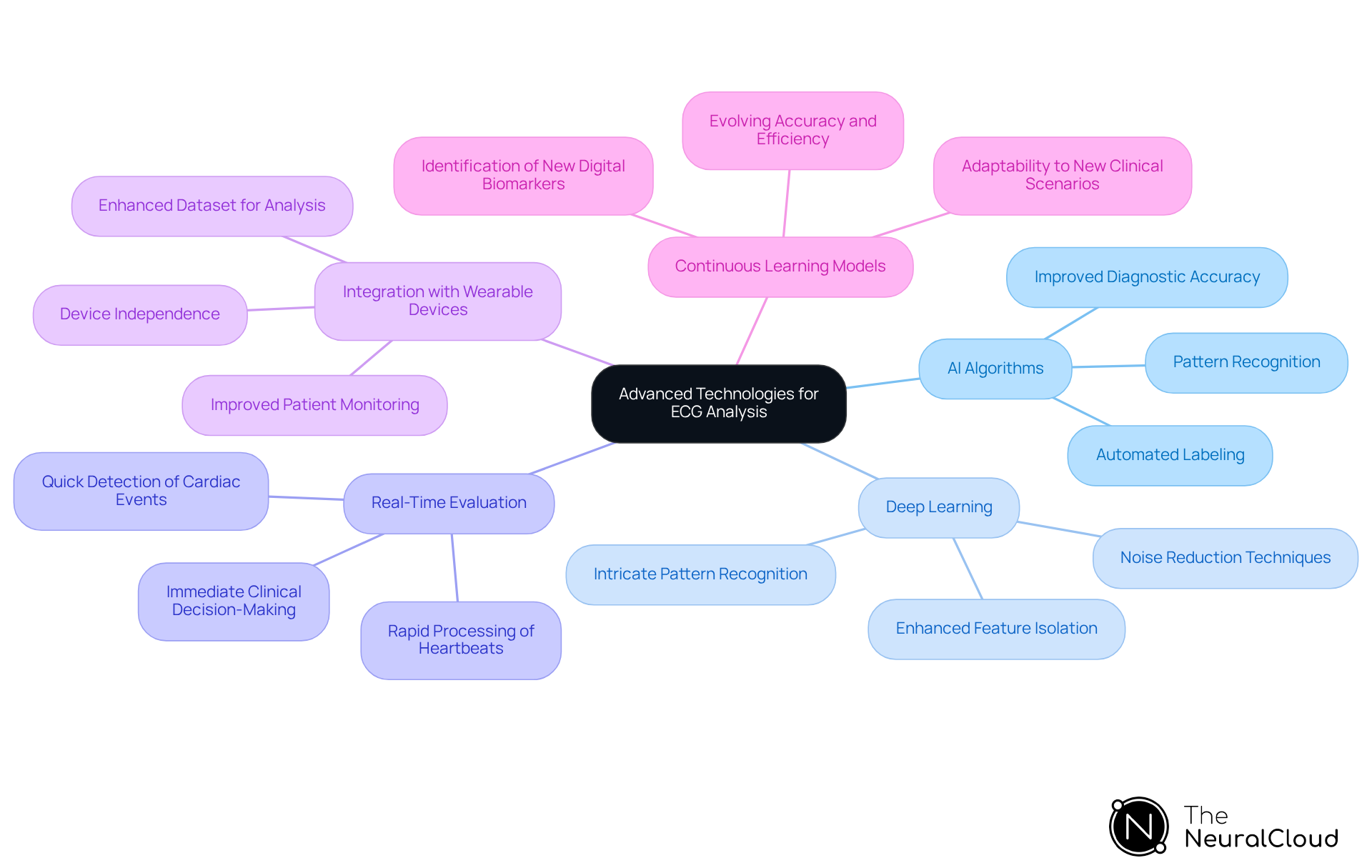
Advanced technologies, particularly AI and machine learning, are revolutionizing healthcare. However, challenges persist in accurately interpreting ECG data, which can lead to misdiagnoses and delayed treatments. The industry addresses these challenges by integrating cutting-edge technologies that enhance analysis.
- Machine Learning: The platform utilizes machine learning algorithms to analyze extensive datasets of ECG readings. This capability allows for the identification of patterns and anomalies, significantly improving diagnostic accuracy. For instance, the 'Neural Cloud Solutions' platform automates the labeling of P, QRS, and T wave onsets and offsets, providing beat-by-beat evaluations that enhance diagnostic precision.
- Deep Learning: Techniques within MaxYield™ greatly enhance ECG interpretation. They recognize intricate patterns that traditional methods often overlook. By employing advanced noise reduction techniques, the system isolates key features in every heartbeat, delivering clear insights even from noisy recordings.
- Real-Time Evaluation: The platform's ability to provide immediate feedback is crucial for immediate clinical decision-making, especially in emergencies. It processes 200,000 heartbeats in under 5 minutes, enabling quick detection of cardiac events and supporting confident clinical decisions.
- Integration with Wearable Devices: MaxYield™ enhances the dataset available for examination by integrating data from wearable devices. This leads to improved diagnostics and patient monitoring. The platform is device-independent, effortlessly capturing ECG recordings from various devices, including wearable monitors and Holter monitors, thus broadening the range of data available for evaluation.
- Adaptive Models: These models evolve over time, enhancing their accuracy and efficiency as they process more data. This adaptability is vital for addressing new clinical scenarios. Neural Cloud Solutions develops neural network models that not only improve performance but also assist in identifying new digital biomarkers across various industries.
By incorporating these advanced technologies, the platform offers innovative solutions that significantly enhance the quality and reliability of ECG analysis, ultimately leading to improved patient outcomes.
Conclusion
Mastering the nuances of normal ECG numbers is crucial for health tech developers focused on improving cardiac diagnostics. A solid grasp of the fundamental components of electrocardiography - like the P wave, QRS complex, and T wave - forms the basis for accurate interpretation, ultimately leading to better patient outcomes. As the use of ECGs among healthcare professionals is expected to rise, the ability to interpret these signals effectively becomes increasingly vital.
Key insights throughout this article highlight:
- The importance of normal ECG parameters
- A step-by-step approach to analyzing ECG readings
- The significant role of advanced technologies such as AI and machine learning in boosting diagnostic accuracy
The focus on tools like MaxYield™ illustrates how automating ECG analysis can tackle common challenges faced by clinicians, ensuring timely and precise evaluations.
As cardiac care continues to evolve, it is essential for developers and healthcare professionals to adopt these advancements. By utilizing innovative technologies and following established ECG analysis protocols, the potential for enhanced patient care and outcomes is considerable. Engaging with these insights not only improves individual skills but also contributes to the overarching goal of raising healthcare standards in cardiology.
Frequently Asked Questions
What is electrocardiography (ECG)?
Electrocardiography (ECG) is a diagnostic tool that captures the heart's electrical activity through electrodes placed on the skin, providing a visual representation of electrical impulses essential for diagnosing various cardiac conditions.
What are the fundamental components of an ECG?
The fundamental components of an ECG include the P wave, QRS complex, T wave, and specific intervals like the PR interval and QT interval, each representing different phases of the heart's electrical activity.
What does the P wave represent in an ECG?
The P wave represents atrial depolarization, typically lasting around 80 milliseconds, indicating the heart's electrical activity from the atria.
What is the significance of the QRS complex in an ECG?
The QRS complex signifies ventricular depolarization, with a normal duration typically ranging from 80 to 100 milliseconds, which is crucial for assessing the heart's pumping ability.
What does the T wave indicate in an ECG?
The T wave reflects ventricular repolarization and is usually upright in most leads except for lead aVR, playing a critical role in understanding the heart's recovery phase.
What are the important intervals in an ECG?
Key intervals in an ECG include the PR interval, which should be between 120 to 200 milliseconds, and the QT interval, ideally corrected to be ≤ 0.40 seconds, both critical for evaluating electrical conduction timing through the heart.
How prevalent is the use of ECGs among healthcare professionals?
By 2026, approximately 70% of healthcare professionals are expected to utilize ECGs for cardiac diagnosis, highlighting the method's increasing prevalence in clinical practice.
Why is accurate interpretation of ECG components important?
Accurate interpretation of ECG components is vital as it can significantly impact patient outcomes, allowing for timely interventions in cases of arrhythmias or myocardial infarctions.
What advancements are being made in ECG technology?
Advanced platforms like Neural Cloud Solutions automate ECG examination, providing beat-by-beat analysis and enhancing diagnostic accuracy. Additionally, HeartBeam's 12-lead ECG synthesis software has received FDA clearance, improving efficiency in ECG analysis.
How do these technological advancements benefit clinical workflows?
These innovations streamline clinical workflows by allowing healthcare professionals to focus on high-level decision-making rather than manual tasks, ultimately improving patient care.
List of Sources
- Explain the Fundamentals of Electrocardiography
- medicaldevice-network.com (https://medicaldevice-network.com/news/alivecor-fda-nod-kardia-system)
- AI-driven ECG improves detection of severe heart attacks (https://news-medical.net/news/20251029/AI-driven-ECG-improves-detection-of-severe-heart-attacks.aspx)
- ECG Devices Market Size & Share, Growth Trends 2035 (https://researchnester.com/reports/ecg-devices-market/4241)
- AI-Powered ECG Analysis Offers Promising Path for Early Detection of Chronic Obstructive Pulmonary Disease, Say Mount Sinai Researchers (https://mountsinai.org/about/newsroom/2026/ai-powered-ecg-analysis-offers-promising-path-for-early-detection-of-chronic-obstructive-pulmonary-disease-say-mount-sinai-researchers)
- HeartBeam Receives FDA Clearance for First-Ever, Cable-Free Synthesized 12-Lead ECG for At-Home Arrhythmia Assessment (https://ir.heartbeam.com/news-events/press-releases/detail/107/heartbeam-receives-fda-clearance-for-first-ever-cable-free)
- Identify Key Characteristics of Normal ECGs
- heart.org (https://heart.org/en/healthy-living/fitness/fitness-basics/target-heart-rates)
- Normal Electrocardiography (ECG) Intervals: Normal Electrocardiography Intervals (https://emedicine.medscape.com/article/2172196-overview)
- ECG interpretation: Characteristics of the normal ECG (P-wave, QRS complex, ST segment, T-wave) – The Cardiovascular (https://ecgwaves.com/topic/ecg-normal-p-wave-qrs-complex-st-segment-t-wave-j-point)
- What your heart rate is telling you - Harvard Health (https://health.harvard.edu/heart-health/what-your-heart-rate-is-telling-you)
- Normal Heart Rate: Range, When It's Dangerous, Resting vs. Exercise (https://healthline.com/health/dangerous-heart-rate)
- Analyze ECG Readings: A Step-by-Step Guide
- AI-Powered ECG Analysis Offers Promising Path for Early Detection of Chronic Obstructive Pulmonary Disease, Say Mount Sinai Researchers (https://mountsinai.org/about/newsroom/2026/ai-powered-ecg-analysis-offers-promising-path-for-early-detection-of-chronic-obstructive-pulmonary-disease-say-mount-sinai-researchers)
- Normal Electrocardiography (ECG) Intervals: Normal Electrocardiography Intervals (https://emedicine.medscape.com/article/2172196-overview)
- Electrocardiogram - StatPearls - NCBI Bookshelf (https://ncbi.nlm.nih.gov/books/NBK549803)
- ECG Rate Interpretation (https://litfl.com/ecg-rate-interpretation)
- bookey.app (https://bookey.app/book/the-ecg-made-easy/quote)
- Utilize Advanced Technologies for Enhanced ECG Analysis
- AI-Powered ECG Analysis Offers Promising Path for Early Detection of Chronic Obstructive Pulmonary Disease, Say Mount Sinai Researchers (https://mountsinai.org/about/newsroom/2026/ai-powered-ecg-analysis-offers-promising-path-for-early-detection-of-chronic-obstructive-pulmonary-disease-say-mount-sinai-researchers)
- AI-driven ECG improves detection of severe heart attacks (https://news-medical.net/news/20251029/AI-driven-ECG-improves-detection-of-severe-heart-attacks.aspx)
- Checking your browser - reCAPTCHA (https://pmc.ncbi.nlm.nih.gov/articles/PMC10145690)
- Year in Review: Evidence Around AI in Cardiology Grows (https://tctmd.com/news/year-review-evidence-around-ai-cardiology-grows)
- New Data Show Viz.ai’s AI-Enabled ECG Screening Increases Detection and Accelerates Diagnosis of Hypertrophic Cardiomyopathy (https://hmpgloballearningnetwork.com/site/eplab/news/new-data-show-vizais-ai-enabled-ecg-screening-increases-detection-and-accelerates)