Introduction
Understanding the complexities of ECG interference is crucial for healthcare professionals who strive to provide accurate diagnostics. Various types of interference, ranging from electrical noise to motion artifacts, can significantly compromise the interpretation of ECG readings. This article explores advanced techniques and best practices that enhance the clarity of ECG signals, empowering clinicians to make informed decisions.
Healthcare providers face numerous challenges in navigating these interferences to ensure optimal patient outcomes. By implementing effective strategies, they can improve the accuracy of ECG analysis, ultimately benefiting patient care. The MaxYield™ platform offers innovative solutions designed to address these challenges, enhancing the overall diagnostic process.
Define ECG Interference: Types and Causes
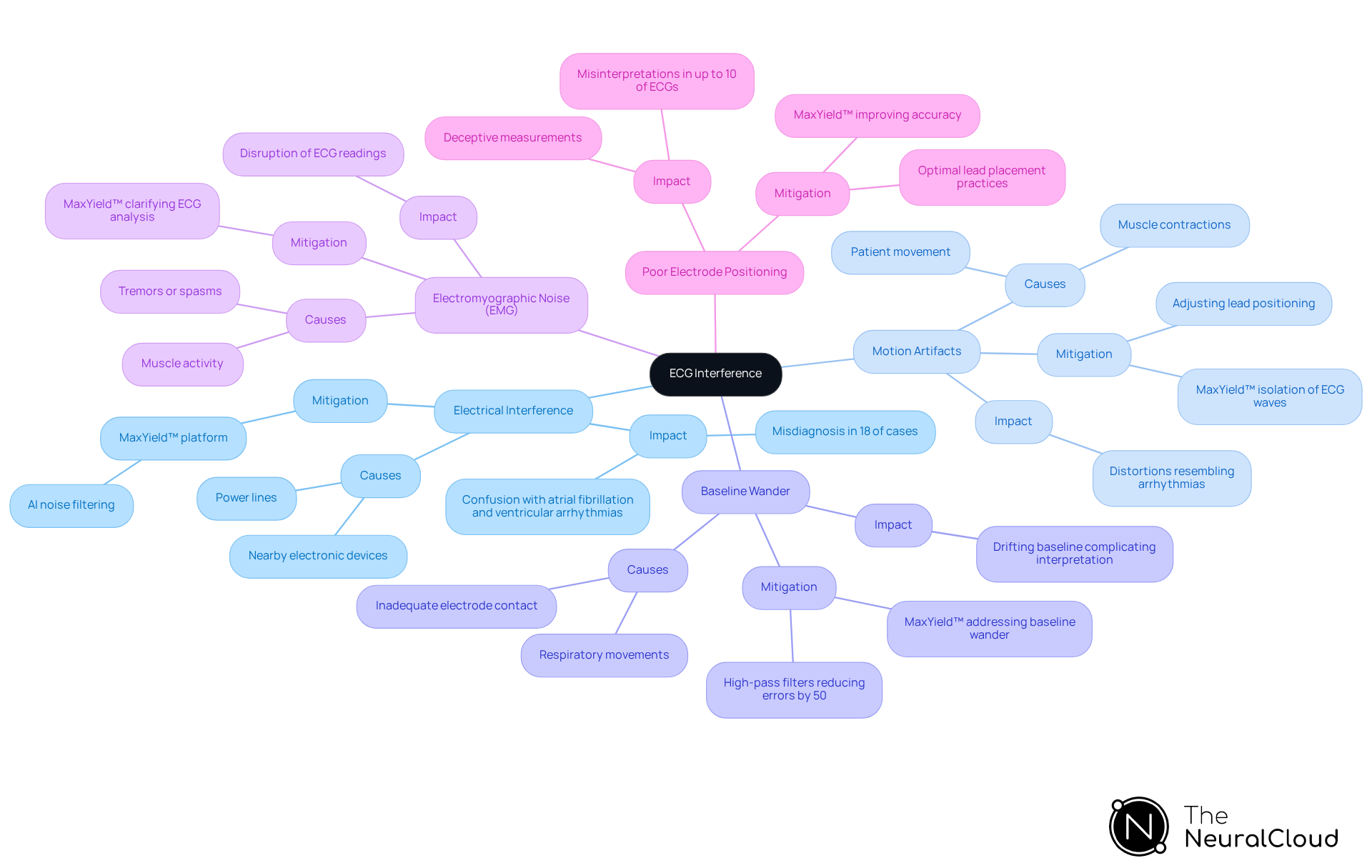
can significantly distort readings, potentially leading to misdiagnoses. Understanding the primary types of interference is crucial for clinicians to ensure accurate interpretation and improve patient outcomes. The main types of interference include:
- Electromagnetic Interference: Often generated by nearby electronic devices, such as power lines and medical equipment, this interference can introduce noise into the ECG reading. A study found that there was significant noise on machines when mobile phones were placed nearby, leading to misdiagnoses in 18% of cases, particularly confusion with atrial fibrillation and ventricular arrhythmias. The technology from Neural Cloud Solutions effectively identifies and filters out this noise using advanced AI technology, ensuring that critical data is accurately captured even in challenging environments.
- Motion Artifacts: Patient movement, including shifting or muscle contractions, can create artifacts that obscure the true cardiac reading. For instance, muscle tremors can produce distortions resembling arrhythmias, complicating interpretation. MaxYield™ quickly isolates ECG waves from recordings with artifacts caused by movement and muscle artifacts, enhancing clarity. Prioritizing patient comfort and adjusting lead positioning can help minimize these disturbances.
- Baseline Wander: This occurs due to respiratory movements or inadequate electrode contact, resulting in a drifting baseline that complicates interpretation. Employing high-pass filters can reduce baseline estimation errors by up to 50%, which helps to minimize confusion and enhances the reliability of analyses. MaxYield™ addresses baseline wander effectively, salvaging previously obscured sections of lengthy Holter and patch monitor recordings.
- Electromyographic Noise (EMG): Electrical signals that disrupt the ECG, especially in patients with tremors or spasms. This kind of noise can cause inaccurate readings, which is particularly challenging in clinical environments where precise measurements are essential. The advanced AI technology of MaxYield™ clarifies the ECG analyzing process, providing accurate and crisp signals to support workflow efficiency.
- Lead Misplacement: Incorrectly placed sensors can result in deceptive measurements, as the ECG device may not precisely record the heart's electrical activity. Research indicates that improper lead placement can lead to misinterpretations in up to 10% of ECGs. Neural Cloud Solutions' technology evolves with each use, continuously improving its accuracy and efficiency in overcoming these challenges.
By understanding these types of interference, healthcare professionals can leverage the insights to improve ECG analysis, ensuring more accurate diagnostics and better patient care.
Optimize Electrode Placement and Preparation Techniques
To achieve optimal ECG readings, effective electrode placement and preparation techniques are essential:
- Clean the skin at contact points thoroughly with alcohol wipes to remove oils and dirt. This step is crucial, as it enhances adhesion and ensures proper contact, directly impacting the accuracy of ECG readings.
- Adhere to standardized positions for sensors, such as those in the 12-lead configuration, to accurately capture the heart's electrical activity. Misplacement can lead to significant diagnostic errors; studies indicate that incorrect placement can severely affect diagnostic accuracy.
- Utilize Quality Conductors: Opt for premium conductors that ensure strong adhesion and conductivity. Pre-gelled conductors are particularly effective, streamlining the application process and enhancing transmission quality.
- Minimize Motion: Instruct patients to remain still during the ECG recording to reduce motion artifacts. If necessary, use supports or soft restraints to limit movement, as patient motion can introduce considerable noise into the data. Here, Neural Cloud Solutions' technology plays a vital role by filtering out noise and artifacts, ensuring accurate results even with movement or muscle interference.
- Regularly inspect terminal connections and cables for wear and tear. Defective connections can cause interference and reduce ECG output quality, leading to erroneous measurements.
- Change sensors daily to maintain optimal reading quality and prevent skin irritation, which can compromise measurement accuracy. This practice is crucial for preserving the integrity of the ECG waveform over time.
- Verify Limb Placement: Always check limb placement to avoid diagnostic errors, as incorrect placement can distort the heart's electrical activity. Ensuring correct placement is essential for accurate interpretation.
By implementing these techniques, healthcare professionals can significantly enhance the accuracy of ECG results. Moreover, utilizing advanced solutions like software tools helps address inefficiencies and improve data quality, facilitating accurate diagnoses and improving patient outcomes.

Implement Advanced Solutions for ECG Interference Mitigation
To effectively mitigate ECG interference, healthcare providers can consider several solutions:
- Digital filters, including low-pass, high-pass, and band-stop filters, can be applied to eliminate unwanted noise while preserving the integrity of the ECG waveform. These filters can be integrated into ECG machines or utilized during post-processing, significantly enhancing the clarity of the readings.
- Adaptive algorithms that filter out noise based on real-time data analysis can be employed. This technology dynamically adjusts to varying interference conditions, leading to a notable improvement in clarity. Research shows that adaptive filtering can reduce QRS interval differences to as low as 4.28 ms, demonstrating its effectiveness in practical applications.
- Monitoring systems that continuously check electrode impedance ensure optimal contact with the skin. This proactive approach helps identify and rectify issues before they impact ECG readings, thereby maintaining data integrity.
- Artificial intelligence algorithms can enhance accuracy in ECG readings. This not only enhances diagnostic accuracy but also alleviates the workload on healthcare professionals, allowing them to concentrate on critical decision-making. The MaxYield™ platform exemplifies this capability by leveraging advanced AI technology to improve ECG clarity and automate analysis.
- Patient education: Educating patients about the importance of remaining still and following instructions during the ECG process can minimize motion artifacts. Proper patient preparation significantly reduces disturbances, leading to more reliable ECG results.
By integrating these solutions into clinical practice, healthcare providers can enhance the quality of ECG data and minimize interference in ECG, thereby improving patient outcomes.

Summarize Key Strategies for Effective ECG Analysis
To achieve effective ECG analysis, healthcare professionals should focus on several key strategies:
- Understanding interference types, including electrical noise and motion artifacts, is crucial. Recognizing these allows for timely identification and resolution during analysis, ultimately enhancing diagnostic accuracy.
- Following proper electrode placement and skin preparation techniques is essential. Correct positioning reduces artifacts, which greatly enhances the quality of the output. Studies indicate that optimized electrode configurations can improve signal quality, thereby leading to more reliable interpretation outcomes.
- Utilize advanced tools: Implementing advanced algorithms and AI-driven analysis tools, such as MaxYield™, can effectively mitigate interference. MaxYield™ rapidly labels P, QRS, and T Wave onsets, offsets, and time-series intervals in a CSV format for easy ingestion into current workflows. This innovative technology enhances analysis efficiency, allowing for more accurate diagnoses and supporting the discovery of new digital biomarkers.
- Patient cooperation: Patient cooperation is vital for minimizing motion artifacts. Instructing patients to remain still and adhere to guidelines during the ECG process can significantly reduce noise, leading to clearer results.
- Regularly review techniques: Staying informed about the latest advancements in ECG technology and methodologies is essential for continuous improvement. Engaging with ongoing training and educational resources can help healthcare professionals refine their skills and adapt to evolving best practices.
By implementing these strategies and leveraging cutting-edge solutions like MaxYield™, healthcare professionals can enhance the accuracy and reliability of ECG analyses, ultimately leading to improved patient outcomes.

Conclusion
Understanding and addressing interference in ECG readings is crucial for accurate diagnostics and optimal patient care. Healthcare professionals face challenges such as electrical noise, motion artifacts, and baseline wander, which can compromise ECG analysis. By recognizing these types of interference, they can implement strategies to minimize their impact. Advanced technologies like Neural Cloud Solutions' MaxYield™ platform significantly enhance the clarity of ECG signals, leading to more precise interpretations.
The MaxYield™ platform offers several key features that improve ECG analysis:
- It utilizes sophisticated filtering techniques to reduce noise and artifacts, ensuring that the signals captured are as clear as possible.
- The platform supports optimal electrode placement, which is essential for accurate readings.
These features not only streamline the analysis process but also empower healthcare professionals to make informed decisions based on reliable data.
The advantages of using the MaxYield™ platform extend beyond just improved signal clarity. By embracing this technology, healthcare providers can enhance patient outcomes through more accurate diagnostics. Educating patients on the importance of remaining still during recordings further complements these efforts, ensuring that the data collected is of the highest quality. Regularly updating techniques in line with advancements in ECG technology keeps healthcare providers equipped to deliver exceptional care.
In conclusion, integrating best practices and innovative solutions like the MaxYield™ platform is essential for healthcare professionals dedicated to mastering ECG interference. By focusing on these strategies, they can significantly improve the accuracy of ECG readings and ultimately enhance patient care.
Frequently Asked Questions
What is ECG interference and why is it important to understand?
ECG interference refers to distortions in electrocardiogram readings that can lead to misinformed clinical decisions. Understanding it is crucial for clinicians to ensure accurate interpretation and improve patient outcomes.
What are the main types of interference in ECG readings?
The main types of interference in ECG readings include electrical interference, motion artifacts, baseline wander, electromyographic noise (EMG), and poor electrode positioning.
What causes electrical interference in ECG?
Electrical interference is often generated by nearby electronic devices, such as power lines and medical equipment, which can introduce noise into the ECG reading. For example, mobile phones placed near ECG machines can lead to misdiagnoses.
How do motion artifacts affect ECG readings?
Motion artifacts are caused by patient movement, such as shifting or muscle contractions, which can obscure the true cardiac reading and produce distortions resembling arrhythmias.
What is baseline wander and how does it impact ECG interpretation?
Baseline wander occurs due to respiratory movements or inadequate electrode contact, resulting in a drifting baseline that complicates ECG interpretation.
How can high-pass filters help with baseline wander?
High-pass filters can reduce baseline estimation errors by up to 50%, helping to minimize interference in ECG and enhancing the reliability of analyses.
What is electromyographic noise (EMG) and who is most affected by it?
EMG refers to electrical impulses produced by muscle activity that disrupt ECG readings, particularly challenging in patients with tremors or spasms.
How does poor electrode positioning affect ECG readings?
Incorrectly placed sensors can result in deceptive measurements, leading to misinterpretations in up to 10% of ECGs.
How does the MaxYield™ platform assist in overcoming ECG interference?
The MaxYield™ platform uses advanced AI technology to identify and filter out noise, isolate ECG waves from artifacts, clarify analysis processes, and improve the accuracy and efficiency of ECG readings.
List of Sources
- Define ECG Interference: Types and Causes
- theneuralcloud.com (https://theneuralcloud.com/post/10-key-artefact-ecg-issues-and-their-solutions)
- pubmed.ncbi.nlm.nih.gov (https://pubmed.ncbi.nlm.nih.gov/19824066)
- Memorable Cardiology Quotes | TheKnowHow Blog (https://theknowhow.ae/memorable-cardiology-quotes-heart)
- Guide to Understanding ECG Artifact | ACLS Training Blog (https://aclsmedicaltraining.com/blog/guide-to-understanding-ecg-artifact)
- arxiv.org (https://arxiv.org/html/2502.14522v1)
- Optimize Electrode Placement and Preparation Techniques
- thebiomedguys.com (https://thebiomedguys.com/blog/ecg-lead-positioning-complete-guide-to-3-5-and-12lead-electrode-placement?srsltid=AfmBOormumgiJ2cjABY9v01DjRhgFH7uzjFTxAChsv-Jl7-82cp3Ksn0)
- pmc.ncbi.nlm.nih.gov (https://pmc.ncbi.nlm.nih.gov/articles/PMC6832916)
- 12-Lead ECG Electrode Placement: Best Practices- (https://intcomedical.com/news/info/12-lead-ecg-electrode-placement-best-practices-for-clinical-accuracy-in-healthcare.html)
- AACN Updates Cardiac Monitoring Practice Alerts - AACN (https://aacn.org/newsroom/aacn-updates-cardiac-monitoring-practice-alerts)
- cardinalhealth.com (https://cardinalhealth.com/en/product-solutions/medical/patient-monitoring/electrocardiography/resources-for-electrodes/skin-preparation-tips.html)
- Implement Advanced Solutions for ECG Interference Mitigation
- AI-ECG Momentum and Rising Competition Reshape Diagnostic Cardiology in 2026 (https://signifyresearch.net/insights/diagnostic-cardiology-market-bouncing-into-2026)
- theneuralcloud.com (https://theneuralcloud.com/post/10-key-artefact-ecg-issues-and-their-solutions)
- pubmed.ncbi.nlm.nih.gov (https://pubmed.ncbi.nlm.nih.gov/41309790)
- ECG Noise Filtering Improves Clinical Accuracy (https://emjreviews.com/interventional-cardiology/news/ecg-noise-filtering-improves-clinical-accuracy)
- Summarize Key Strategies for Effective ECG Analysis
- HeartBeam Receives FDA Clearance for First-Ever, Cable-Free Synthesized 12-Lead ECG for At-Home Arrhythmia Assessment (https://ir.heartbeam.com/news-events/press-releases/detail/107/heartbeam-receives-fda-clearance-for-first-ever-cable-free)
- Checking your browser - reCAPTCHA (https://pmc.ncbi.nlm.nih.gov/articles/PMC7522782)
- medicaleconomics.com (https://medicaleconomics.com/view/ai-enabled-ecg-tool-detects-aortic-stenosis-years-before-intervention-study-finds)
- AI-ECG Momentum and Rising Competition Reshape Diagnostic Cardiology in 2026 (https://signifyresearch.net/insights/diagnostic-cardiology-market-bouncing-into-2026)