Introduction
Understanding the QT interval on an electrocardiogram (ECG) is crucial for anyone involved in cardiac health, as it serves as a key indicator of the heart's electrical activity. This article explores the importance of the normal QT interval, emphasizing its clinical implications and the technology that supports its accurate measurement. ECG analysis faces challenges due to various factors influencing QT duration, such as medications and physiological changes. This raises an important question: how can developers ensure their ECG analysis tools effectively address these complexities and improve patient outcomes?
The MaxYield™ platform offers innovative features designed to enhance ECG analysis. By integrating advanced algorithms, it provides precise measurements of the QT interval, allowing healthcare professionals to make informed decisions. This technology not only streamlines the analysis process but also reduces the risk of misinterpretation, ultimately benefiting patient care.
In summary, the MaxYield™ platform stands out by addressing the challenges in ECG analysis. Its features lead to improved accuracy and efficiency, empowering healthcare professionals to deliver better patient outcomes. With a focus on clarity and precision, this platform is an essential tool for those dedicated to cardiac health.
Define the QT Interval and Its Clinical Importance
The QT interval is a vital metric on an electrocardiogram (ECG), representing the time it takes for the ventricles to undergo depolarization and repolarization. Specifically, it is measured from the onset of the Q wave to the end of the T wave. Clinically, the QT interval is a key indicator for assessing the heart's electrical activity, with abnormal values potentially signaling arrhythmias. The QT interval in ECG generally ranges from 400 to 440 milliseconds, though variations can occur based on factors such as age and sex.
Recent studies underscore the significance of the QT interval in relation to arrhythmias, showing that QTc values over 500 milliseconds are associated with a five- to eightfold increased risk of sudden cardiac death before age 40, particularly in females with LQTS2 and males with LQTS3. Additionally, case studies reveal that prolonged QT intervals can lead to severe conditions like torsades de pointes, emphasizing the importance of monitoring.
Neural Cloud Solutions' technology addresses the challenges in ECG analysis by employing advanced noise filtering and distinct wave recognition. This technology enables the rapid isolation of ECG waves, even in recordings affected by significant noise and artifacts. Such capabilities are crucial for accurately assessing QT intervals, especially in lengthy Holter, 1-Lead, and patch monitor recordings.
Routine checks of QT intervals before and after initiating treatment are essential for ensuring patient safety. For developers of ECG technologies, a comprehensive understanding of the QT interval is critical, as accurate analysis can significantly impact patient outcomes and improve diagnostic precision. Management strategies for QT prolongation, including avoiding triggers and utilizing beta-blockers, are vital for grasping the clinical implications of QT interval measurements. As cardiologist Anand Ambhore notes, "QT prolongation has many causes, the common ones being drugs and electrolyte disturbances."
In summary, the QT interval enhances patient care by providing healthcare professionals with the tools necessary for accurate assessment, ultimately leading to better patient care.

Explore the Physiology of the QT Interval in Cardiac Function
The QT segment serves as a vital indicator of ventricular electrical activity and represents the interval, capturing the duration of both depolarization and repolarization phases within the cardiac cycle. During depolarization, the cardiac muscle contracts, while repolarization allows the muscle to reset for the next heartbeat. Several factors influence the QT interval, with pulse rate being a significant determinant. Generally, a slower pulse leads to a longer QT interval, whereas a faster pulse results in a shorter QT interval. Understanding this relationship is essential for developers, as it directly impacts the design of algorithms that accurately measure heart rhythms across various physiological conditions.
Research shows that QT intervals can vary considerably with changes in heart rate, making normalization formulas, such as Bazett's formula, necessary for precise assessments. A QTc interval of 370-440 milliseconds is typically considered a normal range, while values exceeding 460 milliseconds may indicate potential pathologies, including congenital long QT syndrome (LQTS). Furthermore, experts stress the importance of monitoring QT intervals in patients on certain medications, as the risk of arrhythmias increases with QT intervals above 500 milliseconds. Grasping these dynamics is crucial for developers aiming to create reliable tools that can navigate the complexities of cardiac function.

Measure and Analyze the QT Interval in ECG Readings
Accurate measurement of the QT interval is crucial in ECG analysis, as it involves pinpointing the onset of the Q wave and the conclusion of the T wave. This measurement can be performed manually with calipers or automatically using advanced ECG machines. A widely accepted guideline states that the QT interval should be less than half the preceding R-R interval, which serves as a benchmark for establishing a normal QT interval.
The solution from Neural Cloud Solutions addresses the challenges in QT interval measurement by integrating algorithms that effectively detect these critical points. Its advanced noise filtering and distinct wave recognition capabilities allow for the rapid isolation of ECG waves, even in recordings plagued by high noise levels and artifacts. This feature is particularly advantageous for recovering previously obscured segments in lengthy Holter, 1-Lead, and patch monitor recordings.
Moreover, to facilitate meaningful comparisons among patients, the QT interval must be corrected, particularly when assessing the risk of arrhythmias. Various formulas exist for this correction, with the Bazett formula being one of the most commonly used, despite its limitations at extreme heart rates. The ongoing learning model of MaxYield™ continuously enhances QT interval detection by adapting and refining its algorithms, ensuring improved accuracy and efficiency in detecting abnormalities.
Understanding these measurement techniques and their implications, along with advancements in ECG technology, is vital for developing reliable diagnostic tools. Such tools can significantly enhance patient outcomes and streamline clinical workflows.

Identify Factors Influencing QT Interval Variability
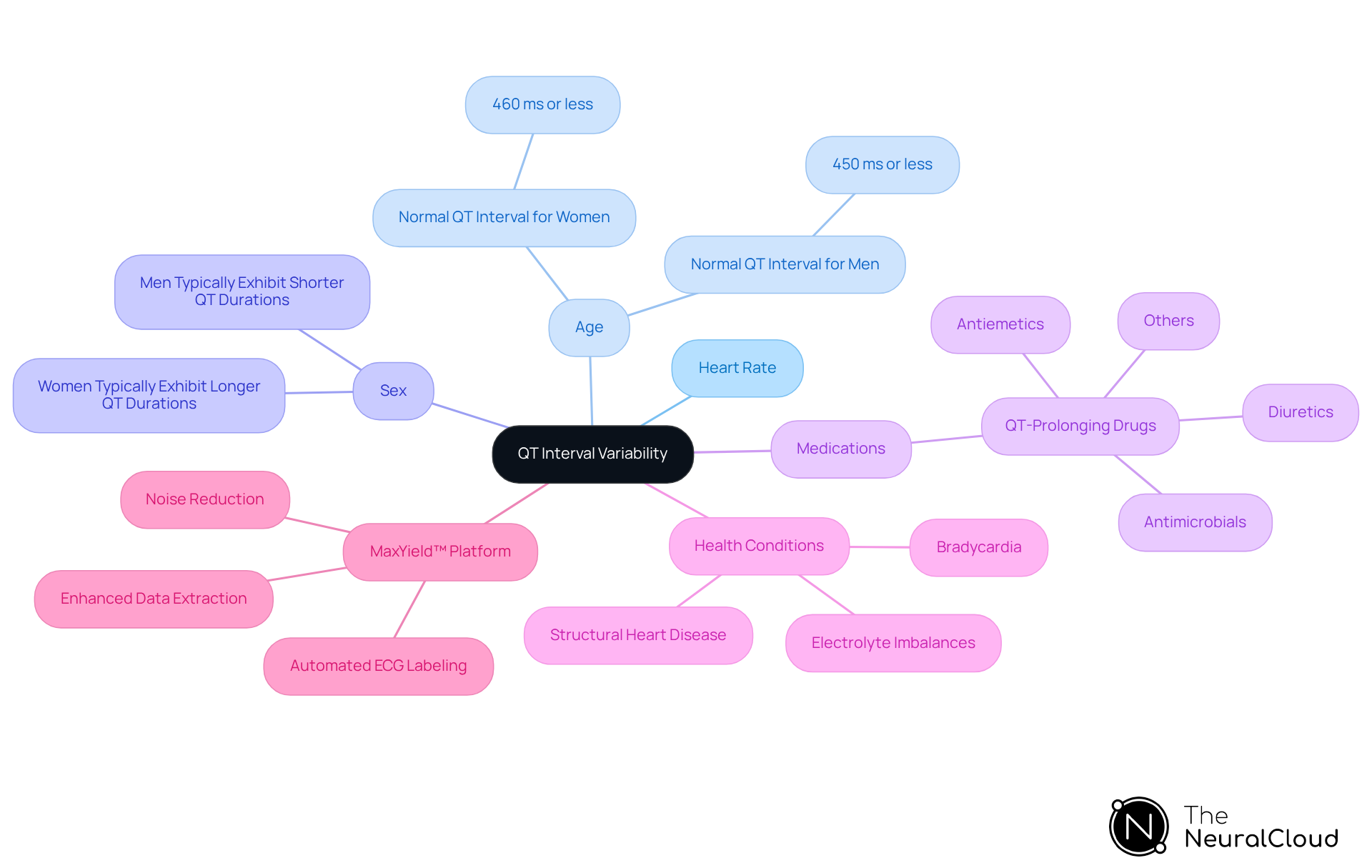
Notably, women typically exhibit longer QT durations than men, and a longer QT interval. These values are crucial in clinical practice, as maintaining a normal QT interval is essential to prevent serious complications such as arrhythmias and sudden cardiac death.
Medications significantly contribute to QT interval prolongation. Studies show that 99.5% of patients were prescribed medications that affect the QT interval, underscoring the prevalence of this issue in clinical settings. Additionally, physiological factors like electrolyte imbalances and autonomic tone further contribute to variability in QT measurements. For developers, understanding QT interval variability is essential when designing ECG analysis tools.
The MaxYield™ platform addresses these challenges effectively. It automates ECG labeling and enhances data extraction, significantly improving the accuracy and reliability of ECG interpretations. Key features of MaxYield™ include:
- Automation: Reduces manual errors and saves time.
- Clarity: Provides clearer insights from ECG recordings.
- Noise reduction: Transforms lengthy and noisy ECG recordings into clean, crisp signals.
These features lead to several advantages for healthcare professionals. By utilizing MaxYield™, clinicians can conduct more efficient analyses, ultimately improving patient outcomes. The platform not only streamlines the ECG interpretation process but also empowers healthcare providers with reliable data, enhancing decision-making in patient care.
Conclusion
The normal QT interval is a vital indicator of the heart's electrical activity, reflecting the time it takes for the ventricles to depolarize and repolarize. Understanding this interval is crucial for healthcare professionals and developers, as it directly impacts patient safety and diagnostic accuracy. By ensuring precise measurement and monitoring of the QT duration, the risk of arrhythmias and other serious cardiac events can be significantly reduced.
Challenges in ECG analysis often stem from noise interference and inaccurate wave recognition, which can lead to misinterpretations of the QT interval. The MaxYield™ platform from Neural Cloud Solutions addresses these challenges by enhancing ECG analysis through improved noise filtering and advanced wave recognition capabilities. This technology not only streamlines the analysis process but also aids in the management of QT prolongation by providing essential data for informed clinical decision-making.
The advantages of utilizing the MaxYield™ platform are substantial. Healthcare professionals benefit from enhanced diagnostic accuracy, which ultimately leads to better patient outcomes. By leveraging advanced ECG analysis tools, developers and healthcare providers can ensure accurate assessments, fostering a proactive approach to managing heart health and preventing complications associated with QT interval abnormalities.
In conclusion, a comprehensive understanding of the normal QT interval and its implications in cardiac health is vital. The MaxYield™ platform stands out as a powerful tool that equips healthcare professionals with the necessary insights to improve patient care. By embracing this technology, the medical community can significantly enhance the safety and effectiveness of cardiac monitoring.
Frequently Asked Questions
What is the QT interval and why is it clinically important?
The QT interval is a measurement on an electrocardiogram (ECG) that represents the time it takes for the ventricles to depolarize and repolarize. It is clinically important as it serves as a key indicator of the heart's electrical activity, with abnormal QT values potentially signaling arrhythmias.
What is the normal range for the QT interval?
The normal QT interval in an ECG generally ranges from 400 to 440 milliseconds, although variations can occur based on factors such as age and sex.
What are the risks associated with prolonged QT intervals?
QTc values over 500 milliseconds are associated with a five- to eightfold increased risk of cardiac events before age 40, particularly in females with LQTS2 and males with LQTS3. Prolonged QT durations can lead to severe conditions like torsades de pointes.
How does the MaxYield™ platform improve ECG analysis?
The MaxYield™ platform employs advanced noise filtering and distinct wave recognition to rapidly isolate ECG waves, even in recordings affected by significant noise and artifacts. This enhances the accurate assessment of QT duration, especially in lengthy Holter, 1-Lead, and patch monitor recordings.
Why is routine checking of QT duration important?
Routine checks of QT duration before and after initiating antiarrhythmic agents are essential for ensuring patient safety and monitoring potential risks associated with QT prolongation.
What management strategies are suggested for QT prolongation?
Management strategies for QT prolongation include avoiding potential triggers and utilizing beta-blockers, which are vital for understanding the clinical implications of QT duration measurements.
What are common causes of QT prolongation?
Common causes of QT prolongation include certain medications and electrolyte disturbances, as noted by cardiologist Anand Ambhore.
List of Sources
- Define the QT Interval and Its Clinical Importance
- jamanetwork.com (https://jamanetwork.com/journals/jama/fullarticle/1357296)
- ECG series. Importance of QT interval in clinical practice - PMC (https://pmc.ncbi.nlm.nih.gov/articles/PMC4291996)
- Normal Electrocardiography (ECG) Intervals: Normal Electrocardiography Intervals (https://emedicine.medscape.com/article/2172196-overview)
- QT Interval (https://litfl.com/qt-interval-ecg-library)
- QT prolongation: Definition, causes, treatment, and more (https://medicalnewstoday.com/articles/qt-prolongation)
- Explore the Physiology of the QT Interval in Cardiac Function
- drsvenkatesan.com (https://drsvenkatesan.com/category/cardiology-quotes/page/2)
- pmc.ncbi.nlm.nih.gov (https://pmc.ncbi.nlm.nih.gov/articles/PMC12277598)
- sciencedirect.com (https://sciencedirect.com/topics/biochemistry-genetics-and-molecular-biology/qt-interval)
- jamanetwork.com (https://jamanetwork.com/journals/jama/fullarticle/1357296)
- Measure and Analyze the QT Interval in ECG Readings
- researchgate.net (https://researchgate.net/publication/5826582_Pulling_It_All_Together_Case_Studies_on_ECG_Monitoring)
- innovationsincrm.com (https://innovationsincrm.com/cardiac-rhythm-management/articles-2021/march/1732-initial-experience-in-monitoring-qt-intervals)
- ECG Case Studies | Interpretation & Answers | Geeky Medics (https://geekymedics.com/ecg-case-studies)
- QT Interval (https://litfl.com/qt-interval-ecg-library)
- Identify Factors Influencing QT Interval Variability
- clinicalgate.com (https://clinicalgate.com/q-t-interval-qt-dynamicity-and-qt-variability)
- pmc.ncbi.nlm.nih.gov (https://pmc.ncbi.nlm.nih.gov/articles/PMC12465303)
- sps.nhs.uk (https://sps.nhs.uk/articles/identifying-risk-factors-for-developing-a-long-qt-interval)
- ncbi.nlm.nih.gov (https://ncbi.nlm.nih.gov/books/NBK534864)