Introduction
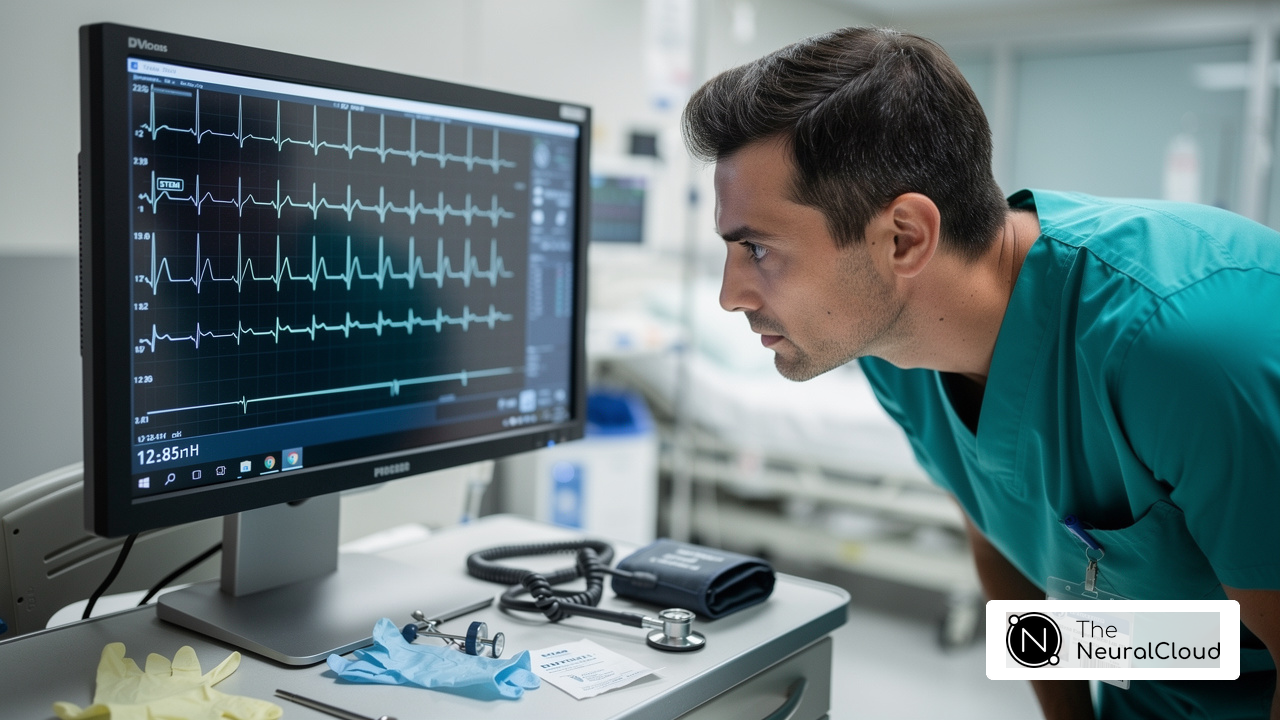
Understanding the complexities of a normal ECG reading is crucial in healthcare, as it acts as a standard for evaluating cardiac health. A typical ECG reveals essential patterns of electrical activity, enabling healthcare professionals to detect potential heart issues and enhance patient outcomes. However, accurately interpreting these readings can be challenging due to noise and artifacts that may obscure critical signals.
Innovative technologies like Neural Cloud Solutions' MaxYield™ platform address these challenges by improving the clarity and reliability of ECG analysis. MaxYield™ offers advanced features that enhance signal processing, allowing for more precise interpretation of ECG data. This platform not only filters out noise but also highlights significant patterns, making it easier for healthcare professionals to identify abnormalities.
The advantages of using MaxYield™ are substantial. By providing clearer ECG readings, healthcare providers can make more informed decisions, leading to better patient care. The platform's user-friendly interface ensures that both technical and non-technical users can navigate it effectively, fostering a collaborative environment in clinical settings. Ultimately, MaxYield™ transforms ECG analysis, paving the way for improved cardiac health outcomes.
Defining a Normal ECG Reading
A typical ECG reading showcases a distinct pattern of electrical activity in the heart, prominently featuring signals such as P, QRS, and T. The P component signifies atrial depolarization, the QRS complex indicates ventricular depolarization, and the T element represents ventricular repolarization. In a standard 12-lead ECG, a normal reading shows that a heart rhythm is characterized by a regular rhythm and consistent intervals between beats. The heart rate typically ranges from 60 to 100 beats per minute, while the PR interval typically spans from 0.12 to 0.20 seconds. These parameters are crucial for healthcare professionals to accurately assess cardiac function.
For instance, a normal ECG may display a consistent P shape morphology, narrow QRS complexes, and regular intervals, indicating optimal cardiac health. Research indicates that approximately 77.7% of individuals without prior heart issues demonstrate a normal ECG, underscoring the importance of these assessments in clinical practice. Understanding these characteristics not only aids in diagnosis but also enhances the overall quality of patient care.
However, ECG interpretation can be challenging due to noise and artifacts that obscure vital information. This is where Neural Cloud Solutions' technology comes into play. MaxYield™ enhances ECG analysis through advanced algorithms and unique signal recognition. It effectively recognizes and tags essential information, even in recordings affected by interference. This capability allows for the quick separation of ECG signals from recordings impacted by baseline drift, motion, and muscle artifacts.
The MaxYield™ algorithm continuously evolves with each use, improving its accuracy and efficiency over time. It can even salvage previously obscured sections of lengthy Holter, 1-Lead, and patch monitor recordings. This not only aids in diagnosing potential abnormalities but also significantly enhances the overall quality of patient care by improving the efficiency and accuracy of ECG interpretation.
Key Features of MaxYield™:
- Unique signal recognition
- Continuous algorithm improvement
- Ability to salvage obscured recordings
Advantages for Healthcare Professionals:
- Enhanced accuracy in ECG interpretation
- Better patient care through reliable assessments
By integrating MaxYield™ into their practice, healthcare professionals can ensure they are equipped with the tools necessary for optimal cardiac health assessment.
Clinical Significance of Normal ECG Readings
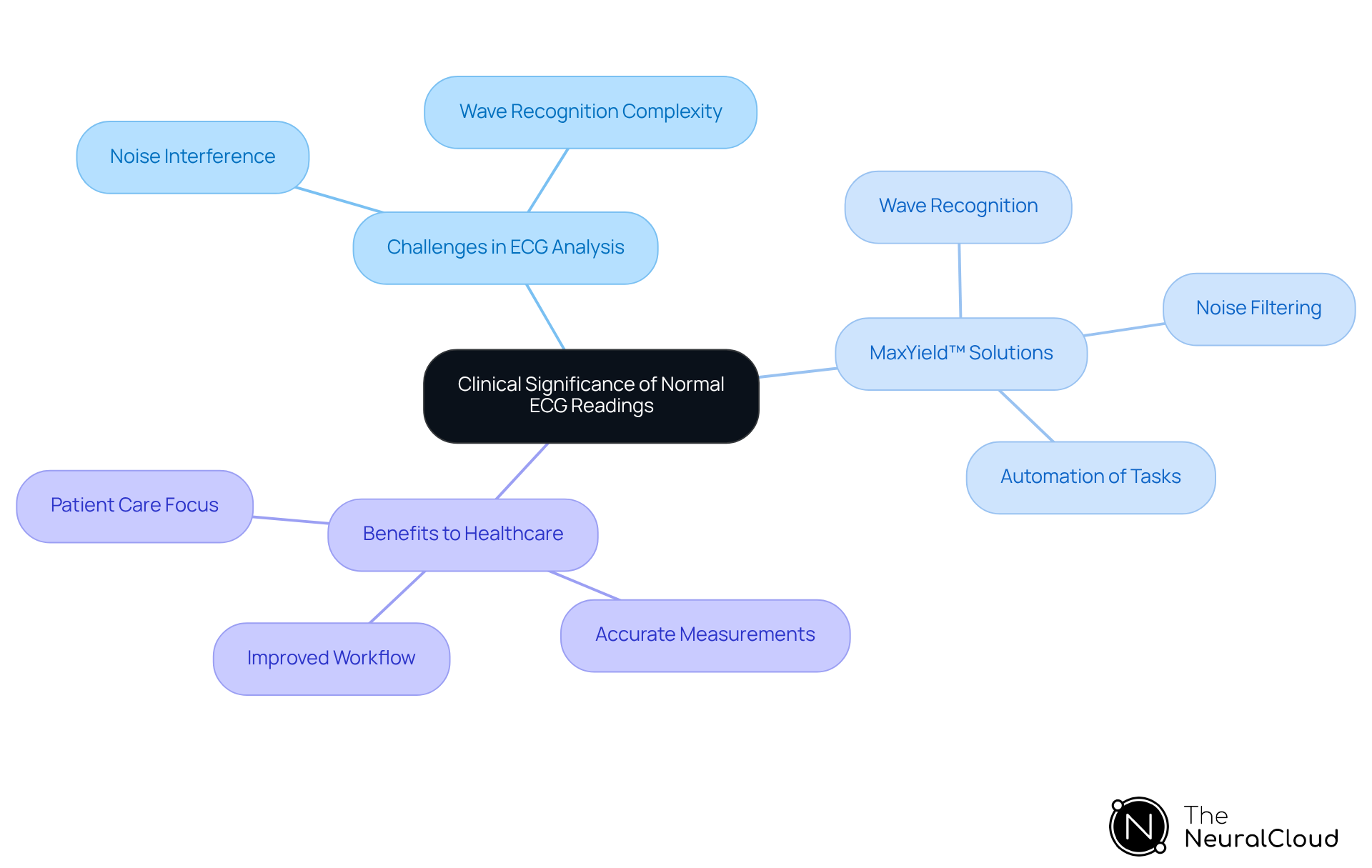
In clinical environments, it is essential to know what is a normal ECG reading, as it provides a standard for evaluating cardiac health. These measurements enable clinicians to identify deviations that may signal potential health issues. However, the field often faces challenges, including noise interference, which can hinder accurate interpretations.
Neural Cloud Solutions' MaxYield™ addresses these challenges with advanced noise filtering and wave recognition capabilities. This integration significantly enhances the accuracy of ECG readings, allowing healthcare professionals to make more reliable assessments. For instance, a normal ECG reading can offer reassurance to both patients and healthcare providers, while any detected abnormalities can prompt further investigation.
Moreover, through its data wall, MaxYield™ enables healthcare professionals to process larger volumes of data in less time. This automation not only improves efficiency but also allows clinicians to focus more on patient care. Regular monitoring of ECG readings helps in understanding what is a normal cardiac rhythm, supported by this technology, aids in tracking treatment effectiveness and managing chronic conditions, making it an indispensable tool in modern healthcare.
In summary, MaxYield™ enhances clinical workflows by providing accurate readings and streamlining workflows, ultimately benefiting healthcare professionals and their patients.
Physiology of the Cardiac Conduction System
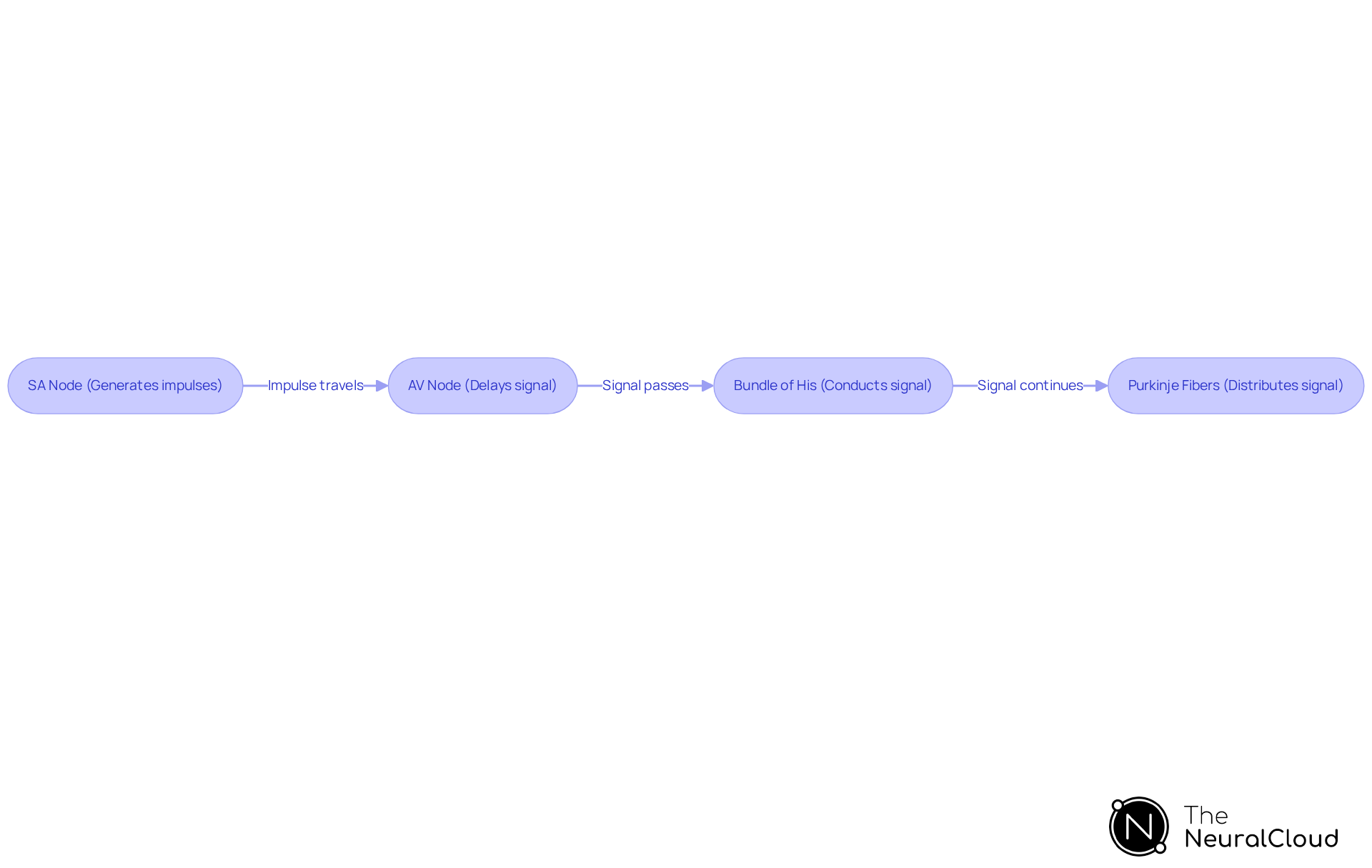
The cardiac conduction system is a network of specialized cells responsible for initiating and conducting electrical impulses throughout the heart. This system includes the sinoatrial (SA) node, atrioventricular (AV) node, bundle of His, and Purkinje fibers. The SA node, often referred to as the body's natural pacemaker, generates impulses that trigger atrial contraction. The electrical signal then travels to the AV node, where it is briefly delayed before passing to the ventricles via the bundle of His and Purkinje fibers, resulting in coordinated ventricular contraction. This intricate process ensures that the heart beats in a synchronized manner, producing the characteristic waves that define what is a normal ECG reading.
However, traditional ECG readings can present challenges, particularly in interpreting variations. This is where innovative solutions like advanced algorithms come into play. These algorithms map ECG signals through noise and deliver beat-by-beat analysis of 200,000 heartbeats in less than 5 minutes. By enhancing the clarity of cardiac events, these solutions provide detailed insights through clear waveforms, including P waves and T waves.
The features of these platforms not only improve the accuracy of ECG interpretation but also support confident clinical decisions. Healthcare professionals benefit from the platform's ability to transform raw data into actionable data, addressing traditional limitations in ECG interpretation. With advanced analytics, clinicians can make informed decisions based on precise and reliable information, ultimately improving patient outcomes.
Common Variations and Abnormalities in ECG Readings
Common variations and abnormalities in ECG readings include atrial fibrillation, ventricular tachycardia, and premature ventricular contractions.
- Atrial fibrillation: This condition is characterized by an irregular heartbeat and is often benign, typically related to respiratory patterns.
- Ventricular tachycardia: In contrast, this condition presents as an irregularly irregular rhythm, which can significantly increase the risk of stroke.
- Premature ventricular contractions: Marked by a rapid heart rate originating from the ventricles, this condition can be life-threatening and requires immediate medical attention.
Recognizing these variations is crucial for healthcare professionals, as they can significantly impact patient health and treatment outcomes.

Conclusion
Understanding a normal ECG reading is fundamental for evaluating heart health and ensuring effective patient care. However, ECG analysis often faces challenges such as noise and artifacts that can obscure critical information. This is where innovative solutions like Neural Cloud Solutions' MaxYield™ platform come into play.
The MaxYield™ platform offers advanced noise filtering capabilities, which significantly enhance the clarity of ECG readings. By continuously improving its algorithms, the platform ensures that healthcare professionals can rely on accurate data for their assessments. This feature not only streamlines the analysis process but also reduces the likelihood of misdiagnosis, which can have serious implications for patient care.
The advantages of using MaxYield™ extend beyond just improved accuracy. With its user-friendly interface, healthcare professionals can quickly interpret ECG data, leading to timely interventions when abnormalities are detected. This capability is crucial in preventing serious health issues and supports ongoing patient management.
In conclusion, the implications of normal ECG readings are profound. By leveraging the MaxYield™ platform, healthcare professionals can enhance their diagnostic capabilities, ultimately improving patient outcomes. Embracing such advancements reinforces the commitment to delivering high-quality patient care in a rapidly evolving health tech landscape.
Frequently Asked Questions
What does a normal ECG reading look like?
A normal ECG reading features a distinct pattern with components such as P, QRS, and T. The P component signifies atrial depolarization, the QRS complex indicates ventricular depolarization, and the T element represents ventricular repolarization.
What is the normal pulse rate indicated in an ECG?
A normal pulse rate ranges from 60 to 100 beats per minute, characterized by a regular rhythm and consistent intervals between beats.
What are the key duration parameters in a normal ECG?
In a normal ECG, the QRS complex duration should be less than 0.12 seconds, while the PR interval typically spans from 0.12 to 0.20 seconds.
How common is a normal ECG reading among individuals without heart issues?
Approximately 77.7% of individuals without prior heart issues demonstrate a normal ECG reading.
What challenges are associated with ECG analysis?
ECG analysis can be challenging due to noise and artifacts that obscure vital information.
How does the MaxYield™ platform enhance ECG analysis?
MaxYield™ enhances ECG analysis through advanced noise filtering and unique signal recognition, allowing for the quick separation of ECG signals from recordings affected by noise and artifacts.
What are the key features of MaxYield™?
Key features of MaxYield™ include advanced noise filtering, unique signal recognition, continuous algorithm improvement, and the ability to salvage obscured recordings.
What advantages does MaxYield™ provide for healthcare professionals?
MaxYield™ offers enhanced accuracy in ECG analysis, improved efficiency in diagnosing cardiac conditions, and better patient care through reliable assessments.
How does MaxYield™ improve over time?
The MaxYield™ algorithm continuously evolves with each use, improving its accuracy and efficiency over time.
List of Sources
- Defining a Normal ECG Reading
- Normal Sinus Rhythm (https://litfl.com/normal-sinus-rhythm-ecg-library)
- artemiscardiac.com (https://artemiscardiac.com/blog/heart-attack-vs-normal-ecg-a-simple-guide-to-reading-your-report)
- Normal Electrocardiography (ECG) Intervals: Normal Electrocardiography Intervals (https://emedicine.medscape.com/article/2172196-overview)
- What Is a Normal ECG Reading? Essential Guide | Qaly (https://qaly.co/post/what-is-a-normal-ecg-reading-essential-guide)
- Clinical Significance of Normal ECG Readings
- Electrocardiogram - StatPearls - NCBI Bookshelf (https://ncbi.nlm.nih.gov/books/NBK549803)
- Normal Electrocardiography (ECG) Intervals: Normal Electrocardiography Intervals (https://emedicine.medscape.com/article/2172196-overview)
- What Is a Normal ECG Reading? Essential Guide | Qaly (https://qaly.co/post/what-is-a-normal-ecg-reading-essential-guide)
- mdpi.com (https://mdpi.com/2673-3846/2/4/39)
- Spotlight on early detection of 3 heart diseases using ECG-AI - Mayo Clinic News Network (https://newsnetwork.mayoclinic.org/discussion/spotlight-on-early-detection-of-3-heart-diseases-using-ecg-ai)